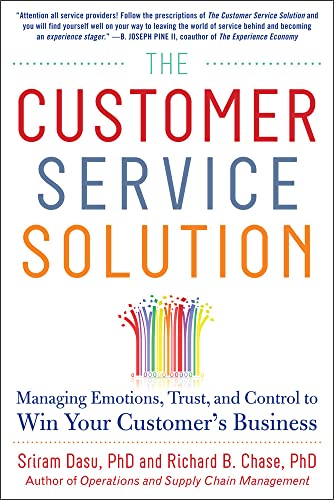

The customer service solution managing emotions, trust, and control to win your customer's business by Sriram Dasu and Richard Chase.
Editor: New York McGraw-Hill [2013]Descripción: xvi, 223 pages illustrations 24 cm Tipo de medio:- 9780071809931 (alk. paper)
- 0071809937 (alk. paper)
- 658.8/12 23
- HF5415.5 .D175 2013
| Imagen de cubierta | Tipo de ítem | Biblioteca actual | Biblioteca de origen | Colección | Ubicación en estantería | Signatura topográfica | Materiales especificados | Info Vol | URL | Copia número | Estado | Notas | Fecha de vencimiento | Código de barras | Reserva de ítems | Prioridad de la cola de reserva de ejemplar | Reservas para cursos | |
|---|---|---|---|---|---|---|---|---|---|---|---|---|---|---|---|---|---|---|
| Libro | Biblioteca Encarnación Valdés Colección General bev | 658.812 D231c 2013 (Navegar estantería(Abre debajo)) | Disponible | 80000002533274 |
Descripciones mejoradas de Syndetics:
Understand Consumer Psychology to Drive Profits and Growth
Want to know exactly what's driving your customer's behavior?
NOW YOU CAN!
The Customer Service Solution explains how consumers perceive services and shows you how toenhance the customer experience--every time.
In this economic climate, the customer service experience is more critical than ever. Most leading service firms advocate the TLC mantra: Think Like a Customer. That's a good practice, but first you have to understand what your customer is thinking and feeling. Today's business leaders cannot afford to neglect the psychological principles that govern customer satisfaction and long-term loyalty.
What are the factors that really determine customer satisfaction? Two of the nation's leading authorities on service psychology, Sriram Dasu and Richard Chase, have written this groundbreaking guide that identifies and demystifies the psychological triggers behind customer behavior. You'll go where customer satisfaction surveys, mystery shoppers, and focus groups can't--and learn exactlywhy customers respond and behave the way they do.
With findings drawn from behavioral science research, this book provides all the tools you need to evaluate your current service platforms and design future strategies to enhance customer perceptions positively and drive your sales.
The Customer Service Solution illustrates whyeven companies with high levels of satisfaction are missing tremendous opportunities by neglecting the emotional elements that govern consumer interactions.
This book will show you how to:
Shape and manage customer perceptions Understand implicit versus explicit outcomes Develop the roles of control and choiceamong buyers Design emotionally intelligent processes Build trust among customersWhatever your business may be--healthcare, hospitality, financial services, e-commerce, and more--this book is an essential tool to help you increase profits by leveraging your company's customer experience.
PRAISE FOR THE CUSTOMER SERVICE SOLUTION:
"Harnessing the power of emotions will help to drive an exceptional customer experience creating customers for life to help your business thrive. Finally, a guide tohelp us better understand how to do this." -- James Merlino, MD, Chief Experience Officer, Cleveland Clinic
"Required reading for anyone designing a service encounter." -- James Heskett, Professor Emeritus, Harvard Business School, coauthor of The Service Profit Chain and Service Future
"I have always known that our customers shop with us because they want to, not because they have to. How to make them want to is the secret that this great bookunlocks." -- Kevin Davis, President and CEO, Bristol Farms
"[Dasu and Chase] share easy-to-understand ideas and guidance to operations managers who typically do not think about the psychology of customers in designing their services." -- Mary Jo Bitner, PhD, Professor andExecutive Director, Center for Services Leadership, W. P. Carey School, Arizona State University
"Dasu and Chase provide an excellent set of ideas for delivering emotional customer service experiences through systems and operations." -- Rodolfo Medina, Vice President, Marketing & Commercial, Rock in Rio
"This book provides valuable insights to managing and molding the customer's emotional journey, leading to ultimate satisfaction and sustainable loyalty." -- Ali V. Kasikci, Regional Managing Director, Orient-Express
Includes bibliographical references and index.
Tabla de contenidos provista por Syndetics
- Preface(p. xiii)
- Acknowledgments(p. xv)
- Chapter 1 Customer Service Solutions: Leveraging Customer Psychology to Design Service Operations(p. 1)
- Implicit Outcomes Are Important for Your Customers(p. 2)
- Types of Knowledge Needed for Delivering Implicit Outcomes(p. 3)
- Parsing the Service Encounter(p. 6)
- It Is All About Your Customers' Perceptions(p. 7)
- Factors That Shape Your Customers' Perceptions(p. 8)
- A Scientific Approach to Delivering Great Experiences(p. 20)
- Beyond the Encounter: Memory Management(p. 21)
- Chapter 2 Designing Emotionally Intelligent Processes(p. 23)
- Emotions 101(p. 24)
- Services Differ in Their Emotional Content(p. 29)
- Emotions and Emotional Intelligence(p. 31)
- Factors That Drive Your Customers' Emotions(p. 31)
- Tiered Approach for Shaping Emotions(p. 36)
- Designing Emotional Themes(p. 37)
- Creating Processes to Deliver the Emotional Theme(p. 44)
- Blueprints for Tracking Your Customers' Emotions(p. 47)
- Segmenting Your Customers(p. 52)
- Responding to Your Customers' Transaction History(p. 54)
- A Limited Approach to Managing Emotions(p. 55)
- Key Principles for Designing for Optimal Emotional Impact(p. 56)
- Conclusion(p. 56)
- Chapter 3 Engendering Your Customers' Trust(p. 59)
- Market Mechanisms for Reducing Risk for Your Customer(p. 61)
- Benefits of Trust(p. 62)
- Components of Trust(p. 63)
- Whom Does Your Customer Trust: The Firm or the Employee?(p. 65)
- Moments That Influence Trust(p. 67)
- Cues to Trustworthiness Before the Encounter(p. 69)
- Calculated Versus Blind Trust(p. 72)
- Cues to Trustworthiness During the Encounter(p. 73)
- Building Your Trust Fund(p. 79)
- Key Principles for Building Trust(p. 87)
- Chapter 4 Shaping Your Customers' Perceptions of Control(p. 89)
- Control Matters(p. 90)
- Components of Control: Behavioral and Cognitive Control(p. 91)
- Moments That Influence Your Customers' Perception of Control(p. 92)
- Battles for Control(p. 93)
- Allocating Control to Your Customer Through Choice(p. 96)
- Allocating Control to Your Customer Through Self-Service(p. 99)
- Framework for Sharing Control with Your Customers(p. 102)
- Enhancing Your Customers' Perceived Control(p. 106)
- Devise Mistake-Proof Processes(p. 111)
- Manage Server Behavior(p. 112)
- Sway with Social Proofing(p. 113)
- Conclusion(p. 114)
- Chapter 5 Sequencing the Experience(p. 117)
- The Sequence Impacts Your Customers' Perceptions(p. 118)
- Customers' Preferences for Separating or Combining Events(p. 125)
- Sequencing When There Are Multiple Encounters(p. 126)
- Designing the Sequence(p. 128)
- Sequence Theory Matters for Your Employees(p. 133)
- Principles for Sequencing the Encounter(p. 134)
- Self Quiz: DSL Help Desk(p. 135)
- Chapter 6 Time Warp: Duration Management(p. 139)
- Perception Is Everything When It Comes to Time(p. 140)
- Temporal Distortions(p. 141)
- Factors That Influence Duration Judgments(p. 146)
- The Value of Time(p. 147)
- Factors That Alter Your Customers' Valuation of Time(p. 147)
- Pacing and Cultural Intelligence(p. 149)
- Reducing Your Customers' Perceived Duration of the Wait(p. 150)
- Build Your Customers' Anticipation for Positive Outcomes(p. 162)
- Enhance Value-Added Activities(p. 164)
- Conclusion(p. 167)
- Chapter 7 Attribution: Ensuring that You Get Your Due(p. 169)
- Subjective Perceptions(p. 170)
- Do Your Customers Recognize a Success or a Failure?(p. 172)
- How Your Customers May Discern the Cause(p. 173)
- When Memory Plays Attribution Tricks(p. 177)
- How Your Customers May Assign Responsibility(p. 179)
- Feeling the Hurt(p. 182)
- Channeling Your Customers' Attribution(p. 184)
- Principles for Managing Attribution(p. 191)
- Chapter 8 Putting the Concepts to Work(p. 193)
- Identify the Relevant Psychological Factors(p. 195)
- Develop Service Experience Improvement Projects(p. 199)
- Project Examples(p. 202)
- Think in Terms of Three Ts and Four Ps(p. 206)
- ETCs for Employees(p. 207)
- Endnotes(p. 211)
- Index(p. 217)
Notas de autor provistas por Syndetics
Sriram Dasu , associate professor at the Marshall School of Business, University of Southern California, haswritten numerous articles on operations management andcontinues to publish in leading academic and professionaljournals nationwide.
Richard B. Chase , Justin Dart Professor Emeritus,Marshall School of Business, University of SouthernCalifornia, is the coauthor of Operations and Supply Chain Management , which sold over a million copies and is now in its thirteenth edition, having been translated into 12 languages. He's widely acknowledged as one of the founders of the Service Operations Management field.