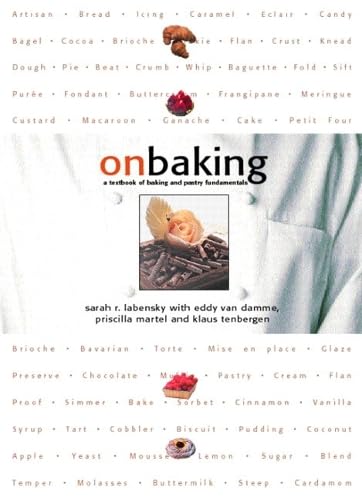
Imagen de portada de Amazon
Imagen de Amazon.com
Imagen de cubierta Syndetics
Portada de Syndetics
Imagen de OpenLibrary

On baking: a textbook of baking and pastry fundamentals. Sarah R. Labensky...[et al]; photographs by Richard Embery; drawings by Winters Quattrone.

Colaborador(es): Detalles de publicación: New Jersey Pearson;Prentice Hall c2005.Edición: 1 edDescripción: xx; 704 p. ill. (col. pictures)ISBN:
  • 0135336473
Tema(s):
Premios: Haga clic para abrir en una nueva ventana
Valoración
    Valoración media: 0.0 (0 votos)
Existencias
Imagen de cubierta Tipo de ítem Biblioteca actual Biblioteca de origen Colección Ubicación en estantería Signatura topográfica Materiales especificados Info Vol URL Copia número Estado Notas Fecha de vencimiento Código de barras Reserva de ítems Prioridad de la cola de reserva de ejemplar Reservas para cursos
Libro Biblioteca de Mayagüez Sala de Referencia mb TX 63 .B3233 2005 (Navegar estantería(Abre debajo)) c. 1 Missing 50000003192936
Total de reservas: 0

Descripciones mejoradas de Syndetics:

Attractively designed and extensively illustrated with color photographs, numerous recipes and formulas, line drawings, charts, and sidebars, this contemporary introduction to baking and pastry arts focuses on information that is relevant to today's baker. Comprehensive and well-written, it emphasizes an understanding of baking fundamentals, explores the preparation of fresh ingredients, and provides information on other relevant topics, such as food history and food science. This introduction to baking outlines professionalism, tools and equipment, ingredients, mise en place, bakeshop principles, healthful and special needs baking, desserts.  It contains over 615 recipes/formulas and 700 photographs and line drawings.   For Chefs, Bakers, Restaurant Managers and others in the food service industry.

EIGM 08/2009

Includes indexes.

Tabla de contenidos provista por Syndetics

  • 1 Professionalism
  • 2 Tools and Equipment for the Bakeshop
  • 3 Principles of Baking
  • 4 Bakeshop Ingredients
  • 5 Mise en Place
  • 6 Quick Breads
  • 7 Yeast Breads
  • 8 Enriched Yeast Doughs
  • 9 Cookies and Brownies
  • 10 Pies and Tarts
  • 11 Pastry Doughs
  • 12 Laminated Doughs
  • 13 Syrups, Icings and Sauces
  • 14 Cakes and Torts
  • 15 Custards and Creams
  • 16 Ice Cream and Frozen Deserts
  • 17 Fruits
  • 18 Healthful and Special-Needs Baking
  • 19 Petits Fours
  • 20 Restaurant Desserts
  • 21 Chocolate and Decorative Work
  • Appendix I Measurements and Conversion Charts
  • Appendix II High Altitude Baking
  • Appendix III Fresh Fruit Availability Chart
  • Appendix IV Professional Organizations
  • Bibliography and Recomended Readings
  • Glosary
  • General Index

Extracto provisto por Syndetics

Building on the successful approach developed in On Cooking: A Textbook of Culinary Fundamentals, On Baking is a carefully designed text intended to teach both the principles and practices of baking and the pastry arts. Although it contains more than 600 recipes for a wide range of traditional and contemporary bakeshop items, the focus of this book is on the underlying baking principles and skills necessary to produce a wide array of baked goods and confections. Throughout the text, we discuss both the how and why of baking. Extensive step-by-step photographs help you visualize the techniques used to form bread dough or shape cookies or temper chocolate, for example, while recipes illustrate the baking principle and procedures. Throughout the book, we also provide extensive illustrated sections identifying bakeshop ingredients and equipment. We believe that a thorough understanding of the function of ingredients will serve you well throughout your baking career. Numerous professional bakers, pastry chefs and educators throughout the country contributed recipes to this book, usually illustrated with a photograph of the item as it was actually prepared in their kitchens. These recipes and illustrations allow you to explore different techniques and presentation styles. As in On Cooking, informative sidebars provide background on the rich historical and cultural traditions of the bakeshop. And professionals share their insights and technical knowledge in brief comments scattered throughout the book. Chapter 18 is devoted to alternative baking for consumers with special dietary needs in the hope that today's well-trained baker will understand how and why to adapt formulas to this clientele. As a working professional, you may encounter convenience products in use in many restaurants, hotels or institutions. Therefore, each chapter of On Baking includes practical information on convenience products, providing information on the selection, storage, handling and use of these items. We wish you much success throughout your professional career and hope that this book serves to inspire and inform you for many years to come. A NOTE ON RECIPES AND FORMULAS Recipes throughout this text are designed to reinforce and explain techniques and procedures presented in the text. Recipes intentionally produce lower yields used typically in small schools and teaching kitchens. Volume measurements are provided only when the quantity of an ingredient would be difficult to weigh without specialized equipment--less than 1/2 ounce of salt, leavening or spices, for example. All ingredients are listed in both U.S. and metric measurements. In most instances the metric equivalents are rounded off to even, easily measured amounts. You should consider these ingredient lists as separate recipes or formulas; do not measure some ingredients according to the metric amounts and other ingredients according to the U.S. amounts or the proportions will not be accurate and the intended result will not be achieved. Baker's percentages are also included for many of the recipes in this text. Widely used in the professional bakeshop, baker's percentages are very useful for increasing or decreasing yields as needed. Yields are provided in either total batch weight or total yield, offering suggested portion sizes where appropriate. Detailed procedures for standard techniques are presented in the text and are generally not repeated in each recipe (for example, "apply egg wash" or "divide the dough"). No matter how detailed the written recipe, however, we must assume that you possess certain knowledge, skills and judgment. Variations appear at the end of selected recipes. These variations enable you to see how one set of techniques or procedures can be used to prepare different dishes with only minor modifications. Variations also provide the advanced baker or pastry chef the opportunity to customize recipes for different applications. A registered dietician analyzed all of the recipes in this book using nutritional analysis software that incorporates data from the U.S. Department of Agriculture, research laboratories and food manufacturers. The nutrient information provided here should be used only as a reference, however. A margin of error of approximately 20 percent can be expected because of natural variations in ingredients. Preparation techniques and serving sizes may also significantly alter the values of many nutrients. In the nutritional analysis for a recipe that offers a choice of ingredients, the first-mentioned ingredient is the one used unless stated otherwise. Ingredients listed "as needed" are omitted from the analysis. Corn oil and whole milk are used throughout for "vegetable oil" and "milk," respectively. In cases of a range of ingredient quantities or numbers of servings, the average is used. Throughout this book various recipes are marked with a pyramid symbol. This symbol identifies dishes that are particularly low in calories, fat, saturated fat or sodium; if appropriate, they may also be a good source of vitamins, protein, fiber or calcium. The World Wide Web icon appears next to end-of-chapter Questions for Discussion whose answers may be researched on the web. It is most important to remember that baking is both an art and a science. It is best learned through hands-on experience combined with study of the principles that underlie each technique. You should rely on the knowledge and skills of your instructor for guidance. Although some skills and an understanding of theory can be acquired through reading and study, no book can substitute for repeated, hands-on preparation and observations. Excerpted from On Baking: A Textbook of Baking and Pastry Fundamentals by Sarah R. Labensky, Priscilla A. Martel, Sierra Software Staff, Klaus G. Tenbergen, Eddy Van Damme All rights reserved by the original copyright owners. Excerpts are provided for display purposes only and may not be reproduced, reprinted or distributed without the written permission of the publisher.

Notas de autor provistas por Syndetics

Sarah R. Labensky, CCP, Director of the Mississippi University for Women Culinary Arts Institute and co-author of On Cooking: A Textbook of Culinary Fundamentals

Eddy Van Damme, Pastry Chef and Director of the pastry arts program, Houston Community College

Priscilla Martel, food writer and baking instructor, co-author of The Best Bread Ever, and contributing editor of The New Cook's Catalogue

Klaus Tenbergen, CMB, CEPC, ASBPB, German Master Baker and Chef Instructor at The School of Culinary Arts at Kendall College

Compartir
logopucpr-y-vive

Contáctanos

¡Queremos saber de ti!

Tel. 787.841.2000 Ext. 1801

bibliotecavaldes@pucpr.edu

⁣Búscanos en las redes

© 2026 Desarrollado por Ignite Online • All Rights Reserved • Powered by Koha.