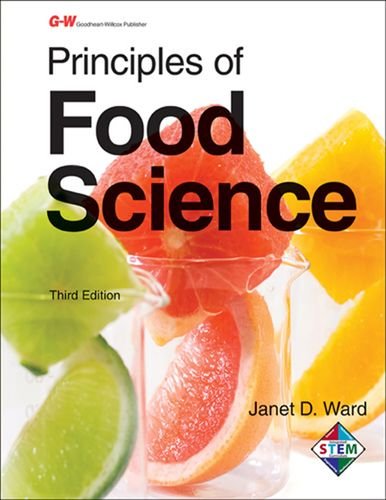

Principles of food science Janet D. Ward ; contributing author Larry T. Ward.
Detalles de publicación: Tinley Park, Ill. Goodheart-Willcox Company, Inc. 2013.Edición: Third editionDescripción: xxii, 842 pages col. ill. 29 cmISBN:- 9781605256092
- 664 W2561p3 23
- TP370 .W37 2013
| Imagen de cubierta | Tipo de ítem | Biblioteca actual | Biblioteca de origen | Colección | Ubicación en estantería | Signatura topográfica | Materiales especificados | Info Vol | URL | Copia número | Estado | Notas | Fecha de vencimiento | Código de barras | Reserva de ítems | Prioridad de la cola de reserva de ejemplar | Reservas para cursos | |
|---|---|---|---|---|---|---|---|---|---|---|---|---|---|---|---|---|---|---|
| Libro | Biblioteca Encarnación Valdés Colección General bev | 664 W2561p3 (Navegar estantería(Abre debajo)) | Disponible | 80000002460650 |
Descripciones mejoradas de Syndetics:
Principles of Food Science incorporates science concepts into a lab-oriented foods class. This text shows how the laws of science are at work in foods prepared at home and by the food industry. Each chapter includes engaging features, including NEW Going Green environmental updates and Science Matters articles. Other features focus on areas such as current research, technology, and nutrition news. Through lab experiments in the text and Lab Manual, students will practice scientific and sensory evaluation of foods. They will discover how nutrients and other food components illustrate basic chemistry concepts. Additionally, they will examine the positive and negative impacts of microorganisms on the food supply. Students will also explore the variety of careers available to graduates with a food science background.
* Physical properties, functions, and nutritional impact of the macronutrients are covered in the text.
* Students will learn about the micronutrients as well as other microcomponents including phytochemicals, food analogs, and additives.
* The positive and negative effects that microbes have on foods are explored.
* Various methods of food preservation and packaging are discussed as well as the benefits and drawbacks.
Special features throughout the text cover environmental issues, science facts, nutrition news, food science history, technology, recent research, international issues, and more.
Experiments at the end of each chapter and in the lab manual include safety tips and lists of needed equipment and supplies. Students employ the scientific method to perform the experiments.
Includes index.