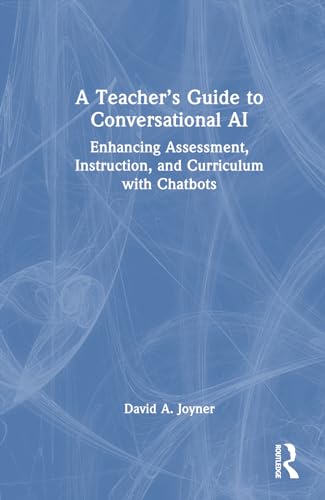

A teacher's guide to conversational AI enhancing assessment, instruction, and curriculum with chatbots / David A. Joyner.
Editor: New York, NY : Routledge, 2024Descripción: xviii, 232 pages ; 23 cmTipo de contenido:- text
- unmediated
- volume
- 9781032686776
- 9781032671154
- 371.33/4 23/eng/20231212
- LB1028.43 .J69 2024
| Imagen de cubierta | Tipo de ítem | Biblioteca actual | Biblioteca de origen | Colección | Ubicación en estantería | Signatura topográfica | Materiales especificados | Info Vol | URL | Copia número | Estado | Notas | Fecha de vencimiento | Código de barras | Reserva de ítems | Prioridad de la cola de reserva de ejemplar | Reservas para cursos | |
|---|---|---|---|---|---|---|---|---|---|---|---|---|---|---|---|---|---|---|
| Libro | Biblioteca de Mayagüez Colección General mb | LB1028.43 .J69 2024 (Navegar estantería(Abre debajo)) | c. 1 | Disponible | 50000003298535 |
Descripciones mejoradas de Syndetics:
A Teacher's Guide to Conversational AI explores the practical role that language-based artificial intelligence tools play in classroom teaching, learning experiences, and student assessment. Today's educators are well aware that conversational and generative AI-chatbots, intelligent tutoring systems, large language models, and more-represent a complex new factor in teaching and learning. This introductory primer offers comprehensive, novice-friendly guidance into the challenges and opportunities of incorporating AI into K-12 schools and college classes in ways that are appropriate, nourishing to students, and outcomes-driven.
Opening with an informative overview of the foundational properties, key terminology, and ethical considerations of these tools, the book offers a coherent and realistic vision of classrooms that are enhanced, rather than stymied, by AI systems. This includes strategies for:
- designing assessments that are conducive to students' beneficial use of AI while mitigating overreliance or dishonesty;
- using AI to generate lesson examples for student critique or custom content that reinforces course principles;
- leveraging chatbots as a co-instructor or a tutor, a guide during student-driven learning, a virtual debate or brainstorming partner, and a design project; and
- creating course content, lesson plans and activities, expanded language and accessibility options, and beyond.
Through the depth of understanding and applied approach provided in these chapters, teachers and leaders in training and in service, alongside private tutors, college instructors, and other educators, will be better prepared to future-proof their efforts to serve new generations of learners.
Includes bibliographical references and index.
Part 1: Foundational Knowledge -- 1. Introduction to the Book -- 2. Basics of Generative AI -- 3. Ethical Considerations -- Part 2: Assessment Design with AI -- 4. AI-Resistant Assessment -- 5. AI-Conducive Assessment -- 6. AI-Expansive Assessment Part 2 Wrap-Up -- Part 3: Chatbots for Instruction -- 7. AI as Teacher -- 8. AI as Partner -- 9. AI as Goal -- Part 3. Wrap-Up -- Part 4: AI for Teaching Assistance -- 10. AI for Course Creation --11. AI for Course Delivery --12. AI for Course Enhancement -- Part 4 Wrap-Up.
"The Teacher's Guide to Conversational AI explores the practical role that language-based artificial intelligence tools play in classroom teaching, learning experiences, and student assessment. Today's educators are well aware that conversational and generative AI-chatbots, intelligent tutoring systems, large language models, and more-represent a complex new factor in teaching and learning. This introductory primer offers comprehensive, novice-friendly guidance into the challenges and opportunities of incorporating AI into K-12 schools and college classes in ways that are appropriate, nourishing to students, and outcomes-driven. Opening with an informative overview of the foundational properties, key terminology, and ethical considerations of these tools, the book offers a coherent and realistic vision of classrooms that are enhanced, rather than stymied, by AI systems. Through the depth of understanding and applied approach provided in these chapters, teachers and leaders in training and in service, alongside private tutors, college instructors, and other educators, will be better prepared to future-proof their efforts to serve new generations of learners"-- Provided by publisher.
Notas de autor provistas por Syndetics
David A. Joyner is Principal Research Associate and Executive Director of Online Education and the Online Master of Science in Computer Science as well as Adjunct Faculty in the School of Computing Instruction and the School of Interactive Computing at Georgia Tech College of Computing, USA.