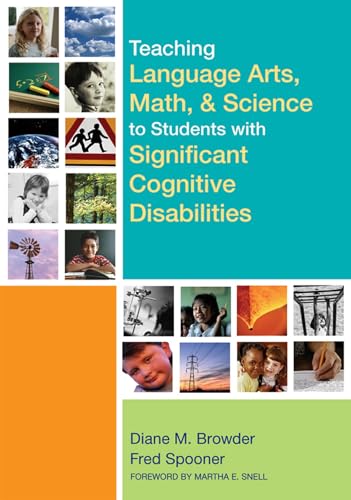
Imagen de portada de Amazon
Imagen de Amazon.com
Imagen de cubierta Syndetics
Portada de Syndetics
Imagen de OpenLibrary

Teaching language arts, math, & science to students with significant cognitive disabilities edited by Diane M. Browder and Fred Spooner.

Colaborador(es): Detalles de publicación: Baltimore P. H. Brookes Pub. c2006.Descripción: xix, 324 p. ill. 25 cmISBN:
  • 1557667985
  • 9781557667984
Otro título:
  • Teaching language arts, math, and science to students with significant cognitive disabilities
Tema(s): Clasificación CDD:
  • 371.928 T2534 22
Clasificación LoC:
  • LC4616 .T43 2006
Recursos en línea:
Valoración
    Valoración media: 0.0 (0 votos)
Existencias
Imagen de cubierta Tipo de ítem Biblioteca actual Biblioteca de origen Colección Ubicación en estantería Signatura topográfica Materiales especificados Info Vol URL Copia número Estado Notas Fecha de vencimiento Código de barras Reserva de ítems Prioridad de la cola de reserva de ejemplar Reservas para cursos
Libro Biblioteca Encarnación Valdés Colección General bev 371.928 T2534 (Navegar estantería(Abre debajo)) Disponible 80000002401548
Total de reservas: 0

Descripciones mejoradas de Syndetics:

Under NCLB, students with severe disabilities are expected to make progress on state academic content standards in language arts, math, and science. But what material should educators teach from these three content areas, and how should they teach it? With this groundbreaking textbook, future educators will finally have the answers they need. The first major research-to-practice resource on this critical topic, this text goes beyond functional and access skills and shows educators how to make the general curriculum accessible to students of all ages with significant cognitive disabilities. Twenty-five of the best-known researchers in the field prepare educators to

adapt lessons in language arts, math, and science for students with disabilities identify meaningful instructional content create effective learning environments through instructional procedures such as peer tutoring, cooperative learning, and co-teaching set appropriate expectations for student achievement align instruction with state content standards and alternate assessment

For each content area, future teachers will get a solid research foundation blended with teaching examples, guidelines, and helpful figures and tables. A timely textbook for preservice educators -- and a valuable reference for in-service teachers seeking guidance -- this important resource will raise expectations for students with disabilities and ensure their progress in key academic areas.

Includes bibliographical references and index.

Extracto provisto por Syndetics

Copyright © 2005 by Paul H. Brookes Publishing Co. All rights reserved. No part of this excerpt may be reproduced or reprinted without permission in writing from the publisher. When Karla began first grade, she had no academic individualized education program (IEP) objectives. Instead, her previous IEP team had focused on her need to acquire a system of communication (she was nonverbal), to become consistent in toilet training, to learn to feed herself, and several other important life skill goals. Her teacher, Ms. Ramirez, was convinced that all students should have the opportunity to gain literacy skills. She began with Karla's interest in Disney movies. She found a book of stories based on these movies and began to read it with Karla. Karla showed keen interest in the stories by laughing, clapping, and pointing to the pictures. Ms. Ramirez then developed a picture communication board for the main characters of the story (e.g., Woody, Buzz Lightyear, Seth, Andy). As she read the story, she had Karla point to the picture on her communication board as well as on the page in the book. Next, she decided to ask Karla comprehension questions after reading the story. "Who was Andy's first favorite toy?" Karla pointed to Woody. She then asked, "When did Buzz Lightyear arrive?" Excitedly, Karla began to blow on the picture of the birthday cake as if blowing out the candles. "Yes!" Ms. Ramirez replied. "Buzz Lightyear was Andy's birthday present." In just a few months, Karla had begun to use picture/word symbols to show her understanding of a story. Her mother was delighted when the IEP team met again to discuss how to teach Karla to read.1 Often when students such as Karla, who is nonverbal and has many life skill needs, begin to show the ability to learn symbols, the instructional approach is to teach sight words that relate to activities of daily living. These sight words can be an important tool for students, allowing them to become more independent in their home, job, and community environments. Unfortunately, sight-word instruction is sometimes the only reading instruction students with significant cognitive disabilities receive. Like all first graders, Karla needs the opportunity to gain broad literacy skills and to have the opportunity to experience the joy of reading. Older students also can benefit from being exposed to the literature that enriches our culture, such as poetry, plays, short stories, and nonfiction. This chapter provides guidelines for teaching sight words that are useful to daily living, but also provides a broader approach to literacy that can be used to help students participate in diverse reading activities. THE GOAL OF LITERACY FOR ALL CHILDREN Before describing the specific guidelines for promoting literacy for students such as Karla, it is important to consider what educators know about how children learn to read. The National Reading Panel (NRP, 2000), in response to a charge from Congress to assess the status of research-based knowledge in teaching children to read, identified five components of reading: phonemic awareness, phonics, vocabulary, fluency, and comprehension. Although the NRP's findings were the source of some debate (Allington, 2002; Shanahan, 2003), most experts would agree that these focal areas are all important elements in learning to read. How these elements are best taught and learned also has been the source of many debates. Multiple learning models have been outlined to explain how children learn to read (Ruddell, Ruddell, & Singer, 1994). Pearson and Stephens (1994) presented a history of more than 30 years of research in literacy, discussing the shifting focal points and beliefs about how best to teach and learn reading. They define reading as ". . . a complex, orchestrated, constructive process through which individuals make meaning" (p. 35). Amid this complexity, there are linguistic, cognitive, social, and politica Excerpted from Teaching Language Arts, Math, and Science to Students with Significant Cognitive Disabilities All rights reserved by the original copyright owners. Excerpts are provided for display purposes only and may not be reproduced, reprinted or distributed without the written permission of the publisher.

Notas de autor provistas por Syndetics


Diane M. Browder, Ph.D., is Snyder Distinguished Professor and doctoral coordinator of Special Education at the University of North Carolina at Charlotte. Dr. Browder has more than 2 decades of experience with research and writing on assessment and instruction of students with severe disabilities. Recently, she has focused on alternate assessment and linking assessment and instruction to the general curriculum. She is Principal Investigator for an Institute of Education Sciences--funded center with a focus on teaching students with moderate and severe disabilities to read. She is a partner in the National Center on Alternate Assessment and Principal Investigator for Office of Special Education Programs--funded projects on access to the general curriculum.


Dr. Spooner is Professor of Special Education, Coordinator of the Adapted Curriculum (Severe Disabilities) Program, and Principal Investigator on a personnel preparation project involving distance delivery technologies at the University of North Carolina at Charlotte. Dr. Spooner has more than 2 decades of experience with research and writing instructional practices for students with severe disabilities. He is co-editor for Teacher Education and Special Education and serves as an associate editor for Research and Practice for Persons with Severe Disabilities. He was a co-editor for TEACHING Exceptional Children and an associate editor for Teacher Education and Special Education. Recently, he has focused on alternate assessment and linking assessment and instruction to the general curriculum and serves as a Senior Research Associate for an Institute of Education Sciences--funded center with a focus on teaching students with moderate and severe disabilities to read.


Compartir
logopucpr-y-vive

Contáctanos

¡Queremos saber de ti!

Tel. 787.841.2000 Ext. 1801

bibliotecavaldes@pucpr.edu

⁣Búscanos en las redes

© 2026 Desarrollado por Ignite Online • All Rights Reserved • Powered by Koha.