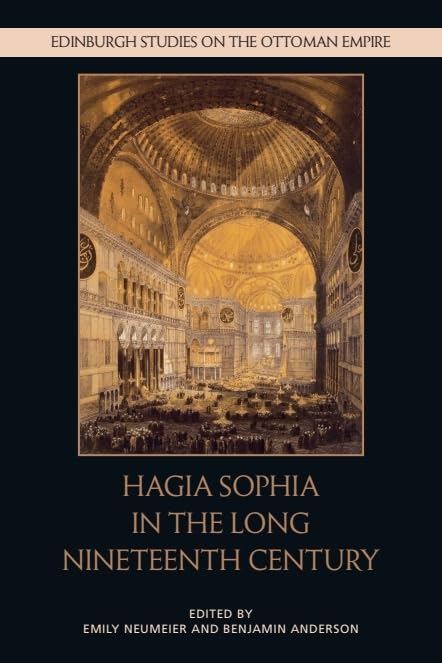

Hagia Sophia in the long nineteenth century / edited by Emily Neumeier and Benjamin Anderson. txt
Series Edinburgh studies on the Ottoman EmpireEditor: Edinburgh : Edinburgh University Press 2024Descripción: xvii, 292 p. : ill. ; col. ; 24 cmTipo de contenido:- text
- unmediated
- volume
- 9781474461009
- 147446100X
- 9781474461023
- 23 726.50949618
- NA5870.A9 H34 2024
| Imagen de cubierta | Tipo de ítem | Biblioteca actual | Biblioteca de origen | Colección | Ubicación en estantería | Signatura topográfica | Materiales especificados | Info Vol | URL | Copia número | Estado | Notas | Fecha de vencimiento | Código de barras | Reserva de ítems | Prioridad de la cola de reserva de ejemplar | Reservas para cursos | |
|---|---|---|---|---|---|---|---|---|---|---|---|---|---|---|---|---|---|---|
| Libro Col. General CARIBET | CARIBET Biblioteca Arquitectura Colección General CARIBET | General NA5870.A9 H34 2024 (Navegar estantería(Abre debajo)) | 1 | Disponible | 91000000073676 |
Descripciones mejoradas de Syndetics:
Hagia Sophia--a building whose domes have defined Istanbul's skyline for over 1500 years--has led many lives. Initially a church, subsequently a mosque, then a museum, the structure is today a monument of world heritage, even as its official status remains contested. Hagia Sophia's global fame took shape during the long nineteenth century, when Europeans 'discovered' its architectural significance. But what role did local actors play in the creation of Hagia Sophia as a modern monument? This book seeks out the audiences of this building beyond its Western interpreters, from Ottoman officials to the diverse communities of Istanbul. Chronologically bracketed by the major renovation of the structure in the 1740s and its conversion into a museum in 1934, this volume traces the gradual transformation of Hagia Sophia within the Ottoman imaginary from imaret (mosque complex) to eser (monument); that is, from lived space to archaeological artifact.
Includes bibliographical references and index.
List of Figures vii --
Notes on Contributors xii --
Note on Translation and Transliteration xv --
Acknowledgments xvi --
Introduction: Writing the Modern Biography of an Ancient Monument Emily Neumeier and Benjamin Anderson 1 --
1. Hagia Sophia’s Second Conversion: The Building Campaign of Mahmud I and the Transformation from Mosque to complex (1739-43) Ünver Rüstem 27 --
2. The Paradoxes of Hagia Sophia’s Ablution Fountain: The Qasida al-Burda in Cosmopolitan Istanbul, 1740 Tülay Artan 66 --
3. The Calligraphic Arts in the Age of Ottoman Architectural Renovation Emily Neumeier 98 --
4. From the Mouth of Angels: Folkloric Hagia Sophia Benjamin Anderson 125 --
5. The Other Ayasofya: The Restoration of Thessaloniki’s Ayasofya Mosque, 1890-1911 Sotirios Dimitriadis 148 --
6. ‘That Domed Feeling’: A byzantine Synagoge in Cleveland Robert S. Nelson 169 --
7. The Monument of the Present: The Fossati Restoration of Hagia Sophia (1847-9) Asli Menevse 197 --
8. From Ceremony to Spectacle: Changing Perceptions of Hagia Sophia through the Night of Power (Laylat al-Qadr) Prayer Ceremonies Ayşe Hilâl Uğurlu 240 --
9. Temple of the Wold’s Desire: Hagia Sophia in the American Press, c. 1910-27 Robert Ousterhout 265 --
Index 281 --
Figures
I.1 View of the public square in front of the Hagia Sophia, 2022 4 --
I.2 A view of Hagia Sophia, ‘the exterior of the mosque, before its restoration’4 --
I.3 Hagia Sophia, mosaic of the South-west vestibule 8 --
I.4 Wilhelm Salzenberg, Alt-christliche Baudenkmale von Constantinopel vom V. bis XII. Jahrhundert 11 --
I.5 Narthex of Hagia Sophia, June 2022 18 --
1.1 Hagia Sophia Library, 1739-40, exterior 28 --
1.2 Hagia Sophia Library, entrance façade in the basilica’s right aisle 29 --
1.3 Hagia Sophia Library, interior of thr reading and recitation room 29 --
1.4 Hagia Sophia Library, interior of the kiosk 30 --
1.5 Hagia Sophia Library School, 1740-1 31 --
1.6 Hagia Sophia ablution fountain, 1740-1 32 --
1.7 View to the north-west taken from the north-east minaret of Hagia Sophia, with the imaret extending diagonally from the bottom right corner 32 --
1.8 Hagia Sophia Imaret, 1742-3, interior of the dining hall looking towards the service windows of the adjacent kitchen 34 --
1.9 Hagia Sophia Imaret, exterior of the main building looking towards the principal entrance of the dining hall 35 --
1.10 Hagia Sophia Imaret, principal gate 36 --
1.11 Hagia Sophia Library, Ornamental Plasterwork on the ceiling of the kiosk reading area 40 --
1.12 Hagia Sophia Library, inner face of the kiosk entrance 42 --
1.13 Hagia Sophia ablution fountain, detail of the marble tank and bronze grillwork 43 --
1.14 Hagia Sophia Imaret, upper part of the main gate 44 --
1.15 Comparison of column capitals from the interior of Hagia Sophia, the main gate of Hagia Sophia Imaret and the façade of the Church of Santi Celso e Giuliano, Rome 51 --
2.1 Historical view of the ablution fountain of Hagia Sophia 67 --
2.2 Public fountain commissioned by Ahmed III at the entrance to the Topkapi Palace 68 --
2.3 Ablution fountain of Hagia Sophia 69 --
2.4 The central fount and the brass gratings topping it have sixteen sides 70 --
2.5 Final topping the brass gratings of the ablution fountain at Hagia Sophia 70 --
2.6 Finial topping the brass gratings of the ablution fountain at Hagia Sophia 72 --
2.7 Inscription frieze of couplets from a qasida attributed to Emin Mehmed, found on the interior of the octagonal colonnade at the ablution fountain of Hagia Sophia 73 --
2.8 Inscription frieze of the Qasida al-Burda, found on the exterior of the octagonal colonnade at the ablution fountain of Hagia Sophia 73 --
2.9 Fourteenth-century manuscript copy of the Qasida al-Burda 76 --
2.10 Frontispiece of fourteenth-century manuscript copy of the Qasida al-Burda 77 --
2.11 Colophon of seventeenth-century manuscript copy of the Qasida al-Burda 79 --
2.12 Colophon of fourteenth-century manuscript copy of the Qasida al-Burda 80 --
2.13 Flyleaf of fifteenth-century manuscript copy of the Qasida al-Burda 81 --
3.1 View of the interior of Hagia Sophia 98 --
3.2 Diagram indicating the location of the calligraphic roundels placed in the interior of Hagia Sophia in the nineteenth century 101 --
3.3 The roundel bearing the name of Huseyin, with the artist’s signature and date located at the bottom 102 --
3.4 Interior of the Hirka-I Serif Mosque, Istanbul 103 --
3.5 Front and rear view of the calligraphic roundels in Hagia Sophia, showing the wooden frame 103 --
3.6 Cornelius Loos, Drawing of the Interior of Hagia Sophia, 1711 105 --
3.7 Interior of the Kilic Ali Pasha Mosque in Tophane, Istanbul 107 --
3.8 Interior view of the Great Mosque of Adana 108 --
3.9 Interior of the Mosque of Sultan Murad III in Manisa, Turkey 110 --
3.10 Interior of the Nuruosmaniye Mosque, Istanbul 111 --
3.11 Interior view of the Bascavus Mosque in Yozgat, Turkey 112 --
3.12 Detail of a roundel painted on the wall of the upper gallery at the Bascavus Mosque in Yozgat, Turkey 113 --
3.13 Interior of the Suleymaniye Mosque, showing the black-and-gold medallions added in the nineteenth century in the semidome of the mihrab area and on the main piers supporting the central dome 116 --
3.14 View of Hagia Sophia after the Fossati restorations 118 --
4.1 Comparison of the dimensions of Hagia Sophia with those of other monuments of world architecture 131 --
4.2 The angel Jibril delivers a message from God to Muhammad, ordering him to leave Mecca and go to Medina 137 --
4.3 Austen Henry Layard, Nineveh and its Remains 138 --
5.1 Transverse section of the Ayasofya Mosque 149 --
5.2 YThe mihrab area of the Ayasofya Mosque 152 --
5.3 Ayasofya and its courtyard after the 1890 fire 156 --
5.4 Th mosque’s portico (son cemaat mahalli) following the 1890 fire 157 --
5.5 The catacombs superimposed on a street plan for the reconstruction of the area 159 --
5.6 Thessaloniki, Catacombs of St John the Baptist 160 --
5.7 Sultan Mehmed V Disembarks as his carriage draws to a halt in front of the mosque’s entrance 162 --
5.8 The interior of the building, shortly after its reconversion to a church 164 --
6.1 Temple Tifereth Israel, Cleveland, main façade, 1924 172 --
6.2 Temple Tifereth Israel, plan 172 --
6.3 Temple Tifereth Israel, older aerial view 173 --
6.4 Temple Tifereth Israel, vestibule 173 --
6.5 Temple Tifereth Israel, interior view to bimah 174 --
6.6 Temple Tifereth Israel, interior view to entrance 175 --
6.7 Temple Tifereth Israel, 1894, currently Friendship Baptist Church, Cleveland 176 --
6.8 Hagia Sophia, Istanbul, dome 177 --
6.9 Domes of the Tifaret Yisrael and Hurva synagoges, Jerusalem, c. 1900 178 --
6.10 Temple Tifereth Israel, façade capital 179 --
6.11 Hagia Sophia, Istanbul, nave capital 180 --
6.12 Hagia Sophia, Istanbul, view to apse 183 --
7.1 First page of the Journal de Constantinople. Echo de l’Orient (29 July 1849) 200 --
7.2 Frontispiece from Gaspare Fossati’s lithography album, Aya Sofia, Constantinople, as Recently Restored by Order of H.M. the Suktan Abdul-Medjid (1852) 206 --
7.3 ‘View from the Main Entrance’, Plate 1 from the Fossati album 208 --
7.4 Plate 1 from the Fossati album 209 --
7.5 W.H. Bartlett, ‘View from the West Gallery’. Julia Pardoe, The Beauties of the Bosphorus by Miss Pardoe (London, 1838) 211 --
7.6 ‘View of the Upper Gallery’, Plate 10 from the Fossati album 212 --
7.7 Detail from Plate 11 of the Fossati album 213 --
7.8 ‘Entrance of the Upper Gallery’, Plate 10 from the Fossati album 214 --
7.9 ‘The New Imperial Loge’ (Hunkar Mahfili), Plate 9 from the Fossati album 216 --
7.10 ‘The View from the North Aisle’, Plate 5 from the Fossati album 218 --
7.11 ‘The View of the Grand Vizier’s Place’, Plate 7 from the Fossati Album 220 --
7.12 Detail from Plate 7 of the Fossati album 221 --
7.13 Wlhelm Salzenberg, Alt-christliche Baudenkmale von Constantinople vom V. bis XII. Jahnrhundert 223 --
7.14 ‘The View of the Central Nave from the North Aisle’, Plate 6 from the Fossati album 224 --
8.1 A plate from the Fossati album showing the interior view of the Hagia Sophia Mosque, drawn from the lower north gallery 242 --
8.2 A plate from the Fossati Album showing the upper galleries of Hagia Sophia from the north-west 243 --
8.3 A nineteenth-century map of Istanbul, showing major imperial mosques that were visited by sultans during Night of Power ceremonies 246 --
8.4 A detail from the same map showing the route of the European group from Buyukdere to Hagia Sophia 249 --
8.5 Newspaper clips about the Night of Power ceremony held in Hagia Sophia on 4 February 1932 253 --
8.6 A scene from the 3D Mapping Show held in 2020 for the 567th anniversary of the conquest of Istanbul 255 --
9.1 Hagia Sophia, seen from the south-west in a popular postcard view 265 --
9.2 Hagia Sophia, interior looking east 266 --
9.3 Hagia Sophia, as illustrated in a newspaper article of 1912 271 --
9.4 Popular newspaper feature from 1927 concerning the conversion of Hagia Sophia into a dancehall 275 --
Uncovers a diversity of local encounters with Hagia Sophia in the late Ottoman Empire Examines the biography" of a single monument from multiple points of viewNine chapters present a variety of methodological approaches drawn from the fields of history and art historyEmphasis on local or non-traditional discourses in the Ottoman Empire and beyondConsiders the physical changes to the structure, decoration and surroundings of Hagia SophiaOpens new avenues of research for readers interested in alternative accounts of modernityHagia Sophia-a building whose domes have defined Istanbul's skyline for over 1500 years-has led many lives. Initially a church, subsequently a mosque, then a museum, the structure is today a monument of world heritage, even as its official status remains contested. Hagia Sophia's global fame took shape during the long nineteenth century, when Europeans "discovered" its architectural significance. But what role did local actors play in the creation of Hagia Sophia as a modern monument?This book seeks out the audiences of this building beyond its Western interpreters, from Ottoman officials to the diverse communities of Istanbul. Chronologically bracketed by the major renovation of the structure in the 1740s and its conversion into a museum in 1934, this volume traces the gradual transformation of Hagia Sophia within the Ottoman imaginary from imaret (mosque complex) to eser (monument); that is, from lived space to archaeological artifact.
Notas de autor provistas por Syndetics
Emily Neumeier is Assistant Professor of Islamic art and architecture at Temple University, Philadelphia. She studies the visual and spatial cultures of the eastern Mediterranean, with a focus on the Ottoman Empire, and her research has been published in venues such as the International Journal of Islamic Architecture , the Journal of the Ottoman and Turkish Studies Association , and History and Anthropology .
Benjamin Anderson is Associate Professor of History of Art and Classics at Cornell University. He is the author of Cosmos and Community in Early Medieval Art (Yale University Press, 2017) and co-editor of Is Byzantine Studies a Colonialist Discipline? Toward a Critical Historiography (Penn State University Press, 2023), and The Byzantine Neighbourhood: Urban Space and Political Action (Routledge, 2022)