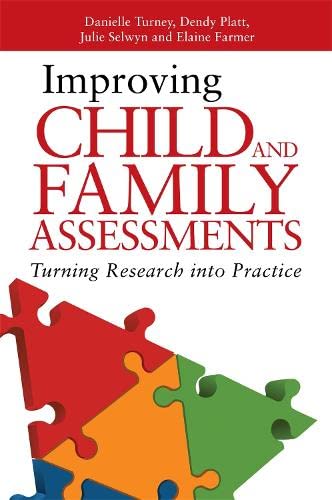

Improving child and family assessments : turning research into practice / Danielle Turney, Dendy Platt, Julie Selwyn, Elaine Farmer.
Editor: Philadelphia, PA : Jessica Kingsley Publishers, c2012Descripción: 1 online resource (256 p.)Tipo de contenido:- text
- computer
- online resource
- 9780857005533 (electronic bk.)
- 0857005537 (electronic bk.)
- 362.82/53 23
- HV697 .I47 2012
| Imagen de cubierta | Tipo de ítem | Biblioteca actual | Biblioteca de origen | Colección | Ubicación en estantería | Signatura topográfica | Materiales especificados | Info Vol | URL | Copia número | Estado | Notas | Fecha de vencimiento | Código de barras | Reserva de ítems | Prioridad de la cola de reserva de ejemplar | Reservas para cursos | |
|---|---|---|---|---|---|---|---|---|---|---|---|---|---|---|---|---|---|---|
| Libro electrónico | Biblioteca de Mayagüez Acceso en línea | HV697 .I47 2012 (Navegar estantería(Abre debajo)) | Ebook c. 1 | Disponible | 50000003287553 | |||||||||||||
| Libro electrónico | Biblioteca Encarnación Valdés Acceso en línea | 362.82/53 (Navegar estantería(Abre debajo)) | Disponible | ocn755013555 |
Descripciones mejoradas de Syndetics:
The quality of the assessment of children in need has a significant impact on outcomes for the children concerned. Good assessment contributes to better outcomes, but poor assessment can have tragic consequences. Understanding what makes a good assessment is vital.
This book brings together findings from 10 years of UK research that shed light on different aspects of child and family assessment, and examines the evidence for what works in promoting the best outcomes for children. It covers thresholds for assessment and intervention, what information should be collected in assessments, and assessments in different contexts. It also examines key aspects of practice and the factors that can help or hinder good quality assessment. These areas include analysis, critical thinking and reflection; engaging with children and families; and inter-professional working. Structural, procedural and organisational factors are also considered.
In summarising the research, this important book provides key messages on the links between assessment and outcomes for children, and offers implications for policy and practice. It will be essential reading for social work practitioners, academics, students and researchers, and all those in the child protection field.
Includes bibliographical references (p. 235-248) and index.
Introduction -- Thresholds for recognition, assessment and intervention -- The content of assessments : what information is collected? -- Assessments in particular contexts -- Analysis, critical thinking and reflection in assessments -- Engaging with children, young people, and their parents -- Inter-professional working -- Structural, procedural, and organisational factors -- Assessment and child outcomes -- Conclusions -- Appendix a. method -- Appendix b. list of empirical studies used in this review -- References -- Index.
The quality of the assessment of children in need has a significant impact on outcomes for the children concerned. Good assessment contributes to better outcomes, but poor assessment can have tragic consequences. Understanding what makes a good assessment is vital.This book brings together findings from 10 years of UK research that shed light on different aspects of child and family assessment, and examines the evidence for what works in promoting the best outcomes for children. It covers thresholds for assessment and intervention, what information should be collected in assessments, and assessments in different contexts. It also examines key aspects of practice and the factors that can help or hinder good quality assessment. These areas include analysis, critical thinking and reflection; engaging with children and families; and inter-professional working. Structural, procedural and organisational factors are also considered.In summarising the research, this important book provides key messages on the links between assessment and outcomes for children, and offers implications for policy and practice. It will be essential reading for social work practitioners, academics, students and researchers, and all those in the child protection field.
Description based on print version record.