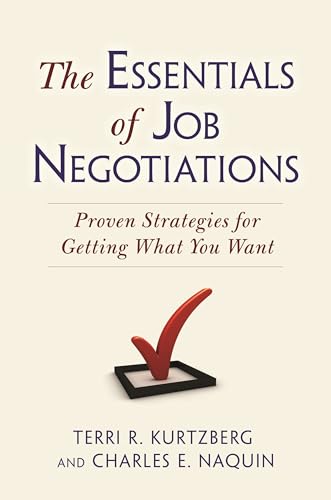

The essentials of job negotiations proven strategies for getting what you want Terri R. Kurtzberg and Charles E. Naquin.
Detalles de publicación: Santa Barbara, Calif. Praeger c2011.Descripción: ix, 195 p. 25 cmISBN:- 9780313395840 (pbk. : alk. paper)
- 650.144 K9696e 23
- HF5549.5.I6 K87 2011
| Imagen de cubierta | Tipo de ítem | Biblioteca actual | Biblioteca de origen | Colección | Ubicación en estantería | Signatura topográfica | Materiales especificados | Info Vol | URL | Copia número | Estado | Notas | Fecha de vencimiento | Código de barras | Reserva de ítems | Prioridad de la cola de reserva de ejemplar | Reservas para cursos | |
|---|---|---|---|---|---|---|---|---|---|---|---|---|---|---|---|---|---|---|
| Libro | Biblioteca Encarnación Valdés Colección General bev | 650.144 K9696e (Navegar estantería(Abre debajo)) | Disponible | 80000002463720 |
Descripciones mejoradas de Syndetics:
Negotiating job packages is one of the trickiest tasks most people face in their professional lives--and everybody wants to know how to do it better. Filled with solid, accessible, research-backed advice, this book counters myths about job negotiations and maps the way to success.
Job negotiations can influence one's income, lifestyle, and even relationships. Based on over 50 years of research in social psychology, decision making, organizational behavior, and negotiations, The Essentials of Job Negotiations: Proven Strategies for Getting What You Want is full of actionable information that will help readers master the job-negotiation process from start to finish.
This book covers all aspects of job negotiation from interviewing to planning for the negotiation to the actual negotiation dance and the employee-employer relationship that results. Special attention is given to the arts of communication and persuasion to help readers strengthen the ways they present ideas and increase the likelihood of success. Each chapter tackles a different aspect of the job-negotiation process, providing practical tips and true stories and explaining the psychological science behind why certain behaviors work while others don't. Throughout, negotiation theory is integrated with real-life experiences to make the concepts easily accessible.
Includes bibliographical references (p. [189]) and index.
Tabla de contenidos provista por Syndetics
- Introduction: Fears and Falsehoods(p. 1)
- Why You Should Give Your Best to this Negotiation (Why You Need This Book)(p. 1)
- The Big Myths to Overcome: The Six Falsehoods(p. 2)
- Overview of the Book(p. 7)
- 1 Behind-the-Scenes Preparation: Before You Even Walk in the Door(p. 9)
- "Gut-Feel" Reactions versus Proactive Planning(p. 10)
- What Does the Company Want, Generally Speaking?(p. 17)
- Preparing Yourself: Emotions at the Table(p. 20)
- Preparation FAQ(p. 22)
- Summary(p. 27)
- 2 Impression Management: Working the Interview(p. 29)
- A Good Mind-set(p. 30)
- What Are Interviewers Looking For?(p. 31)
- Making a Good Impression(p. 32)
- The Value of Interview Experience(p. 37)
- Asking Good Questions to Demonstrate Your Passion(p. 38)
- Interview FAQ(p. 40)
- Special Topic: Gender and Racial Bias in Job Negotiations(p. 44)
- Summary(p. 47)
- 3 Beginning the Negotiation: When to Start, and When Not To(p. 51)
- Getting a Written Offer(p. 51)
- Why You Don't Want to State the First Number(p. 54)
- Anchoring against Your Own Best Interests(p. 57)
- Avoiding the Salary Conversation, Specifically(p. 58)
- Should You Always Let Them Make the First Offer?(p. 60)
- Pre-Negotiation/Pre-Offer FAQ(p. 61)
- Summary(p. 68)
- 4 The Actual Negotiation(p. 70)
- Justifying Offers and the Fairness Game(p. 70)
- Trade-offs and Concessions(p. 74)
- Using a Trade-off Matrix to Analyze What to Trade(p. 76)
- Information Sharing(p. 79)
- Comparing Multiple Offers: Using the Offer Rating System(p. 81)
- Using Other Offers as a Springboard(p. 84)
- Contingency Counteroffers(p. 86)
- The Top 10 Don'ts: Common Mistakes and How to Avoid Them(p. 87)
- Summary(p. 89)
- 5 Powerful Communication(p. 92)
- The Curse of Knowledge: Do You Really Understand What I'm Saying?(p. 93)
- Cialdini's Psychology of Persuasion(p. 94)
- Powerful versus Powerless: Communicating Up(p. 101)
- Listening Skills(p. 104)
- Three Additional Tips for Effective Communication in Job Negotiations(p. 108)
- Summary(p. 110)
- 6 Negotiating via E-mail: You May Need to Do This, So Do It Right(p. 113)
- Communication Bandwidth(p. 113)
- Advantages of E-mail(p. 115)
- Disadvantages of E-mail(p. 117)
- Strategies for Success with E-mail(p. 123)
- Top 10 Rules for E-mail Success(p. 125)
- Summary(p. 127)
- 7 Headhunters(p. 130)
- How Headhunters Work(p. 130)
- The Downside to Agent Use(p. 134)
- Managing Your Headhunter Relationship(p. 140)
- Summary(p. 144)
- 8 Special Circumstances: Bad Economies, Family Businesses, and Cross-Cultural Negotiations(p. 145)
- Special Circumstance 1 Strategies for Poor Economic Times(p. 145)
- 4 Strategies Adding/Trading Issues, Anchoring, Justifying, and Contingency(p. 146)
- Negotiating from a Position of Unemployment" or Underemployment(p. 150)
- Poor Economic Times Summary(p. 153)
- Special Circumstance 2 Family Businesses(p. 153)
- Family Business Summary(p. 157)
- Special Circumstance 3 Cross-Cultural Negotiations(p. 157)
- Does Culture Matter?(p. 158)
- A Closer Look at Specific Cultural Divides159
- The Language Barrier(p. 160)
- Cross-Cultural Negotiations Summary(p. 161)
- 9 After the Deal: What's Next?(p. 164)
- Situation 1 Raises(p. 164)
- Situation 2 Advanced Degrees and Certifications(p. 169)
- Situation 3(p. 170)
- Situation 4(p. 173)
- Situation 5(p. 174)
- Summary(p. 177)
- 10 The Top 10 Most Important Things to Remember(p. 179)
- Appendix A Planning Table: The Seven Key Insights for Effective Planning(p. 185)
- Appendix B Potential Issues(p. 187)
- Appendix C Online Salary Information(p. 189)
- Index(p. 191)
Reseñas proporcionadas por Syndetics
Booklist Review
President Obama has made his decision: by the end of this year, U.S. military involvement in Iraq will end. Our nation has paid a high price in blood and treasure for our mission, but what does the future hold for Iraq? In particular, is the current democracy, established under U.S. stewardship, effective and sustainable? Ghanim, an Iraqi native and scholar on Middle Eastern affairs, offers a disturbing and convincing criticism of the current state of Iraq's government and political culture. He paints a portrait of endemic corruption, contempt for the rights of ethnic and religious minorities, and a proportional electoral system that locks in sectarian divisions. Ghanim assigns some blame to the U.S. for failing to understand Iraqi cultural realities, but he also assigns ample blame to Iraq's political leaders. Ghanim may be unduly pessimistic since the evolution of democratic systems is inevitably slow, uneven, and messy. Still, this is a necessary, timely glimpse at the short-term future of a still-important nation.--Freeman, Jay Copyright 2010 BooklistNotas de autor provistas por Syndetics
Terri R. Kurtzberg , PhD, is associate professor of management and global business at the Rutgers Business School.
Charles E. Naquin , PhD, is associate professor of management at DePaul's Kellstadt Graduate School of Business, Chicago, IL, where he teaches negotiations and organizational behavior.