Descripciones mejoradas de Syndetics:
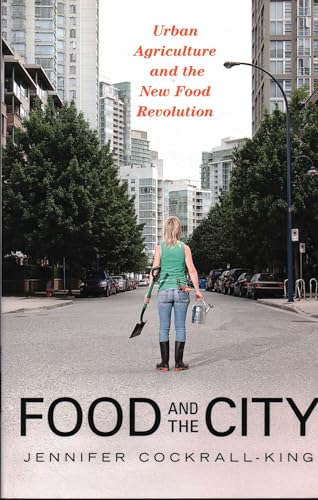
A global movement to take back our food is growing. The future of farming is in our hands-and in our cities.This book examines alternative food systems in cities around the globe that are shortening their food chains, growing food within their city limits, and taking their "food security" into their own hands. The author, an award-winning food journalist, sought out leaders in the urban-agriculture movement and visited cities successfully dealing with "food deserts." What she found was not just a niche concern of activists but a global movement that cuts across the private and public spheres, economic classes, and cultures. She describes a global movement happening from London and Paris to Vancouver and New York to establish alternatives to the monolithic globally integrated supermarket model. A cadre of forward-looking, innovative people has created growing spaces in cities: on rooftops, backyards, vacant lots, along roadways, and even in "vertical farms." Whether it's a community public orchard supplying the needs of local residents or an urban farm that has reclaimed a derelict inner city lot to grow and sell premium market veggies to restaurant chefs, the urban food revolution is clearly underway and working.This book is an exciting, fascinating chronicle of a game-changing movement, a rebellion against the industrial food behemoth, and a reclaiming of communities to grow, distribute, and eat locally.
Includes index.
Includes bibliographical references.
Discusses how urban agriculture can help revolutionize the environmentally unsustainable modern food industry, providing evidence of thriving urban farms within "food deserts" and describing the global movement towards alternative food production.
Reseñas proporcionadas por Syndetics
Library Journal Review
In 2008, the United Nations announced that for the first time in human history the majority of people in the world lived in cities. Today, many government leaders are grappling with the issue of food security for urban populations. In this book, Canadian freelance food journalist Cockrall-King focuses on urban agriculture as a constructive alternative to industrialized agriculture and the globalized food industry. She visits some of the movement's pioneers in cities like Paris, Toronto, Detroit, and Havana. While Cockrall-King does an admirable job of introducing us to some of the major players in urban agriculture today, her attempts to vilify industrialized agriculture come across as biased and shrill. She does best simply documenting the trend toward urban agriculture, rather than analyzing its political roots and implications. VERDICT Full of inspirational stories about people and places on the cutting edge of urban agriculture, this book will motivate you to plant tomatoes on your balcony. For a more personal take on the trend, check out Novella Carpenter's memoir, Farm City: The Education of an Urban Farmer.-Kelsy Peterson, Prairie Village, KS (c) Copyright 2012. Library Journals LLC, a wholly owned subsidiary of Media Source, Inc. No redistribution permitted.
Publishers Weekly Review
With this incisive study of the urban farming movement, Canadian food writer Cockrall-King identifies weak links in complex global food chains supplying supersized retailers (e.g., narrowing biodiversity, just-in-time delivery, "global summertime" mentality) that, she says, will result in urban food deserts in the face of natural disasters, terrorism, contamination scares, lack of fuel, and inflation. Despite the appearance of unlimited, cheap food, Cockrall-King contends, the era of low prices has peaked as food products are diverted to agro and biofuel production, and Third World suppliers grapple with ecological devastation. In case studies of urban farmers and beekeepers stretching from London and Paris to Canada and the U.S., she reports on the growth of green markets and gardens and vineyards on rooftops, by roadsides, and in abandoned lots and community plots. Of particular note is her chapter on Cuba, which became a food desert in the 1990s after it lost financial backing from the U.S.S.R. and is now a model for urban agriculture. Despite her dire predictions for health and food security, Cockrall-King provides ample proof of city dwellers who have taken steps toward self-sufficiency by growing their food close to home. (Feb.) (c) Copyright PWxyz, LLC. All rights reserved.
CHOICE Review
One of the many discoveries made from the 9/11 attack on New York City is that the cornucopia of the American supermarket is illusory. According to Canadian food journalist Cockrall-King, the food supply of a large city can disappear in about three days following a catastrophic event. This discovery has precipitated a small but growing interest in urban agriculture. This form of agriculture has a number of advantages. These include available land; a virtually unlimited source of compost; readily available customers and markets; an abundant water supply; a heat island effect, in which the expanse of concrete increases temperature by several degrees; reduction in food miles; and the mitigation of food deserts. The author documents creative, inspiring projects in a variety of cities in Canada, the US, and Europe, ranging from rooftop gardens to vertical farms. In inner-city Chicago, for instance, one multistory vertical farm integrates the growing of vegetables, including mushrooms in the basement, with animal husbandry and aquaculture. Through most of the book, the author's tone is unremittingly optimistic. In her final chapter, though, Cockrall-King concedes that the movement is in its incipient stages, its objectives may be quixotic, and results must improve dramatically to compete with conventional agriculture. Summing Up: Recommended. All levels/libraries. D. M. Gilbert Maine Maritime Academy
Booklist Review
You don't have to go back to the land, you're already there. Motivated to learn more about the seemingly overnight interest in urban food production, Cockrall-King, a Canadian journalist, set off on a worldwide tour, and her informed impressions make up this fascinating snapshot of the contemporary urban-agriculture movement. From urban vineyards in London to beehives that crown Paris' national opera house (and produce the world's most expensive honey) to the world's first operational vertical farm (in a repurposed Chicago factory), the projects are both refreshingly grassroots and astonishingly innovative. Succinct overviews of the industrial food complex and the rise of urban agriculture provide ample context and include sobering statistics, as well as spot-on quotes from both international leaders and neighborhood farmers: This is just the tip of the iceberg lettuce, a Canadian activist warns. Readers may not agree with all of the author's strongly stated and sometimes loosely organized views, but this illuminating title should be essential reading for anyone interested in food safety, urban sustainability, and how to eat closer to home.--Engberg, Gillian Copyright 2010 Booklist
Notas de autor provistas por Syndetics
Jennifer Cockrall-King is an award-winning food journalist whose work has appeared in the Chicago Sun-Times, the National Post, Canadian Geographic, Maclean's, and other major publications. She lives in Edmonton, Alberta, and in the Okanagan Valley in British Columbia, where she founded and runs the Okanagan Food and Wine Writers Workshop. Visit Jennifer online at www.foodgirl.ca and www.facebook.com/FoodandtheCity, and on Twitter @jennifer_ck.