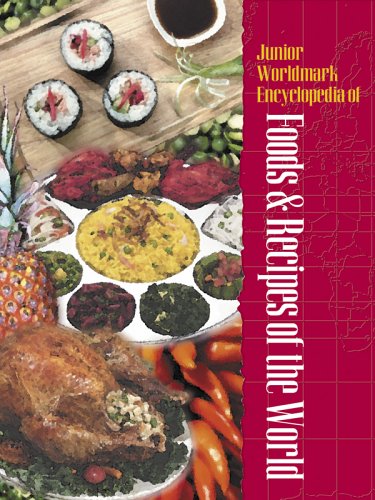
Imagen de portada de Amazon
Imagen de Amazon.com
Imagen de cubierta Syndetics
Portada de Syndetics
Imagen de OpenLibrary

Junior Worldmark encyclopedia of foods and recipes of the world / Karen Hanson;

Por: Detalles de publicación: Detroit, MI; U X L: c2002.Descripción: 4 v. maps. 24 cmTipo de contenido:
Tipo de medio:
Tipo de soporte:
ISBN:
  • 078765423X
Otro título:
  • Food and recipes of the world
Tema(s):
Contenidos:
v. 1. Algeria to France -- v. 2. Germany to Japan -- v. 3. Kazakhstan to South Africa -- v. 4. Spain to Zimbabwe, cumulative index.
Tema: Profiles the food, recipes, and culture of sixty countries.
Valoración
    Valoración media: 0.0 (0 votos)
Existencias
Imagen de cubierta Tipo de ítem Biblioteca actual Biblioteca de origen Colección Ubicación en estantería Signatura topográfica Materiales especificados Info Vol URL Copia número Estado Notas Fecha de vencimiento Código de barras Reserva de ítems Prioridad de la cola de reserva de ejemplar Reservas para cursos
Libro Biblioteca de Mayagüez Sala de Referencia mb TX349 .J86 2002 (Navegar estantería(Abre debajo)) v.1 Disponible 50000002177078
Libro Biblioteca de Mayagüez Sala de Referencia mb TX349 .J86 2002 (Navegar estantería(Abre debajo)) v.2 Disponible 50000002177086
Libro Biblioteca de Mayagüez Sala de Referencia mb TX349 .J86 2002 (Navegar estantería(Abre debajo)) v.3 Disponible 50000002177094
Libro Biblioteca de Mayagüez Sala de Referencia mb TX349 .J86 2002 (Navegar estantería(Abre debajo)) v.4 Disponible 50000002177102
Total de reservas: 0

Descripciones mejoradas de Syndetics:

This new 4-vol. set provides comprehensive coverage of the foods and recipes of approximately 75 cultural groups from more than 60 countries -- from Algeria to Vietnam. Entries provide 10-15 recipes for each group and include data on the agriculture and dietary habits of each group as well as an overview of each group's nutrition and health. Arranged alphabetically by country, entries also describe both traditional and modern methods of preparation and cooking foods. For each country/group, the "Encyclopedia" covers: Foods for religious and holiday celebrations Foods of the group Geographic setting and environment History and food Mealtime customs Politics, economies and nutrition And more

Value-added features include lists of sources for further study, including cookbooks and internet sources; sidebars covering related material, including definitions of specific terminology or descriptions of the evolution of a particular cooking method/custom; a timeline of historical progression of dietary customs; and both general and recipe indexes.

Profile the food, recipes, and culture of sixty countries.

Includes bibliographical references and index.

v. 1. Algeria to France -- v. 2. Germany to Japan -- v. 3. Kazakhstan to South Africa -- v. 4. Spain to Zimbabwe, cumulative index.

Profiles the food, recipes, and culture of sixty countries.

Reseñas proporcionadas por Syndetics

School Library Journal Review

Gr 5-8-A disappointing effort. Included are 700 recipes that represent countries, regions within the U.S., and various cultural groups. Along with 10 recipes, each of the 70 entries contains brief sections on "Geographic Setting and Environment"; "History and Food"; "Mealtime Customs"; and other topics. Unfortunately, there are no specific sources given for the many facts and statistics (notably in the "Politics, Economics and Nutrition" sections), or for the recipes. Generalizations include statements such as: "It is tradition for African Americans to eat a lot of food for breakfast" and "Bologna is a popular luncheon meat for many African Americans." Many of the recipes are complicated or the instructions are unclear. Sometimes they are overly simplistic (the recipe for the Argentinean drink "Submarino," or milk with chocolate syrup, instructs "Place the spoon with the syrup in the cold milk, but don't stir it. Drink a little milk, then lick some of the chocolate off the spoon. Continue until glass is empty"). The recipe for "Man-O-Min" lists a measurement without the ingredient. Many of the black-and-white photographs are of poor quality. Two tiny maps are included in each article. There is a single index, which is hard to maneuver. Although recipes are in heavy demand for school assignments, the deficiencies of this set do not make it a worthwhile purchase.-Janice Greenberg, formerly at Brooklyn Public Library, NY (c) Copyright 2010. Library Journals LLC, a wholly owned subsidiary of Media Source, Inc. No redistribution permitted.

Booklist Review

This approach to world cultures through food could have been a major breakthrough for its intended middle-school audience. It has many of the right ingredients, especially its established Junior Worldmark format, where alphabetized country entries are divided into standard subsections covering geography; history; foods (including those of different culture groups); religious and holiday celebrations; mealtime customs; politics, economics, and nutrition; and both print and Web-based resources for further study. The 70 articles cover nations and culture groups worldwide and offer more than 700 recipes for both traditional and modern dishes. Introductory material addresses basic safety and health issues, defines cooking terminology and procedures, and lists ingredients, with suggestions on how to locate more exotic goods. Unfortunately, the set has several drawbacks. The most noticeable is the lack of color photographs or graphic enhancement. Murky black-and-white pictures accompany the recipes, creating tableaus that are particularly unappetizing. The photos are so grainy that even shots meant to instruct or demonstrate are useless. The recipes themselves are serviceable but unexciting. Although there is useful information here about food and dietary customs, it is difficult to discern the practical application for the recipes. Are the volumes meant to be used as cookbooks, because middle-school curriculum often rotates students through electives, including foods preparation classes? Are they meant for the social studies classroom, where cooking facilities are rare? If the majority of students will be preparing the dishes at home, as seems likely, wouldn't a loose-leaf binder with easily reproducible pages have made more sense? Considering the intended audience, other user-friendly enhancements, such as consecutive numbering throughout all four volumes instead of a cumbersome volume-page system, would also have been preferable. This resource could have been a visually enticing, innovative introduction to different cultures and ethnic groups. Perhaps the publishers will consider serving up something a bit more palatable in future editions.
Compartir
logopucpr-y-vive

Contáctanos

¡Queremos saber de ti!

Tel. 787.841.2000 Ext. 1801

bibliotecavaldes@pucpr.edu

⁣Búscanos en las redes

© 2026 Desarrollado por Ignite Online • All Rights Reserved • Powered by Koha.