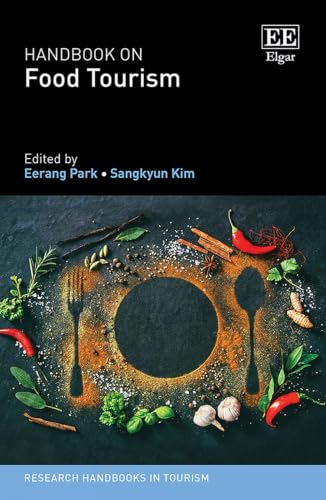

Handbook on food tourism / edited by Eerang Park, Sangkyun Kim.
Series Research handbooks in tourismEditor: Cheltenham, UK ; Northampton, MA : Edward Elgar Publishing, [2024]Edición: First editionDescripción: Electronic text (xiv, 314 pages) : illustrations ; 26 cmTipo de contenido:- text
- computer
- online resource
- 9781803924168
- TX631 .H363 2024
| Imagen de cubierta | Tipo de ítem | Biblioteca actual | Biblioteca de origen | Colección | Ubicación en estantería | Signatura topográfica | Materiales especificados | Info Vol | URL | Copia número | Estado | Notas | Fecha de vencimiento | Código de barras | Reserva de ítems | Prioridad de la cola de reserva de ejemplar | Reservas para cursos | |
|---|---|---|---|---|---|---|---|---|---|---|---|---|---|---|---|---|---|---|
| Libro electrónico | Biblioteca de Mayagüez Acceso en línea | TX631 .H363 2024 (Navegar estantería(Abre debajo)) | Ebook | Disponible | 50000003297024 |
Descripciones mejoradas de Syndetics:
This Handbook on Food Tourism provides an overview of the past, present, and future of research traditions, perspectives, and concerns about the food tourism phenomenon. Taking a multidisciplinary approach, it contributes to the historical and anthropological understanding of the nexus between food, society, and tourism that underpins the divergent business and marketing efforts in tourism today.
Expert contributors from across the globe not only explore the theoretical and conceptual foundations of food tourism research, but also address the significance of the multistakeholder nature of tourism in the context of food tourism development. Chapters present empirical research using quantitative and qualitative methods, conceptual papers and critical literature reviews employing archival research methods and informetric mapping, and analysis of secondary data from social, political, and environmental sources. Rich with information and data about diverse socio-cultural and environmental issues, this Handbook consolidates knowledge on the studies of food tourism from around the world and provides a vision for future research.
Covering the breadth of food tourism research, this Handbook will be a fundamental reference work for researchers, academics, and students in tourism management, human geography, social and cultural geography, and business and management. It will similarly appeal to professionals, local authorities, and local food and tourism industries and businesses.
Includes bibliographical references and index.
1. Introduction: the endless journey through our imagined curiosities, our tasteful stories -- PART I (RE)THINKING AND (RE)EVALUATING FOOD TOURISM -- 2. Festivals as culinary tourism destinations and attractions -- 3. Building an imagined sense of place and resurrecting memories with food tourism -- 4. Characteristics of place for food destinations: a foodscape perspective -- 5. Zorba’s kitchen: consuming Greekness in tourist-oriented restaurants in Greece -- 6. Food for thought: tourism, eating and the consequences of everyday decisions -- 7. There’s no place like food: instant noodles, instant elsew(here) -- PART II FOOD TOURISM DEVELOPMENT AND STAKEHOLDERS -- 8. The notion of in rural food tourism: insights from the Swedish context -- 9. Regenerative practices and the local turn: food tourism in rural regional context -- 10. Cultural innovation of chefs and food tourism development: the case of South Africa -- 11. Rethinking the importance of food tourism to destination sustainability: a supply-side discussion of noodle experiences in Suzhou -- PART III TRENDS, INNOVATIONS, AND NEW FOOD TOURISM ATTRACTIONS -- 12. The homeland of Sanuki udon: unconsolidated placemaking processes in a food tourism destination -- 13. From a newspaper page to a must-visit food tourism attraction -- 14. Novelty experiences as food tourism attractions in Japan -- 15. From watching to eating: food tourism perspectives on Japan’s divers and their catches -- 16. Learning to eat and eating to learn: unpacking co-created tourism experiences at a wild food festival -- 17. Evaluating the value creation of memorable or extraordinary gastronomic tourism experiences: a case study approach -- PART IV PROSPECTS AND OUTLOOKS FOR NEXT GENERATION OF FOOD TOURISM -- 18. Food taste experiences and gastrophysics: gender matters? -- 19. Adapting the luxury gastronomic experience to the new post-crisis scenario from a resilience approach -- 20. What we know of food tourism: systematic review of the literature using informetric analysis and directions for future research -- Index.
"This Handbook on Food Tourism provides an overview of the past, present, and future of research traditions, perspectives, and concerns about the food tourism phenomenon. Taking a multidisciplinary approach, it contributes to the historical and anthropological understanding of the nexus between food, society, and tourism that underpins the divergent business and marketing efforts in tourism today. Expert contributors from across the globe not only explore the theoretical and conceptual foundations of food tourism research, but also address the significance of the multistakeholder nature of tourism in the context of food tourism development. Chapters present empirical research using quantitative and qualitative methods, conceptual papers and critical literature reviews employing archival research methods and informetric mapping, and analysis of secondary data from social, political, and environmental sources. Rich with information and data about diverse socio-cultural and environmental issues, this Handbook consolidates knowledge on the studies of food tourism from around the world and provides a vision for future research. Covering the breadth of food tourism research, this Handbook will be a fundamental reference work for researchers, academics, and students in tourism management, human geography, social and cultural geography, and business and management. It will similarly appeal to professionals, local authorities, and local food and tourism industries and businesses"-- Provided by publisher.