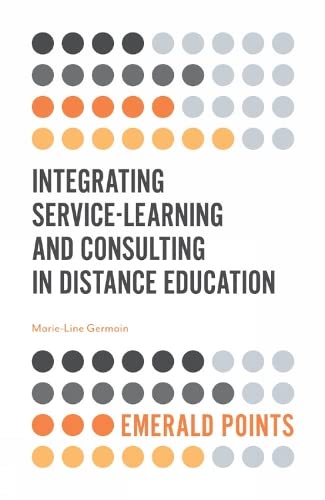

Integrating Service-Learning and Consulting in Distance Education / Marie-Line Germain.
Series Emerald Points SerEditor: Bingley : Emerald Publishing Limited, 2019Fecha de copyright: ©2019Descripción: 1 online resource (253 pages)Tipo de contenido:- text
- computer
- online resource
- 9781787694118
- 378
- LC5805 .G476 2019
| Imagen de cubierta | Tipo de ítem | Biblioteca actual | Biblioteca de origen | Colección | Ubicación en estantería | Signatura topográfica | Materiales especificados | Info Vol | URL | Copia número | Estado | Notas | Fecha de vencimiento | Código de barras | Reserva de ítems | Prioridad de la cola de reserva de ejemplar | Reservas para cursos | |
|---|---|---|---|---|---|---|---|---|---|---|---|---|---|---|---|---|---|---|
| Libro electrónico | Biblioteca de Mayagüez Acceso en línea | LC5805 .G476 2019 (Navegar estantería(Abre debajo)) | Ebook c. 1 | Disponible | 50000003287611 | |||||||||||||
| Libro electrónico | Biblioteca Encarnación Valdés Acceso en línea | 378 (Navegar estantería(Abre debajo)) | Disponible | EBC5790478 | ||||||||||||||
| Libro electrónico | Biblioteca Mons. Iñaki Mallona (Arecibo) Acceso en línea | 378 (Navegar estantería(Abre debajo)) | Ebooks | Disponible | 60000010175799 |
Descripciones mejoradas de Syndetics:
The pressures upon students from employers are greater than ever. Demands for a highly skilled workforce in a digitalized economy mean that higher education institutions need to do more to prepare their student bodies for this new way of working. The geographical boundaries set by traditional on-campus courses prevent most universities from allowing online students to engage in community service. Online service-learning responds to this limitation by initiating the transfer of in-person community service to the online environment. E-service learning addresses the growing demand for flexible online courses and programs. Anchored in research and supported by eight years of successful implantation, this book presents an award-winning e-service-learning model which allows students to enhance their employability with real work experience. Faculty can go beyond theory while building their service requirements, and may use e-service-learning to offer real world applications and hands-on experience. Clients benefit from pro bono services, and universities are able to fulfill their strategic goals, serve the community-at-large, and grow their online programs by offering students a unique online course experience.This book advocates a model and instructions for faculty to successfully integrate a remote service-learning and consulting component in an online course making this an illuminating text for higher education researchers and leaders alike.
ALA COVID Relief Fund
Includes bibliographical references and index.
Front Cover -- Copyright Page -- Dedication -- Contents -- About the Authors -- Preface -- Acknowledgments -- Introduction -- Part I Theoretical Underpinnings -- Chapter 1 Distance Education -- Current Trends in the United States -- Public and For-profit Universities -- Ivy Leagues -- Brown University -- Columbia University -- Cornell University -- Dartmouth College -- Harvard University -- Princeton University -- The University of Pennsylvania -- Yale University -- Development of the Web and Education -- From Web 1.0 to Web 5.0 -- 1990-2000: Web 1.0 -- 2000-2010: Web 2.0 -- 2010-2020: Web 3.0 -- 2020-2030: Web 4.0 and 5.0. Open, Linked, and Intelligent Web - the "Emotional Web" -- From Education 1.0 to Education 5.0 -- Education 1.0 -- Education 2.0 -- Education 3.0 -- Education 4.0 -- Education 5.0 -- Distance Education Outside the United States -- Expected Growth and Trends -- Chapter Synopsis -- Chapter 2 Service-Learning and e-Service-Learning -- Defining Service-Learning -- The Case for e-Service-Learning -- e-Service-Learning Typology -- Digital Access -- Benefits of e-Service-Learning -- Service-Learning and e-Service-Learning to Overcome Online Learning Limitations -- Skills Acquired through e-Service-Learning -- How e-Service-Learning Can Increase Employee Marketability and Social Responsibility -- Chapter Synopsis -- Chapter 3 Service-Learning and Consulting -- Defining Consulting -- Consultant Traits and Skills -- Internal versus External Consulting -- In-person versus Virtual Consulting -- Pro Bono versus Paid Consulting -- Consulting for For-profit versus Not-for-profit Organizations -- Summary of Consulting Stages -- Stages of Consultancy -- Stage 1 - Entry and Contracting -- Stage 2 - Data Collection and Diagnosis -- Stage 3 - Feedback and Design for Action -- Stage 4 - Action -- Stage 5 - Evaluation and Withdrawal.
Students as Consultants -- Steps in Integrating Service-Learning in Online Courses -- Chapter Synopsis -- Part II Application: Integration of e-Service-Learning -- Chapter 4 The Consulting Team -- The Team -- Faculty -- Project Manager -- Selecting a Project Manager -- Team Leader -- Consultant -- Student Teams -- Client's and Consultant's Assumptions -- Understanding the Client-consultant Relationship Development -- Establishing Credibility -- Developing Trust -- Swift Trust -- Barriers to the Creation of Swift Trust in Virtual Teams -- Individual Barriers -- Organizational Barriers -- Technological Barriers -- Team Barriers -- Building Relational Bonds in Online Environments -- Emphasizing the Need for Regular, Prompt, and Consistent Communication -- Client Commitment -- Chapter Synopsis -- Chapter 5 The Three-step e-Consulting Model -- Entry and Contracting -- Discovery and Dialogue -- Feedback and Design for Action -- Action -- Evaluation and Withdrawal -- Preparing for the Consultancy -- Step 1 - Call 1: First "Meet and Greet" Call with the Client (Stages 1 and 2 of the Consultancy) -- Preparation for the Call -- Showcasing the Consultant's Skills and Experience -- Understanding the Client's Needs and Expectations -- Organizational Assessment and Audit Form -- During the Consulting Process (Stages 3 and 4 of the Consultancy) -- Addressing Low Client and Student Engagement -- Client's Resistance to Change -- The Compliant Client -- Communication with the Client -- Step 2 - Call 2: Presenting the First Draft of the Consulting Work to the Client -- Dealing with the Client's Demands for Additional Work -- Resetting Goals and Expectations -- Step 3 - Call 3: Presenting the Final Consulting Project Draft (Stage 5 of the Consultancy) -- Post-consulting Implementation and Client-Consultant Relationship Closure -- Ensuring Successful Implementation.
Closing the Relationship -- Consultant's Self-reflection -- Chapter Synopsis -- Part III Recommendations for Success -- Chapter 6 Case Study -- e-Consulting Initiative in an Online Degree Program at a Large US University -- Online Students -- Client Organizations -- Chapter 7 Benefits of e-Service-Learning and e-Consulting -- Benefits of e-service-learning to the university and administration, faculty, project manager, team leaders, students, and ... -- University -- University and Administration -- Faculty -- Project Manager -- Team Leaders/Students -- Alumni Students and Business Professionals -- Internship and Student Job Seekers -- Client and Community -- Student, Client, and Faculty Satisfaction -- Plan for Long-term Sustainability -- Cost of the e-Service-Learning Initiative -- Limitations -- Legal Considerations -- Chapter Synopsis -- Chapter 8 Recommendations for a Successful e-Service-Learning Integration -- Courses -- Clear Statement of Competencies -- Key Elements in e-Service-Learning Initiatives -- People -- Roles and Responsibilities -- Communication -- Technology -- Course Design -- Metrics of Success -- Chapter Synopsis -- Conclusion -- References -- Index.
The pressures upon students from employers are greater than ever. Demands for a highly skilled workforce in a digitalized economy mean that higher education institutions need to do more to prepare their student bodies for this new way of working. The geographical boundaries set by traditional on-campus courses prevent most universities from allowing online students to engage in community service. Online service-learning responds to this limitation by initiating the transfer of in-person community service to the online environment. E-service learning addresses the growing demand for flexible online courses and programs. Anchored in research and supported by eight years of successful implantation, this book presents an award-winning e-service-learning model which allows students to enhance their employability with real work experience. Faculty can go beyond theory while building their service requirements, and may use e-service-learning to offer real world applications and hands-on experience. Clients benefit from pro bono services, and universities are able to fulfill their strategic goals, serve the community-at-large, and grow their online programs by offering students a unique online course experience.This book advocates a model and instructions for faculty to successfully integrate a remote service-learning and consulting component in an online course making this an illuminating text for higher education researchers and leaders alike.
Description based on publisher supplied metadata and other sources.
Electronic reproduction. Ann Arbor, Michigan : ProQuest Ebook Central, 2021. Available via World Wide Web. Access may be limited to ProQuest Ebook Central affiliated libraries.