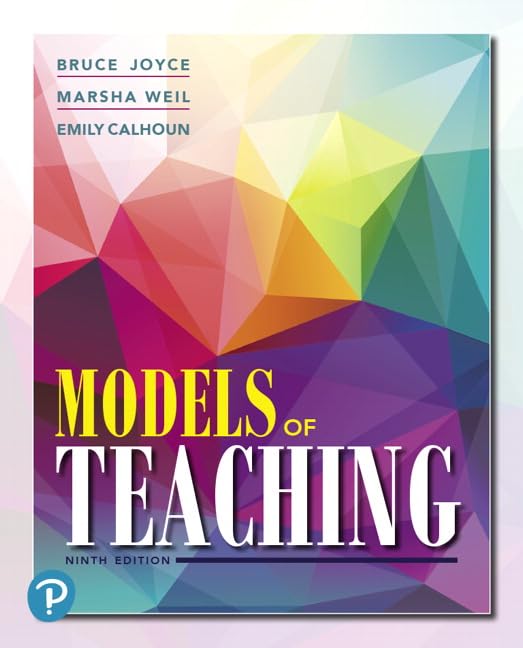

Models of teaching / Bruce Joyce, Marsha Weil, and Emily Calhoun.
Editor: Boston : Pearson, c2015Edición: Ninth editionDescripción: xxviii, 452 pages ; 24 cmTipo de contenido:- text
- unmediated
- volume
- 9780134892580
- 0134892585
- 371.39 22
- LB1027 .J69 2015
| Imagen de cubierta | Tipo de ítem | Biblioteca actual | Biblioteca de origen | Colección | Ubicación en estantería | Signatura topográfica | Materiales especificados | Info Vol | URL | Copia número | Estado | Notas | Fecha de vencimiento | Código de barras | Reserva de ítems | Prioridad de la cola de reserva de ejemplar | Reservas para cursos | |
|---|---|---|---|---|---|---|---|---|---|---|---|---|---|---|---|---|---|---|
| Libro | Biblioteca de Mayagüez Colección General mb | LB1027 .J69 2015 (Navegar estantería(Abre debajo)) | c. 1 | Disponible | 50000003280855 |
Descripciones mejoradas de Syndetics:
Models of Teaching: The Heart of the Core gives readers well-developed approaches to teaching, grounded in research and experience and designed to ensure the high levels of learning they are intended to generate. With the goal of providing the strongest positive effect on student achievement while keeping in line with the current emphasis on standards-based education, Models of Teaching pairs rationale and research with real-world examples and applications to provide a strong foundation for future and new educators. The book encompasses all of the major psychological and philosophical approaches to teaching and schooling, includes thoroughly documented research on the various models of teaching and their subsequent positive effects on student success, and gives teachers the tools they need to build strong classrooms that accelerate student learning.
Includes bibliographical references and index.
Part One - Models of Teaching: A Working Professional Repertoire -- 1. Where Models of Teaching Come From -- 2. Building the Community of Expert Learners: Taking Advantage of Our Students’ Capacity to Learn (and Ours) -- Part Two - The Basic Information-Processing Models of Teaching -- 3. Learning to Learn Inductively: The Really, Really Basic Model of Teaching -- 4. Scientific Inquiry: Learning through Investigations -- 5. The Picture Word Inductive Model: Developing Literacy Through Inquiry -- Part Three - Special Purpose Information-Processing Models -- 6. Concept Attainment : The Explicit Teaching of Important Concepts -- 7. Synectics: Teaching the Left Brain to Put the Right Side to Work -- 8. Memorization: Getting the Facts Straight, Now and for the Long Term -- 9. Using Advance Organizers to Design Presentations: Scaffolding Lectures, ICT, and Distance Offerings -- 10. The Inquiry Training Model: Training Inquiry Skills Directly -- Part Four - The Social Family of Models of Teaching -- 11. Partners in Learning: Getting Everybody on Board -- 12. Group Investigation: Rigorous Inquiry through Democratic Process -- 13. Role Playing: Studying Values -- Part Five - The Personal Family of Models -- 14. Nondirective Teaching - The Learner at the Center -- 15. Developing Positive Self-Concepts -- Part Six - The Behavioral Family of Models -- 16. Explicit Instruction: Comprehension When Reading and Composing When Writing -- 17. Mastery Learning: Bit by Bit, Block by Block, We Climb Our Way to Mastery -- 18. Direct Instruction: Applied Psychology Goes to Work -- Part Seven - The Conditions of Learning, Learning Styles, and Conceptual Levels -- 19. Creating Curricula: The Conditions of Learning -- 20. Expanding Our Horizons: Making Discomfort Productive -- Appendix: Peer Coaching Guides.
With the goal of providing the strongest positive effect on student achievement while keeping in line with the current emphasis on standards-based education, Models of Teaching pairs rationale and research with real-world examples and applications to provide a strong foundation for future and new educators. It includes thoroughly documented research on the various models of teaching and their subsequent positive effects on student success. Serving as the core of a successful K-12 teacher education program, Models of Teaching encompasses all of the major psychological and philosophical approaches to teaching and schooling, and gives teachers the tools they need to build strong classrooms that accelerate student learning. Well-developed approaches to teaching: The models are grounded in research and experience, have been taught to and used effectively by actual teachers, and are demonstrated in actual practice. Multimedia materials support learning of the models: 25 video demonstrations of the models in action are available at www.modelsofteaching.org. Support for incorporating the new Common Core Standards: Each model is described in relation to the relevant standards.