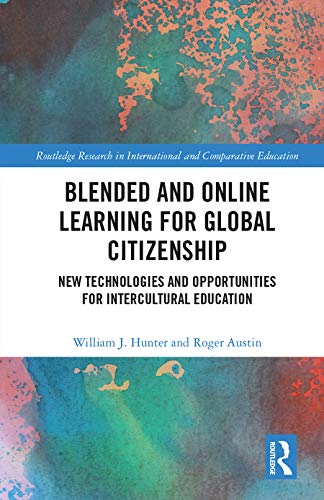

Blended and online learning for global citizenship : new technologies and opportunities for intercultural education / edited by William J. Hunter and Roger Austin.
Editor: New York, NY : Routledge, 2021Descripción: pages cmTipo de contenido:- text
- unmediated
- volume
- 9780367408213
- 9780367569082
- Blended learning -- Cross-cultural studies
- Web-based instruction -- Cross-cultural studies
- Computer-assisted instruction -- Cross-cultural studies
- Internet in education -- Cross-cultural studies
- Multicultural education -- Cross-cultural studies
- International education -- Cross-cultural studies
- Civics -- Study and teaching -- Cross-cultural studies
- 371.33/44678 23
- LB1028.5 .B563 2021
| Imagen de cubierta | Tipo de ítem | Biblioteca actual | Biblioteca de origen | Colección | Ubicación en estantería | Signatura topográfica | Materiales especificados | Info Vol | URL | Copia número | Estado | Notas | Fecha de vencimiento | Código de barras | Reserva de ítems | Prioridad de la cola de reserva de ejemplar | Reservas para cursos | |
|---|---|---|---|---|---|---|---|---|---|---|---|---|---|---|---|---|---|---|
| Libro | Biblioteca Encarnación Valdés Colección General bev | 371.33 H9451b (Navegar estantería(Abre debajo)) | Disponible | 80000002598434 |
Descripciones mejoradas de Syndetics:
By showcasing international, European, and community-based projects, this volume explores how online technologies and collaborative and blended learning can be used to bolster social cohesion and increase students' understanding of what it means to be a global citizen.
With the pace of technology rapidly increasing, Blended and Online Learning for Global Citizenship draws timely attention to the global lessons being learned from the impact of these technologies on peace building, community development, and acceptance of difference. In-depth case studies showcasing successful projects in Europe, Northern Ireland, and Israel explore blended learning and illustrate how schools and educators have embraced online technologies to foster national and international links both within and beyond communities. This has, in turn, equipped students with experiences that have informed their attitudes to cultural and political conflicts, as well as racial, ethnic, and social diversity.
Building on the authors' previous work Online Learning and Community Cohesion (2013), this thought-provoking text will be of interest to researchers, academics, and postgraduate students in the fields of international and comparative education. Educators and school leaders concerned with how multiculturalism and technology play out in the classroom environment will also benefit from reading this text.
Includes bibliographical references and index.
Blended learning in an age of conflict / William J. Hunter, Roger Austin and Rhiannon Turner -- Shared education in Northern Ireland : systemic change through blended learning / Roger Austin, Rhiannon Turner, Sammy Taggart and Mairead Davidson -- Lessons learned from 15 years of multicultural online collaborative learning in Israel / Asmaa Ganayem, Elaine Hoter, and Miri Shonfeld -- Building cultural awareness and understanding in Europe's schools : insights from the European Community's eTwinning Programme / Conor Galvin, Roger Austin, Elena Revyakina, and Anne McMorrough -- International links and global citizenship / William J. Hunter and Roger Austin -- Blended and online collaborative learning for citizenship in Catalonia, Spain / Andrés Besolí, Roger Austin, and William J. Hunter -- Promises fulfilled and challenges ahead / Roger Austin and William J. Hunter.
"By showcasing international, European, and community-based projects, this volume explores how online technologies, collaborative and blended learning can be used to bolster social cohesion, and increase students' understanding of what it means to be a global citizen. With the pace of technology rapidly increasing, Blended and Online Learning for Global Citizenship draws timely attention to the global lessons being learned from the impact of these technologies on peace-building, community development, and acceptance of difference. In-depth case studies showcasing successful projects in Europe, Northern Ireland, and Israel explore blended learning and illustrate how schools and educators have embraced online technologies to foster national and international links both within and beyond communities. This has, in turn, equipped students with experiences that have informed their attitudes to cultural and political conflicts, as well as racial, ethnic, and social diversity. Building on the editors' previous work Online Learning and Community Cohesion (2013), this thought-provoking text will be of interest to researchers, academics, and postgraduate students in the fields of international and comparative education. Educators and school leaders concerned with how multiculturalism and technology play out in the classroom environment will also benefit from reading this text. William J. Hunter is Professor of Education at Ontario Tech University, Canada and a Professor Emeritus at the University of Calgary, Canada. Roger Austin is Emeritus Professor of Education at Ulster University, Northern Ireland"-- Provided by publisher.
Notas de autor provistas por Syndetics
William J. Hunteris Professor of Education at Ontario Tech University, Canada and Professor Emeritus at the University of Calgary, Canada.
Roger Austin is Emeritus Professor of Education at Ulster University, Northern Ireland.