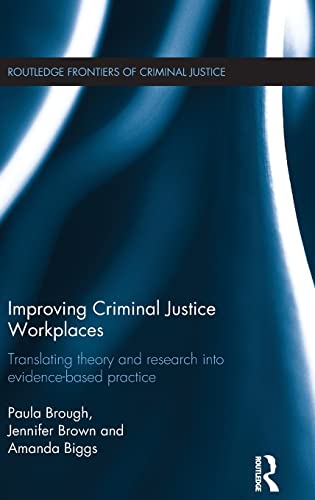

Improving criminal justice workplaces : translating theory and research into evidence-based practice / Paula Brough, Jennifer Brown and Amanda Biggs. [electronic resource]
Series Routledge frontiers of criminal justice ; 32Editor: London ; New York: Routledge, Taylor & Francis Group, 2016Descripción: Electronic text (xiv, 224 pages) ; 24 cmTipo de contenido:- text
- computer
- online resource
- 9781138019461 (hardback)
- 364.068/3 23
- HV7419 .B786 2016
| Imagen de cubierta | Tipo de ítem | Biblioteca actual | Biblioteca de origen | Colección | Ubicación en estantería | Signatura topográfica | Materiales especificados | Info Vol | URL | Copia número | Estado | Notas | Fecha de vencimiento | Código de barras | Reserva de ítems | Prioridad de la cola de reserva de ejemplar | Reservas para cursos | |
|---|---|---|---|---|---|---|---|---|---|---|---|---|---|---|---|---|---|---|
| Libro electrónico | Biblioteca de Mayagüez Acceso en línea | HV7419 .B786 2016 (Navegar estantería(Abre debajo)) | c. 1 | Disponible | 50000003273272 |
Descripciones mejoradas de Syndetics:
All organisations, whether private or public sector, seek to improve criminal justice workplace practice from an evidence base, but often find it difficult to effectively translate research findings into policy or design best-practice interventions. This book provides a direct bridge between academic research in organisational behaviour and the management of workers within criminal justice agencies.
The public sector in particular is currently experiencing significant funding cuts and increasingly needs to create optimal workplace strategies to maintain frontline services and preserve the well-being of the work force. The aim of this book is to equip managers with knowledge about key processes and appropriate research methods, thereby enabling them to more readily understand and apply academic research to their workplaces. The means to translate research findings into implementation strategies are also clearly explained. Furthermore, essential organisational issues that either impede or enhance productivity, employee effectiveness, and management responsiveness to change are discussed, following a common chapter template of problem definition, research and analysis, evidence translation, implementation, and evaluation.
Written by experts in the field, this book applies cutting-edge theoretical discussions and research findings to evidence-based policy. It examines new strategies and best practice in the context of widespread demoralization of staff in the criminal justice sector due to the impact of increased austerity. Improving Criminal Justice Workplaces is essential reading for leadership teams, managers and supervisors in the court, police, probation, and prison services, as well as allied professionals such as forensic psychologists and HR professionals.
Includes bibliographical references and index.
PART I. Framing issues -- What can I do? -- 1. Introduction -- 2. Occupational culture and organisational justice -- 3. Employee engagement -- 4. Leadership and management -- 5. Organisational communication -- 6. Professionalization -- PART II. Tools -- What can I do? -- 7. Evaluation -- 8. Focus groups -- 9. Consultation and consultancy -- 10. Surveys -- 11. Delphi technique -- PART III. Organisational problems and solutions -- What can I do? -- 12. Sustaining environments: work–life balance -- 13. Toxic environments: occupational stress -- 14. Transforming environments: leadership development -- 15. Dangerous environments: bullying and harassment -- 16. Diverse environments: discrimination -- 17. Conclusions: final thoughts, emerging issues and next steps -- Index.
All organisations, whether private or public sector, seek to improve criminal justice workplace practice from an evidence base, but often find it difficult to effectively translate research findings into policy or design best-practice interventions. This book provides a direct bridge between academic research in organisational behaviour and the management of workers within criminal justice agencies. The public sector in particular is currently experiencing significant funding cuts and increasingly needs to create optimal workplace strategies to maintain frontline services and preserve the well-being of the work force. The aim of this book is to equip managers with knowledge about key processes and appropriate research methods, thereby enabling them to more readily understand and apply academic research to their workplaces. The means to translate research findings into implementation strategies are also clearly explained. Furthermore, essential organisational issues that either impede or enhance productivity, employee effectiveness, and management responsiveness to change are discussed, following a common chapter template of problem definition, research and analysis, evidence translation, implementation, and evaluation. Written by experts in the field, this book applies cutting-edge theoretical discussions and research findings to evidence-based policy. It examines new strategies and best practice in the context of widespread demoralization of staff in the criminal justice sector due to the impact of increased austerity. Improving Criminal Justice Workplaces is essential reading for leadership teams, managers and supervisors in the court, police, probation, and prison services, as well as allied professionals such as forensic psychologists and HR professionals.
Notas de autor provistas por Syndetics
Paula Brough is a Professor of Organisational Psychology at Griffith University, Brisbane, Australia. Her early research examining the psychological health and well-being of police officers was conducted in the UK and New Zealand. Paula has contributed over 90 scholarly outputs to the international academic literature in this field (books, book chapters, and journal articles).
Jennifer Brown is a visiting professor at the London School of Economics and Co-Director of the Mannheim Centre for the study of criminology and criminal justice. She has conducted research on occupational stress within the police service as well as making a special study of gender within policing. Most recently she was the deputy chair of an Independent Commission into the future of policing within England and Wales.
Amanda Biggs is a Lecturer at Griffith University, Australia. Her research focuses on psychological and physical health at work, intervention evaluation, positive occupational health psychology, and workplace bullying. Much of Amanda's research experience has been conducted in collaboration with criminal justice organisations, and has been presented at numerous national and international academic conferences.