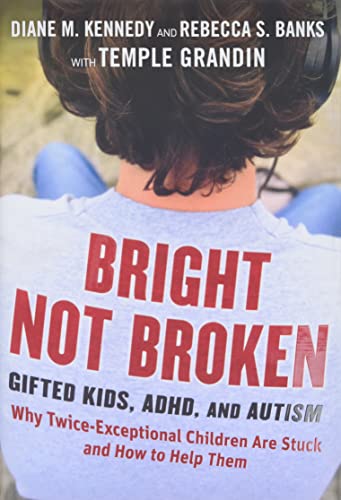

Bright not broken gifted kids, ADHD, and autism Diane M. Kennedy, Rebecca S. Banks with Temple Grandin.
Detalles de publicación: San Francisco Jossey-Bass 2011.Edición: 1st edDescripción: xxvi, 292 p. ill. 24 cmISBN:- 9780470623329
- 649/.1528 23
- RJ137 .K46 2011
- FAM012000
| Imagen de cubierta | Tipo de ítem | Biblioteca actual | Biblioteca de origen | Colección | Ubicación en estantería | Signatura topográfica | Materiales especificados | Info Vol | URL | Copia número | Estado | Notas | Fecha de vencimiento | Código de barras | Reserva de ítems | Prioridad de la cola de reserva de ejemplar | Reservas para cursos | |
|---|---|---|---|---|---|---|---|---|---|---|---|---|---|---|---|---|---|---|
| Libro | Biblioteca de Mayagüez Colección General mb | RJ137 .K46 2011 (Navegar estantería(Abre debajo)) | Disponible | 50000003240552 |
Descripciones mejoradas de Syndetics:
The future of our society depends on our gifted children--the population in which we'll find our next Isaac Newton, Albert Einstein, or Virginia Woolf. Yet the gifts and talents of some of our most brilliant kids may never be recognized because these children fall into a group known as twice exceptional, or "2e." Twice exceptional kids are both gifted and diagnosed with a disability--often ADHD or an Autism Spectrum Disorder--leading teachers and parents to overlook the child's talents and focus solely on his weaknesses. Too often, these children get lost in an endless cycle of chasing diagnostic labels and are never given the tools to fully realize their own potential.
Bright Not Broken sheds new light on this vibrant population by identifying who twice exceptional children are and taking an unflinching look at why they're stuck. The first work to boldly examine the widespread misdiagnosis and controversies that arise from our current diagnostic system, it serves as a wake-up call for parents and professionals to question why our mental health and education systems are failing our brightest children.
Most importantly, the authors show what we can do to help 2e children, providing a whole child model for parents and educators to strengthen and develop a child's innate gifts while also intervening to support the deficits. Drawing on painstaking research and personal experience, Bright Not Broken offers groundbreaking insight and practical strategies to those seeking to help 2e kids achieve their full potential.
Diane M. Kennedy, author of The ADHD-Autism Connection, is a long time advocate, international speaker/trainer, and mother of three twice-exceptional sons.
Rebecca S. Banks, M.A., co-author of The ADHD-Autism Connection, is a veteran educator, national speaker/trainer, and mother of two twice-exceptional children.
Temple Grandin, Ph.D., is a professor, prolific author, and one of the most accomplished and renowned adults with autism in the world.
"Why Twice-Exceptional Kids Are Stuck and How to Help ThemBright, talented children diagnosed with developmental or learning disorders are known as "Twice Exceptional" (or 2e). Because giftedness and disability often mask one another, many 2e kids aren't identified by our current mental health and educational systems--and as a result they don't receive the therapies or special educational services that can minimize their challenges and build on their talents. Despite their giftedness, 2e children often underachieve, drop out, and have poor life outcomes. Bright Not Broken offers parents and professionals proven alternatives for identifying and supporting 2e children.This revolutionary book will resonate with parents and teachers everywhere, showing that there is hope for bright children who have been misunderstood and misdiagnosed. Addresses fundamental problems in our current mental health and education systems and how these impact 2e children Offers hope for 2e children and shows how to develop their true potential Contributor Temple Grandin is an internationally known advocate for individuals with autism This important resource shows parents and educators how to help 2e children become capable adults"-- Provided by publisher.
Includes bibliographical references and index.
gcc/09/13
Tabla de contenidos provista por Syndetics
- About the Authors(p. ix)
- Authors' Note(p. xi)
- Preface(p. xiii)
- Introduction(p. xv)
- Part I Who They Are
- 1 Twice Exceptional: A Nontraditional View of Giftedness(p. 3)
- 2 Recognizing 2e: A Confusing Mix of Abilities and Challenges(p. 17)
- 3 2e, ADHD, and Labels: Misunderstanding Behaviors and Missing Deficits(p. 37)
- 4 Autism and 2e: A Better Understanding of Deficits and Behaviors(p. 57)
- Part II Why They're Stuck
- 5 A Layman's Guide to the Dsm: The Flawed System That Traps Our Children(p. 81)
- 6 Fact or Fallacy: Questioning the Validity of the Adhd Diagnosis(p. 101)
- 7 Misunderstanding the Spectrum of Autism: An Important "e" in 2e(p. 119)
- 8 2e Students and Education: Too Bright, Too Broken(p. 139)
- Part III How to Help Them
- 9 Diagnosing the Whole Child: Identifying Abilities and Minimizing Deficits(p. 165)
- 10 Educating the Whole Child: Nurturing Abilities and Supporting Challenges(p. 183)
- Conclusion: Ensuring the Best Future for Our Brightest Minds(p. 209)
- Additional Resources(p. 219)
- Notes(p. 225)
- Acknowledgments(p. 261)
- Index(p. 267)
Notas de autor provistas por Syndetics
DIANE M. KENNEDY , author of The ADHD-Autism Connection , is a longtime advocate, international speaker/trainer, and mother of three twice-exceptional sons.
REBECCA S. BANKS , MA, coauthor of The ADHD-Autism Connection , is a veteran educator, national speaker/trainer, and mother of two twice-exceptional children.
TEMPLE GRANDIN , PhD, is a professor, prolific author, and one of the most accomplished and renowned adults with autism in the world.