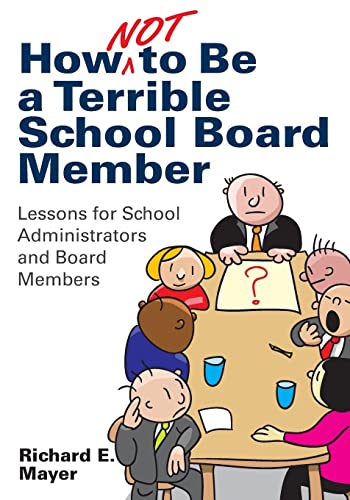

How not to be a terrible school board member lessons for school administrators and board members Richard E. Mayer.
Detalles de publicación: Thousand Oaks, Calif. Corwin c2011.Descripción: xviii, 137 p. 26 cmISBN:- 9781412997935 (pbk.)
- 379.1/531 23
- LB2831 .M39 2011
- EDU032000
| Imagen de cubierta | Tipo de ítem | Biblioteca actual | Biblioteca de origen | Colección | Ubicación en estantería | Signatura topográfica | Materiales especificados | Info Vol | URL | Copia número | Estado | Notas | Fecha de vencimiento | Código de barras | Reserva de ítems | Prioridad de la cola de reserva de ejemplar | Reservas para cursos | |
|---|---|---|---|---|---|---|---|---|---|---|---|---|---|---|---|---|---|---|
| Libro | Biblioteca de Mayagüez Colección General mb | LB2831 .M39 2011 (Navegar estantería(Abre debajo)) | Disponible | 50000003237871 |
Descripciones mejoradas de Syndetics:
Build a successful board by knowing where the land mines are
Veteran school board member, Richard E. Mayer, takes a humorous but substantive approach to the serious relationship between school administrators and board members. While the overwhelming majority of school board members have good motives, even people who mean well can make bad moves. This book shows how to prevent good intentions from creating bad outcomes. Each chapter presents a negative school board scenario, offers alternatives, and provides win-win solutions. Key features include
28 brief case studies Lessons learned for board members Lessons learned for administratorsIn addition to highlighting typical traps, the case studies light the path to positive collaboration and shared decision making between superintendents and school boards. Whether you are a school board member or an administrator who is trying to figure out what goes on in school board members′ heads, How Not to Be a Terrible School Board Member provides clear direction in a realistic and memorable way.
eigm 08/2013
"How to Not Be a Terrible School Board Member is a practical guide both for how to become an effective school board member, and for how school administrators can improve their board relations. The intended audience is prospective, present, and past school board members and school administrators.While the overwhelming majority of school board members have good motives, even people with good motives can make bad moves, even terrible moves. This book is dedicated to preventing situations in which good intentions can lead to bad outcomes. The book takes a case based approach that focuses on terrible school board member moves as the fastest and most memorable way to help one learn how to be an effective school board member ,and to see, by contrast, how a successful school board member operates. Case-based learning is used in many professional programs such as business, law, medicine, and even teacher education, and research on learning by example has a strong and growing empirical research base"--Provided by publisher.
Machine generated contents note: PrefaceAbout the AuthorAcknowledgmentsI. Terrible District teamwork1. Humiliate a District Employee in Public2. Negotiate in Public3. Attack the Administration in Print4. Micromanage the Superintendent5. Never Question the Administration6. Solicit Complaints from Teachers and Staff7. Ask for Special TreatmentII. Terrible Board Teamwork8. Disrespect a Fellow Board Member9. Speak for the Board10. Build Coalitions11. Abstain on Tough Votes12. Be Decisive, Don't Compromise13. Come Unprepared to a Board Meeting14. Do Too Much HomeworkIII. Terrible Public Relations15. Represent Your Supporters16. Minimize Public Input17. Run Your Own District Survey18. Argue with a Hostile Speaker19. Confide in a Reporter20. Garner Public Support21. Sign a PetitionIV. Terrible Personal Style22. Ignore Minor Conflicts of Interest23. Take Political Stands24. Use the District's Credit Card25. Remember Your Political Party26. Do a Favor27. Accept Gifts28. Radiate Negative EnergyEpilogueIndex.
Includes bibliographical references.
Tabla de contenidos provista por Syndetics
- Preface(p. vii)
- Acknowledgments(p. xiii)
- About Me(p. xvii)
- Section I Terrible District Teamwork(p. 1)
- Terrible Habit #1 Humiliate a District Employee in Public(p. 3)
- Terrible Habit #2 Negotiate for the District(p. 9)
- Terrible Habit #3 Attack the Administration in Print(p. 13)
- Terrible Habit #4 Micromanage the Superintendent(p. 19)
- Terrible Habit #5 Never Question the Administration(p. 25)
- Terrible Habit #6 Solicit Complaints From Teachers and Staff(p. 29)
- Terrible Habit #7 Ask for Special Treatment(p. 35)
- Section II Terrible Board Teamwork(p. 39)
- Terrible Habit #8 Disrespect a Fellow Board Member(p. 41)
- Terrible Habit #9 Speak for the Board(p. 47)
- Terrible Habit #10 Build Coalitions(p. 51)
- Terrible Habit #11 Abstain on Tough Votes(p. 55)
- Terrible Habit #12 Be Decisive; Don't Compromise(p. 59)
- Terrible Habit #13 Come Unprepared to Board Meetings(p. 63)
- Terrible Habit #14 Do Too Much Homework(p. 67)
- Section III Terrible Public Relations(p. 73)
- Terrible Habit #15 Represent Your Supporters(p. 75)
- Terrible Habit #16 Minimize Public Input(p. 79)
- Terrible Habit #17 Run Your Own District Survey(p. 83)
- Terrible Habit #18 Argue With a Hostile Speaker(p. 87)
- Terrible Habit #19 Confide in a Reporter(p. 91)
- Terrible Habit #20 Garner Public Support(p. 95)
- Terrible Habit #21 Sign a Petition(p. 99)
- Section IV Terrible Personal Style(p. 103)
- Terrible Habit #22 Ignore Minor Conflicts of Interest(p. 105)
- Terrible Habit #23 Take Political Stands(p. 109)
- Terrible Habit #24 Use the District's Credit Card(p. 113)
- Terrible Habit #25 Remember Your Political Party(p. 117)
- Terrible Habit #26 Do a Favor(p. 121)
- Terrible Habit #27 Accept Gifts(p. 125)
- Terrible Habit #28 Radiate Negative Energy(p. 129)
- Epilogue(p. 133)