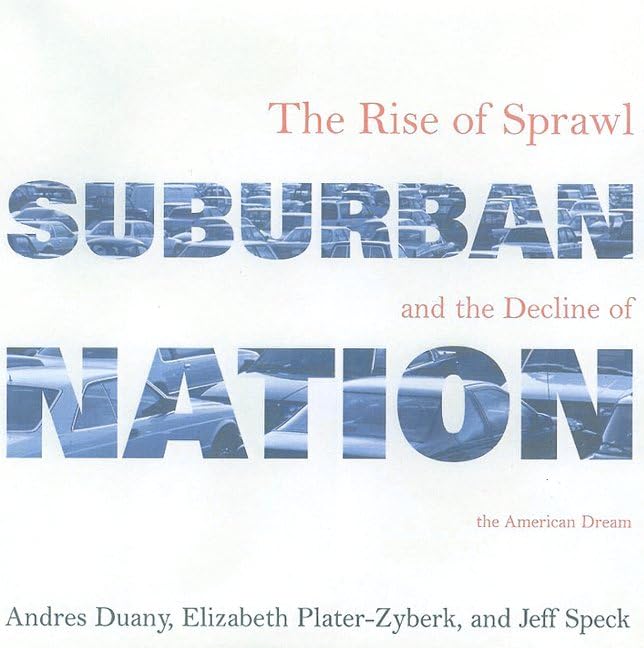

Suburban nation the rise of sprawl and the decline of the American Dream Andres Duany, Elizabeth Plater-Zyberk, and Jeff Speck. txt
Idioma: Español New York North Point Press 2000Edición: 1st edDescripción: xiv, [293 p. ill. 21 cmTipo de contenido:- text
- unmediaded
- volume
- 9780865476066 (alk. paper)
- 307.76/0973 21
- HT384.U5 D83 2000 c.2
| Imagen de cubierta | Tipo de ítem | Biblioteca actual | Biblioteca de origen | Colección | Ubicación en estantería | Signatura topográfica | Materiales especificados | Info Vol | URL | Copia número | Estado | Notas | Fecha de vencimiento | Código de barras | Reserva de ítems | Prioridad de la cola de reserva de ejemplar | Reservas para cursos | |
|---|---|---|---|---|---|---|---|---|---|---|---|---|---|---|---|---|---|---|
| Libro | CARIBET Biblioteca Arquitectura Colección General CARIBET | General HT384.U5 D83 2000 c.2 (Navegar estantería(Abre debajo)) | 2 | Disponible | 91000000000596 |
Navegando CARIBET Biblioteca Arquitectura estanterías,Ubicación en estantería: Colección General CARIBET Cerrar el navegador de estanterías (Oculta el navegador de estanterías)


|
No hay imagen de cubierta disponible No hay imagen de cubierta disponible |


|


|


|


|
|
||
| General F203.5.M2 M35 2008 The National Mall | General NA680 W75 2008 El futuro de la arquitectura | General BD450 D3494 2009 A new philosophy of society | General HT384.U5 D83 2000 c.2 Suburban nation | General HB2065 F37 2006 FARMAX | General NA687 V47 2008 Verb crisis | General NA687 V47 2008 Verb crisis |
Descripciones mejoradas de Syndetics:
A manifesto by America's most controversial and celebrated town planners, proposing an alternative model for community design.
There is a growing movement in North America to put an end to suburban sprawl and to replace the automobile-based settlement patterns of the past fifty years with a return to more traditional planning principles. This movement stems not only from the realization that sprawl is ecologically and economically unsustainable but also from a growing awareness of sprawl's many victims: children, utterly dependent on parental transportation if they wish to escape the cul-de-sac; the elderly, warehoused in institutions once they lose their driver's licenses; the middle class, stuck in traffic for two or more hours each day.
Founders of the Congress for the New Urbanism, Andres Duany and Elizabeth Plater-Zyberk are at the forefront of this movement, and in Suburban Nation they assess sprawl's costs to society, be they ecological, economic, aesthetic, or social. It is a lively, thorough, critical lament, and an entertaining lesson on the distinctions between postwar suburbia-characterized by housing clusters, strip shopping centers, office parks, and parking lots-and the traditional neighborhoods that were built as a matter of course until mid-century. It is an indictment of the entire development community, including governments, for the fact that America no longer builds towns. Most important, though, it is that rare book that also offers solutions.
Index.
Bibliography.
Machine generated contents note: Introduction ix -- What Is Sprawl, and Why? 3 -- z The Devil Is in the Details 21 -- 3 The House That Sprawl Built 39 -- 4 The Physical Creation of Society 59 -- 5 The American Transportation Mess 85 -- 6 Sprawl and the Developer 99 -- 7 TheVictims of Sprawl 115 -- 8 The Cityand the Region i35 -- 9 'he Inner City 153 -- lo Howto Make a Town 83 -- ii What Is to Be Done 215 -- Appendix A: The Traditional Neighborhood -- Development Checklist 245 -- Appendix B: The Congress for the New Urbanism 253 -- Acknowledgments 263 -- Notes 267 -- Bibliography 269 -- Sources of Illustrations 277 -- Index 279.
Extracto provisto por Syndetics
Reseñas proporcionadas por Syndetics
Publishers Weekly Review
Like "an architectural version of Invasion of the Body Snatchers, our main streets and neighborhoods have been replaced by alien substitutes, similar but not the same," state Duany, Plater-Zyberk and Speck in this bold and damning critique. The authors, who lead a firm that has designed more than 200 new neighborhoods and community revitalization plans, challenge nearly half a century of widely accepted planning and building practices that have produced sprawling subdivisions, shopping centers and office parks connected by new highways. These practices, they contend, have not only destroyed the traditional concept of the neighborhood, but eroded such vital social values as equality, citizenship and personal safety. Further, they charge that current suburban developments are not only economically and environmentally "unsustainable," but "not functional" because they isolate and place undue burdens on at-home mothers, children, teens and the elderly. Adapting the precepts that famed urbanologist Jane Jacobs used to critique unhealthy city planning, Duany, Plater-Zyberk and Speck call for a revolution in suburban design that emphasizes neighborhoods in which homes, schools, commercial and municipal buildings would be integrated in pedestrian-accessible, safe and friendly settings. While occasionally presenting unsupported claims--such as that gated communities (of which there are now more than 20,000 in the U.S.) deprive children of gaining "a sense of empathy" in a diverse society--their visionary book holds out hope that we can create "places that are as valuable as the nature they displaced." (Mar.) (c) Copyright PWxyz, LLC. All rights reservedCHOICE Review
This book is a landmark in urban planning, and its first endorser does not exaggerate by ranking it with two modern classics: Jane Jacobs's The Death and Life of Great American Cities (1961) and Robert Venturi, Denise Scott Brown, and Steven Izenour's Learning from Las Vegas (CH, Mar'73; rev. ed., 1977). Duany and Plater-Zyberk are both the founders and leaders of the new urbanism movement and the designers of such cutting-edge communities as Florida's Seaside and Maryland's Kentlands. This book is the most comprehensive attempt to date to put their philosophy and methodology between the covers of a single volume. Profusely illustrated, it is presented as a critique of existing suburban design with a blueprint for an urban future in which the automobile-generated settlement patterns of the past 80 years are transformed into a mosaic of communities based on traditional planning principles. Very handsomely produced, the book is well referenced and indexed. Highly recommended for all planning collections. Public, academic, and professional libraries. ; University of MiamiBooklist Review
Progressive town planners Duany and coauthors share the fruits of their extensive experiences designing new neighborhoods and community revitalization projects in this cogent and illuminating investigation into the nature of sprawl and the failure of suburbs. They mince no words in condemning the soulless, "repetitive and forgettable" landscape of subdivisions, shopping malls, office parks, and congested roadways that ring our cities, and articulate with great precision exactly how and why such places are detrimental to social health. They contrast traditional neighborhoods--"mixed-used, pedestrian-friendly communities" --where people of diverse backgrounds and economic levels interact, with suburbia, where housing, work, shopping, and public facilities are segregated from one another, so people are forced to drive everywhere. Using numerous examples, the authors explain how and why sprawl has occurred, discuss why the quality of balkanized suburban life is so deplorably low, and offer suggestions for a more viable approach to planning in the immediate future. Place matters, and we can do so much better. --Donna SeamanNotas de autor provistas por Syndetics
Andres Duany, along with Elizabeth Plater-Zyberk, leads a firm that has designed more than 200 new neighborhoods & community revitalization plans, most notably, Seaside, Florida.(Bowker Author Biography)