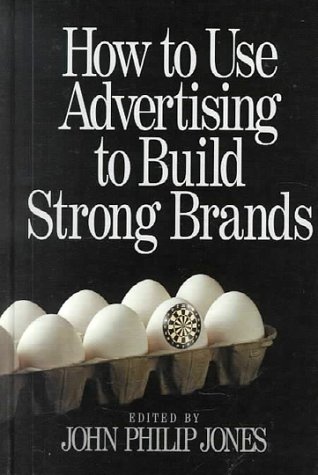

How to use advertising to build strong brands edited by John Philip Jones.
Detalles de publicación: Thousand Oaks, Calif. Sage Publications c1999.Descripción: 394 p. ill. 24 cmISBN:- 0761912428 (cloth : acid-free paper)
- 0761912436 (pbk. : acid-free paper)
- 659.1 H8471 21
- HF6161.B4 H69 1999
| Imagen de cubierta | Tipo de ítem | Biblioteca actual | Biblioteca de origen | Colección | Ubicación en estantería | Signatura topográfica | Materiales especificados | Info Vol | URL | Copia número | Estado | Notas | Fecha de vencimiento | Código de barras | Reserva de ítems | Prioridad de la cola de reserva de ejemplar | Reservas para cursos | |
|---|---|---|---|---|---|---|---|---|---|---|---|---|---|---|---|---|---|---|
| Libro | Biblioteca Encarnación Valdés Colección General bev | 659.1 H8471 (Navegar estantería(Abre debajo)) | Disponible | 80000002121823 |
Descripciones mejoradas de Syndetics:
John Philip Jones belongs to an elite group of intellectual adventurers searching for true meaning in an increasingly complex communication industry. Anyone involved in understanding how brands are born and nurtured should follow his work with keen interest. --Andy Fenning, Executive Vice President, Director of Strategic Development,J. Walter Thompson, New York Advertising′s greatest single contribution to business is its ability to build brands, and this comprehensive volume covers all aspects of this critical marketing process. Edited by John Philip Jones, best-selling author of What′s in a Name? Advertising and the Concepts of Brands and When Ads Work: New Proof That Advertising Triggers Sales, this handbook offers an authoritative examination of successful brand-building techniques. An authoritative cast of chapter authors, representing a global mix of academic and professional backgrounds, that examine all aspects of brand management, brand equity, new and mature brands, and "brand magic." The brand concept is also extended in unexpected new areas such as political marketing, green marketing, and the arts. This handbook is part of a series edited by John Philip Jones that stands as a complete library of essential advertising theory and practice. Other volumes in this series include How Advertising Works: The Role of Research and The Advertising Business.
Includes bibliographical references and index.
Tabla de contenidos provista por Syndetics
- Introduction
- Part 1 Brands - Added Values and Brand Equity
- Brands and Added Values
- Brand Ideas and Their Importance
- 'When Do You Tell the Agency What the Brand Means?'
- Brands and Their Symbols
- Gestalt
- How Brands Are Influenced by Multiple Communications
- Brands and Advertising
- Brand Equity
- Do We Really Need It?
- Putting a Price on Brand Equity
- Parity
- Consumer Perceptions That All Brands Are Alike
- Brand Management
- Part 2 New and Growing Brands
- A Marketing Template for New Brands
- The Initial Growth Cycle for a New Brand
- New Brands
- Success Rate and Criteria for Success
- Exploring Brand Magic
- How Advertising Builds Brand Equity
- Part 3 Mature Brands
- Life Cycle Theory
- The Defensive Role of Advertising
- Are All Consumers Equal? Segmentation: The Statute of Limitations
- Relationship Marketing
- A Picture of a Brand
- Campbell's Soup
- The Case for Collectible Brands
- Part 4 Brand Concepts in Unexpected Fields
- Political Advertising
- How It Works and Who Benefits
- Cable Television Stations as Brands
- Green Brands and Green Marketing
- How Brands Should Be Presented to Elderly Consumers
- Arts Organizations as Brands
- The Role of Effective Direct Response Communications
- Part 5 Developing an Understanding of Brands
- Education for Advertising in American Universities
- Education for the Creative Process
Reseñas proporcionadas por Syndetics
CHOICE Review
Jones brings together a distinguished group of contributing authors for this volume of readings on the role of advertising in building brand equity. This is Jones's third of five works in a series devoted to the theory and practice of advertising, the first two being How Advertising Works (CH, Dec'98) and The Advertising Business: Operations, Creativity, Media Planning, Integrated Communications (CH, Jul'99). Contributors, academicians (11) and practitioners (10), are specialists in their field, and several are on the leading edge of professional knowledge and expertise. The volume's 28 chapters are divided into five sections that examine all aspects of brand management, brand equity, and new and mature brands. Furthermore, the volume extends into new areas such as green marketing, political marketing, and the arts. In content, the volume is similar to Brand Equity and Advertising, edited by David Aaker and Alexander Biel (1993), Managing Brand Equity, also by Aaker (1992), and David Arnold's The Handbook of Brand Management (1992). This comprehensive work is recommended for upper-division undergraduate and graduate students; faculty; and practitioners. S. W. Husted; Lynchburg CollegeNotas de autor provistas por Syndetics
John Philip Jones entered academe in 1981 after a 25-year career in advertising with J. Walter Thompson in Europe, is a tenured Professor in the Newhouse School at Syracuse University, and was Chairman of the Advertising Department for seven years. He has published ten books on advertising and numerous journal articles, and his work has been translated into German, Spanish, Japanese, Korean, Chinese, Portuguese, Turkish and Arabic. In 1991, John Philip Jones was named by the American Advertising Federation as the Distinguished Advertising Educator of the Year. In the same year he became a member of the Council of Judges of the Advertising Hall of Fame. In 1994, he was elected a member of the National Advertising Review Board. In 1996, he received a major award from Cowles Business Media and the American Association of Advertising Agencies for leadership in the media field. There were two prize winners, the other being NBC Sports. He received the Telmar Award in 1997, for extending the concept of Short-Term Advertising Strength (STAS) from television to print media. In 2001, he received the Syracuse University Chancellor's Citation for Exceptional Academic Achievement.