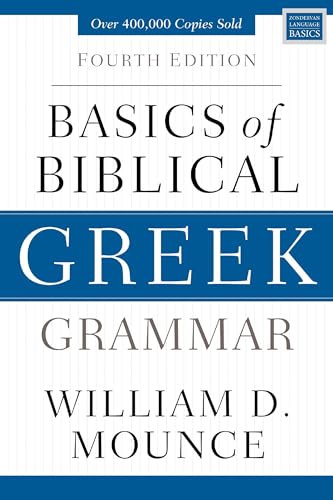

Basics of biblical Greek grammar / William D. Mounce.
Idioma: Inglés, Griego antiguo (hasta 1453) Series Zondervan language basicsEditor: Grand Rapids, Michigan : Zondervan, [2019]Edición: Fourth editionDescripción: xxvi, 509 pages : illustrations ; 24 cmTipo de contenido:- text
- unmediated
- volume
- 9780310537434
- 487/.4 23/eng/20220928
- PA 817 .M63 2019
| Imagen de cubierta | Tipo de ítem | Biblioteca actual | Biblioteca de origen | Colección | Ubicación en estantería | Signatura topográfica | Materiales especificados | Info Vol | URL | Copia número | Estado | Notas | Fecha de vencimiento | Código de barras | Reserva de ítems | Prioridad de la cola de reserva de ejemplar | Reservas para cursos | |
|---|---|---|---|---|---|---|---|---|---|---|---|---|---|---|---|---|---|---|
| Libro BET REF | Biblioteca Escuela de Teología Colección Referencia Escuela de Teología | PA 817 .M63 2019 (Navegar estantería(Abre debajo)) | Disponible | 4200000001523 |
Descripciones mejoradas de Syndetics:
Clear. Understandable. Carefully organized. Basics of Biblical Greek Grammar by William D. Mounce is the standard textbook for colleges and seminaries. Since its initial publication in 1993 its integrated approach has helped more than 250,000 students learn New Testament Greek.
The fourth edition of Basics of Biblical Greek Grammar has been updated throughout based on continuing feedback from professors, students, self-learners, and homeschoolers, making it even more effective for today's students. Other improvements have been made based on recent developments in scholarship.
The key to the effectiveness of Basics of Biblical Greek Grammar in helping students learn is in how it introduces them to the language. Students learn about the features of the Greek language in a logical order, with each lesson building upon the one before it. Unnecessary obstacles that discourage students and hinder progress are removed, such as rote memorization of endless verbal paradigms. Instead, students receive encouragement along the way to assure them they are making the necessary progress. Detailed discussions are also included at key junctures to help students grasp important concepts.
By the time students have worked their way through Basics of Biblical Greek Grammar they will have learned:
The Greek Alphabet Vocabulary for words occurring 50 times or more in the Greek New Testament The Greek noun system The Greek verbal system, including indicative and nonindicative verbs, and participlesA robust suite of learning aids is available for purchase to be used alongside the textbook to help students excel in their studies. These include a workbook, video lectures for each chapter featuring the author, flashcards keyed to vocabulary in each chapter, a laminated quick study sheet with key concepts, and audio of the vocabulary for each chapter to aid in acquisition.
Includes bibliographical references and index.
Clear, understandable, and carefully organized, Basis of Biblical Greek Grammar, now in its fourth edition, is the standard textbook for colleges and seminaries. Since its initial publication, its integrated approach has helped more than 400, 000 students learn the Greek of the New Testament. The Key to the effectiveness of Basics of Biblical Greek Grammar in helping students learn is in the specific way it introduces them to the language. Students learn about the features of the Greek language in a logical order, with each lesson building on the one before it. Unnecessary obstacles that discourage students and hinder progress are removed, such as rote memorization of endless paradigms. Instead, students receive encouragement along the way to assure them they are making the necessary progress. Moreover, detailed discussions are included at key junctures to help students grasp important concepts. A robust suite of learning aids is available for purchase to be used alongside the textbook to help students excel in their studies. These include a workbook, video lectures, flashcards, a laminated study sheet, audio of the vocabulary terms, and a compact guide.
English and Greek.