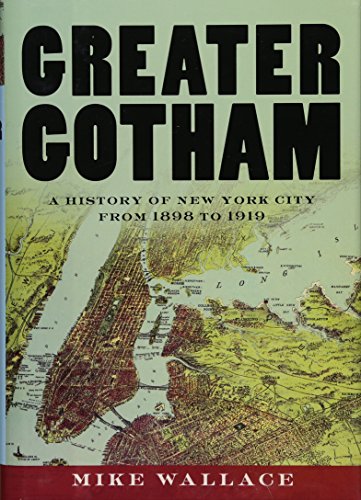

Greater Gotham : a history of New York City from 1898 to 1919 / Mike Wallace. txt
Series Gotham series. Greater Gotham: a history of New York City from 1898 to 1919 ; 2Editor: New York, NY : Oxford University Press, 2017Descripción: xi, 1182 pages : illustrations ; 26 cmTipo de contenido:- text
- unmediated
- volume
- 9780195116359
- 974.7/104 23
- F128.5 W227 2018
| Imagen de cubierta | Tipo de ítem | Biblioteca actual | Biblioteca de origen | Colección | Ubicación en estantería | Signatura topográfica | Materiales especificados | Info Vol | URL | Copia número | Estado | Notas | Fecha de vencimiento | Código de barras | Reserva de ítems | Prioridad de la cola de reserva de ejemplar | Reservas para cursos | |
|---|---|---|---|---|---|---|---|---|---|---|---|---|---|---|---|---|---|---|
| Libro | CARIBET Biblioteca Arquitectura Colección General CARIBET | General F128.5 W227 2018 (Navegar estantería(Abre debajo)) | 1 | Disponible | 91000000055004 |
Descripciones mejoradas de Syndetics:
In this utterly immersive volume, Mike Wallace captures the swings of prosperity and downturn, from the 1898 skyscraper-driven boom to the Bankers' Panic of 1907, the labor upheaval, and violent repression during and after the First World War. Here is New York on a whole new scale, moving from national to global prominence - an urban dynamo driven by restless ambition, boundless energy, immigrant dreams, and Wall Street greed.Within the first two decades of the twentieth century, a newly consolidated New York grew exponentially. The city exploded into the air, with skyscrapers jostling for prominence, and dove deep into the bedrock where massive underground networks of subways, water pipes, and electrical conduits sprawled beneath the city to serve a surging population of New Yorkers from all walks of life. New York was transformed in these two decades as the world's second-largest city and now its financial capital, thriving and sustained by the city's seemingly unlimited potential. Wallace's new book matches its predecessor in pure page-turning appeal and takes America's greatest city to new heights.
Include index.
Includes bibliographical references (pages 1073-1118)
"In Greater Gotham Mike Wallace, co-author of GOTHAM, picks up the story of New York at the critical juncture of 1898 and carries it forward during the period when it became not just the country's greatest urban center but a megapolis on an international scale, and with global reach. Between consolidation and the end of World War One, New York was transformed and transforming, mirroring the juggernauting dynamism of the country at large--and largely fueling it. The names of two its streets encapsulate the degree of the city's preeminence: Wall Street and Broadway. Greater Gotham reveals the workings of the city's consolidation; the emerging hegemony of its financial markets, which effectively reconstructed U.S. capitalism; the influx of migrants from other continents and from the American South; the development of its massive infrastructure--subways and waterways and electrical grid; and New York's growing dominance over the arts, media, and entertainment. It captures and illuminates the swings of prosperity and downturn, from the 1898 skyscraper-driven boom, to the Bankers' Panic of 1907, to the labor upheavals and repressions during and after the World War One. By 1920, New York was the second-largest city in the world and arguably its new capital"--Provided by publisher.
Tabla de contenidos provista por Syndetics
- Introduction(p. 1)
- Vantage Points(p. 3)
- Part 1 Consolidations and Contradictions
- 1 Mergers(p. 15)
- 2 Acquisitions(p. 27)
- 3 Consolidation(p. 49)
- 4 Wall Street(p. 61)
- 5 Critics and Crisis(p. 77)
- Muckrakers(p. 77)
- Teddy(p. 84)
- Panic of 1907(p. 89)
- Other People's Money(p. 101)
- 6 Who Rules New York?(p. 105)
- Bosses and Businessmen(p. 105)
- Radicals and Regulators(p. 121)
- Experts(p. 131)
- Part 2 Construction and Connection
- 7 Sky Boom(p. 143)
- Skyline(p. 143)
- Why Skies?(p. 148)
- Builders, Engineers, Financiers(p. 154)
- Too Small?(p. 159)
- City Beauticians(p. 163)
- Too Tall!(p. 170)
- Zoning(p. 172)
- 8 Arteries(p. 179)
- Trains and Tunnels(p. 179)
- Boats and Docks(p. 189)
- Immigration Island(p. 192)
- Moving Freight(p. 196)
- Water(p. 203)
- Power(p. 205)
- Food In(p. 211)
- Garbage Out(p. 215)
- 9 Ligaments(p. 221)
- Bridges(p. 221)
- Els, Cables, Trolleys(p. 225)
- Planning the Subway(p. 227)
- Building the System(p. 229)
- Expanding the System(p. 235)
- The Automobiling Class(p. 240)
- 10 Housing(p. 251)
- Old Law, New Law(p. 251)
- Model Homes(p. 258)
- A Municipal Role?(p. 260)
- Fighting Congestion(p. 261)
- Working-Class Neighborhoods: Manhattan, Brooklyn, Queens(p. 267)
- The Bronx: Instant City(p. 271)
- Housing the Middle Class: Brooklyn, Queens(p. 283)
- Apartment Living in Manhattan(p. 288)
- Housing Styles of the Rich and Famous(p. 293)
- Summer Homes(p. 298)
- 11 Industrial and Commercial City(p. 305)
- Factory Town(p. 305)
- Touring the Industrial City(p. 307)
- The City of Commerce(p. 322)
- Department Stores(p. 328)
- Commerce v. Industry(p. 335)
- Part 3 Cultures
- 12 Acropoli(p. 341)
- Consolidating Culture(p. 341)
- Art by the Cartload(p. 343)
- Fossil Philanthropy(p. 349)
- The Bronx Zoo(p. 354)
- Wielding the Past(p. 359)
- Universities(p. 368)
- Libraries(p. 376)
- Opera(p. 382)
- Symphony(p. 389)
- The New Theatre(p. 390)
- 13 Show Biz(p. 393)
- Times Square(p. 393)
- Broadway(p. 397)
- Vaudeville(p. 403)
- Of Rants and Actors(p. 406)
- Tin Pan Alley(p. 408)
- Movies(p. 414)
- Nightlife(p. 426)
- Coney Island(p. 432)
- 14 Popular Cultures(p. 439)
- Staging Ethnicity(p. 440)
- Ragtime(p. 451)
- Chorus Line(p. 462)
- Everybody's Doin' It(p. 469)
- 15 Seeing New York(p. 481)
- Part 4 Confrontations
- 16 Progressives(p. 505)
- The Age of Reform(p. 505)
- Settlements and Social Gospelers(p. 510)
- Child Labor(p. 525)
- Women's Work(p. 530)
- Poverty Wars(p. 535)
- Health(p. 544)
- Schools(p. 560)
- A Bully Moose(p. 576)
- 17 Repressives(p. 583)
- Gangs of New York(p. 583)
- Cops and Robbers(p. 596)
- Vice and Vigilantes(p. 603)
- Prostitution(p. 604)
- Gambling(p. 615)
- Drink(p. 631)
- Drugs(p. 638)
- 18 Union Town(p. 649)
- Labor Day(p. 649)
- Builders and Printers(p. 652)
- Bang the Bell, Jack, I'm on Board(p. 658)
- Open-Shop Warriors(p. 661)
- Let's Make a Deal(p. 662)
- Hardball(p. 664)
- Italians(p. 666)
- Jews(p. 673)
- 19 Radicals(p. 681)
- Jewish Radicals(p. 681)
- Italian Sovversivi(p. 695)
- Uprising in the Needle Trades(p. 705)
- Triangle and Tammany(p. 719)
- Wobblies and Socialists(p. 731)
- The Army of the Unemployed(p. 745)
- 20 Bending Gender(p. 751)
- Gorky(p. 751)
- New Women(p. 753)
- Backlash(p. 758)
- It Takes a Village(p. 762)
- Counterculture(p. 767)
- Feminists(p. 775)
- Fairies(p. 783)
- Birth Control(p. 788)
- Suffragists and Suffragettes(p. 791)
- 21 Black Metropolis(p. 805)
- Riot(p. 805)
- Hegira(p. 807)
- Caribbean Connection(p. 808)
- Jim Crow Housing(p. 811)
- Jim Crow Jobs(p. 815)
- Jim Crow Culture(p. 823)
- Black Progressives(p. 828)
- Civil Rights(p. 834)
- Harlem(p. 846)
- New Negroes(p. 855)
- 22 Insurgent Art(p. 863)
- Art Rebels(p. 863)
- Ash Can Realists(p. 864)
- Modernists' Metropolis(p. 872)
- Armory Show(p. 880)
- Dreiser(p. 885)
- Wharton(p. 889)
- Dreams and Nightmares of Greater New York(p. 895)
- Part 5 Wars
- 23 Over There?(p. 909)
- Panic and Paralysis(p. 909)
- Recession(p. 915)
- A Prosperous Neutrality(p. 919)
- Cat's Away(p. 921)
- Be Prepared!(p. 924)
- Peace Now!(p. 936)
- Hyphens(p. 943)
- Be American!(p. 950)
- In Uno Plures(p. 958)
- And the War Came(p. 967)
- 24 Over Here(p. 977)
- Johnny Get Your Gun(p. 977)
- Resistance and Repression(p. 985)
- Electoral Showdowns(p. 993)
- Into the Trenches(p. 1000)
- The Germs of August(p. 1008)
- Potomac and the Hudson(p. 1011)
- New York 1919(p. 1021)
- New World Order(p. 1039)
- Endings and Beginnings(p. 1048)
- Acknowledgments(p. 1053)
- References(p. 1059)
- Bibliography(p. 1073)
- Index of Names(p. 1119)
- Index of Subjects(p. 1135)