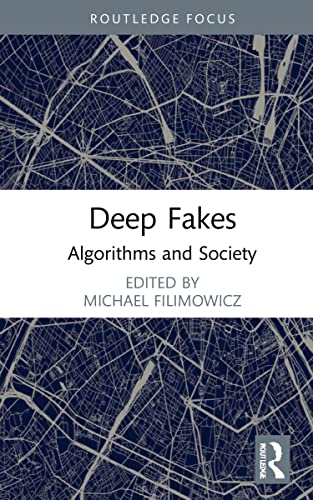

Deep fakes / edited by Michael Filimowicz.
Idioma: Inglés Series Algorithms and societyEditor: Milton Park, Abingdon, Oxon ; New York, NY : Routledge, 2022Descripción: xi, 77 pagesTipo de contenido:- text
- unmediated
- volume
- 9781032002606
- 9781032002620
- Deepfakes
- 302.23/1 23/eng/20220110
- HM1206 .D44 2022
| Imagen de cubierta | Tipo de ítem | Biblioteca actual | Biblioteca de origen | Colección | Ubicación en estantería | Signatura topográfica | Materiales especificados | Info Vol | URL | Copia número | Estado | Notas | Fecha de vencimiento | Código de barras | Reserva de ítems | Prioridad de la cola de reserva de ejemplar | Reservas para cursos | |
|---|---|---|---|---|---|---|---|---|---|---|---|---|---|---|---|---|---|---|
| Libro | Biblioteca Encarnación Valdés Colección General bev | 302.231 D3118 (Navegar estantería(Abre debajo)) | Disponible | 80000002651027 |
Descripciones mejoradas de Syndetics:
Deep Fakes: Algorithms and Societyfocuses on the use of artificial intelligence technologies to produce fictitious photorealistic audiovisual clips that are indistinguishable from traditional video media.
For over a century, the indexical relationship of the photographic image, and its related media of film and video, to the scene of capture has served as a basis for truth claims. Historically, the iconicity of these images has featured a causal traceback to actual light rays in a particular time and space, which were fixed by chemical reactions or digital sensors to the resultant image. Today, photorealistic audiovisual media can be generated from deep learning networks that sever any connection to an actual event. Should society instantiate new regimes to manage this new challenge to our sense of reality and the traditional evidential capacities of the 'mechanical image'? How do these images generate information disorder while also providing the basis for legitimate tools used in entertainment and creative industries?
Scholars and students from many backgrounds, as well as policymakers, journalists and the general reading public, will find a multidisciplinary approach to questions posed by deep fake research from Communication, International Studies, Writing and Rhetoric.
Includes bibliographical references and index.
Deep fakes / Sean Maher -- Deepfakes and disinformation in Asia / Dymples Leong Suying -- On the depth of fakeness / Eunsong Kim.
"Deep Fakes: Algorithms and Society focuses on the use of artificial intelligence technologies to produce fictitious photorealistic audiovisual clips that are indistinguishable from traditional video media. For over a century, the indexical relationship of the photographic image, and its related media of film and video, to the scene of capture has served as a basis for truth claims. Historically, the iconicity of these images has featured a causal traceback to actual light rays in a particular time and space, which were fixed by chemical reactions or digital sensors to the resultant image. Today, photorealistic audiovisual media can be generated from deep learning networks which sever any connection to an actual event. Should society instantiate new regimes to manage this new challenge to our sense of reality and the traditional evidential capacities of the 'mechanical image?' How do these images generate information disorder while also providing the basis for legitimate tools used in entertainment and creative industries? Scholars and students from many backgrounds, as well as policy makers, journalists and the general reading public will find a multidisciplinary approach to questions of privacy and encryption encompassing research from Communication, International Studies, Writing and Rhetoric"-- Provided by publisher.
Notas de autor provistas por Syndetics
Michael Filimowiczis Senior Lecturer in the School of Interactive Arts and Technology (SIAT) at Simon Fraser University. He has a background in computer-mediated communications, audiovisual production, new media art and creative writing. His research develops new multimodal display technologies and forms, exploring novel form factors across different application contexts including gaming, immersive exhibitions and simulations.