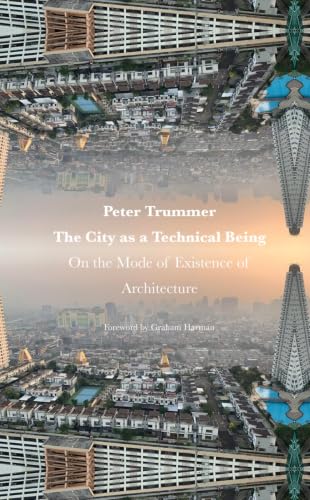

The city as a technical being : on the mode of existence of architecture. / by Peter Trummer. txt
Editor: Novato, Calif. : ORO editions, 2023Descripción: 377 p. : ill. ; 24 cmTipo de contenido:- text
- still image
- unmediated
- volume
- 9781957183558
- 1957183551
- NA2500 T7325 2023
| Imagen de cubierta | Tipo de ítem | Biblioteca actual | Biblioteca de origen | Colección | Ubicación en estantería | Signatura topográfica | Materiales especificados | Info Vol | URL | Copia número | Estado | Notas | Fecha de vencimiento | Código de barras | Reserva de ítems | Prioridad de la cola de reserva de ejemplar | Reservas para cursos | |
|---|---|---|---|---|---|---|---|---|---|---|---|---|---|---|---|---|---|---|
| Libro Col. General CARIBET | CARIBET Biblioteca Arquitectura Colección General CARIBET | General NA2500 T7325 2023 (Navegar estantería(Abre debajo)) | 1 | Disponible | 91000000074534 |
Descripciones mejoradas de Syndetics:
The city is the largest human artifact. It is made by us, yet simultaneously it makes us, as well as all other nonhuman entities.
The particular discourse to which this book on the city contributes is the discipline of architecture. It explores a simple question: How does the city effect the mode of existence of its buildings?The tradition within architectural history that identifies the city as the origin of our buildings poses a challenged to us, as architects, to theorize about the city's form and use in order to rationalize our own actions. In opposition to other disciplinary approaches to the city and its architecture, however, the book argues not for type (Rossi, Ungers) as the deepest aspect of the architecture of the city. Neither will it be the function (Venturi & Scott Brown, Koolhaas) of the city to explain its material organization, nor is matter considered (Jacobs, Banham) to be deeper than the real city.
Instead, this books argues that the mode of existence of architecture is inherent to the city itself, which originates its architecture as part of its being as a technical object.The concept of the technical being that is used to define a new ontology of the architecture of the city is taken from Gilbert Simondon's theory of mechanology. In this book I re-originate Simondon's approach into the discipline of architecture, thus presenting the city not simply as a milieu in which its buildings emerge, but as a technical object with the capacity to converge its elements and individuate new ones--that is, architecture.
FOREWORD by Graham Harman 7 --
ABSTRACT 13 --
INTRODUCTION 15 --
CHAPTER 1:
THE CITY AS THE ORIGIN OF ARCHITECTURE 35 --
1.1. The City and Mechanology 35 --
1.2. A Fourfold Diagram of the Architecture of the City 41 --
1.2.1. Matter: Deeper than Form and Use 43 --
1.2.2. Type: Deeper than Form and Zero-Use 53 --
1.2.3. Function: Deeper than Use and Zero-Form 63 --
1.2.4. Object: Deeper than Zero-Form and Zero-Use 75 --
1.3. Thesis 85 --
CHAPTER 2:
THE CITY AS A TECHNICAL BEING 103 --
2.1. The Mousgoum Village 103 --
2.2. The Kind of Technical Object the City Is 117 --
2.2.1. The City as a Megamachine 123 --
2.2.2. The City as a Proto-subjective Machine 127 --
2.2.3. The City as a Hyperobject 133 --
2.2.4. The City as a Technical Being 139 --
CHAPTER 3:
THE FIVE INDIVIDUATED CITIES 155 --
3.1. The City as an Enclosure 163 --
3.2. The City as a Grid 173 --
3.3. The City as a Line 185 --
3.4. The City as an Archipelago 201 --
3.5. The City as a Solid 225 --
CHAPTER 4:
THE ARCHITECTURE TUNED BY THE CITY 267 --
4.1. The City on a Single Roof 277 --
4.2. The Architectural Ensembles of the City: From Alberti to the Re-origination of Simondon 285 --
4.3. Concretization One: In Which a Building Converges with a Street 313 --
4.4. Concretization Two: In Which a Building Converges with a Public Square 321 -
4.5. Concretization Three: In Which a Building Converges with a Ground 329 --
CONCLUSION: CITOLOGY; OR, HOW THE CITY TUNES ARCHITECTURE 347 --
BIBLIOGRAPHY 355 --
ILLUSTRATION CREDITS 376 --
The city is the largest human artifact. It is made by us, yet simultaneously it makes us, as well as all other nonhuman entities. The particular discourse to which this book on the city contributes is the discipline of architecture. It explores a simple question: How does the city effect the mode of existence of its buildings?