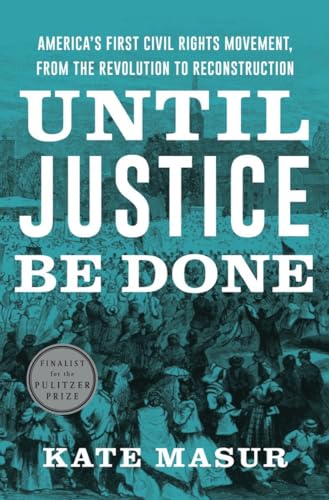

Until justice be done : America's first civil rights movement, from the revolution to reconstruction / Kate Masur.
Editor: New York, New York : W.W. Norton & Company, [2021]Descripción: xxi, 456 pages : illustrations ; 24 cmTipo de contenido:- text
- unmediated
- volume
- 9781324005933
- America's first civil rights movement, from the revolution to reconstruction
- 323.1196/07309034 23
- E185.18 .M337 2021
| Imagen de cubierta | Tipo de ítem | Biblioteca actual | Biblioteca de origen | Colección | Ubicación en estantería | Signatura topográfica | Materiales especificados | Info Vol | URL | Copia número | Estado | Notas | Fecha de vencimiento | Código de barras | Reserva de ítems | Prioridad de la cola de reserva de ejemplar | Reservas para cursos | |
|---|---|---|---|---|---|---|---|---|---|---|---|---|---|---|---|---|---|---|
| Libro | Biblioteca Encarnación Valdés Colección General bev | 323.1196 M424u (Navegar estantería(Abre debajo)) | Disponible | 80000002618026 |
Descripciones mejoradas de Syndetics:
The half-century before the Civil War was beset with conflict over equality as well as freedom. Beginning in 1803, many free states enacted laws that discouraged free African Americans from settling within their boundaries and restricted their rights to testify in court, move freely from place to place, work, vote, and attend public school. But over time, African American activists and their white allies, often facing mob violence, courageously built a movement to fight these racist laws. They countered the states' insistences that states were merely trying to maintain the domestic peace with the equal-rights promises they found in the Declaration of Independence and the Constitution. They were pastors, editors, lawyers, politicians, ship captains, and countless ordinary men and women, and they fought in the press, the courts, the state legislatures, and Congress, through petitioning, lobbying, party politics, and elections. Long stymied by hostile white majorities and unfavorable court decisions, the movement's ideals became increasingly mainstream in the 1850s, particularly among supporters of the new Republican party. When Congress began rebuilding the nation after the Civil War, Republicans installed this vision of racial equality in the 1866 Civil Rights Act and the Fourteenth Amendment. These were the landmark achievements of the first civil rights movement.
Kate Masur's magisterial history delivers this pathbreaking movement in vivid detail. Activists such as John Jones, a free Black tailor from North Carolina whose opposition to the Illinois "black laws" helped make the case for racial equality, demonstrate the indispensable role of African Americans in shaping the American ideal of equality before the law. Without enforcement, promises of legal equality were not enough. But the antebellum movement laid the foundation for a racial justice tradition that remains vital to this day.
Includes bibliographical references and index.
"On The Grounds Of Expediency And Good Policy" Free- State Antiblack Laws In The Early Republic -- "A Free Man Of Colour, And A Citizen Of This State" The Privileges And Immunities Of Citizenship In The 1820s -- "The Sacred Doctrine Of Equal Rights" Ohio Abolitionists In The 1830s -- "The Rights Of The Citizens Of Massachusetts" African American Sailors In Southern Ports In The 1830s -- "Self- Preservation Is The First Law Of Nature" State- To- State Conflict And The Limits Of Congress In The 1840s -- "That All Men Are Created Free And Equal" The Liberty Party And Repeal Of The Ohio Black Laws In The 1840s -- "Injustice And Oppression Incarnate" Illinois And A Nation Divided In The 1850s -- "Establishing One Law For The White And Colored People Alike" Republicans In Power During The Civil War, 1861- 1865 -- "To Restrain The Power Of The States" The Civil Rights Act And The Fourteenth Amendment.
"A groundbreaking history of the antebellum movement for equal rights that reshaped the institutions of freedom after the Civil War. The half century before the Civil War was beset with conflict over freedom as well as slavery: what were the arrangements of free society, especially for African Americans? Beginning in 1803, many free states enacted black codes that discouraged the settlement and restricted the basic rights of free black people. But claiming the equal-rights promises of the Declaration and the Constitution, a biracial movement arose to fight these racist state laws. Kate Masur's magisterial history delivers this pathbreaking movement in vivid detail. Its advocates battled in state legislatures, Congress, and the courts, and through petitioning, party politics and elections. They visited slave states to challenge local laws that imprisoned free blacks and sold them into slavery. Despite immovable white majorities and unfavorable court decisions, their vision became increasingly mainstream. After the Civil War, their arguments shaped the Civil Rights Act and the Fourteenth Amendment, the pillars of our second founding"-- Provided by publisher.
Tabla de contenidos provista por Syndetics
- Preface(p. xi)
- Chapter 1 "On the Grounds of Expediency and Good Policy" Free-State Antiblack Laws in the Early Republic(p. 1)
- Chapter 2 "A Free Man of Colour, and a Citizen of This State" The Privileges and immunities of Citizenship in the 1820s(p. 42)
- Chapter 3 "The Sacred Doctrine of Equal Rights" Ohio Abolitionists in the 1830s(p. 83)
- Chapter 4 "The Rights of the Citizens Of Massachusetts" African American Sailors in Southern Ports in the 1830s(p. 119)
- Chapter 5 "Self-Preservation is the First Law of Nature" State-to-State Conflict and the Limits of Congress in the 1840s(p. 152)
- Chapter 6 "That All Men are Created Free and Equal" The Liberty Party and Repeal of the Ohio Black Laws in the 1840s(p. 185)
- Chapter 7 "Injustice and Oppression Incarnate" Illinois and a Nation Divided in the 1850s(p. 225)
- Chapter 8 "Establishing One Law for the White and Colored People Alike" Republicans in Power during the Civil War, 1861-1865(p. 267)
- Chapter 9 "To Restrain the Power of the States" The Civil Rights Act and the Fourteenth Amendment(p. 303)
- Epilogue(p. 342)
- Acknowledgments(p. 359)
- Note on Historiography(p. 365)
- Notes(p. 373)
- Index(p. 435)