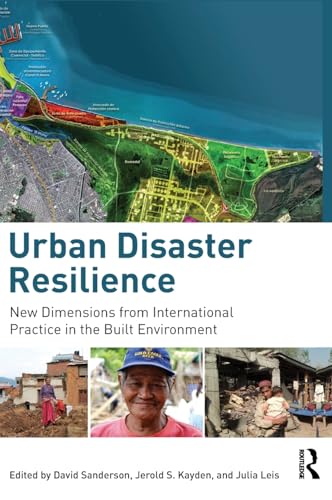

Urban Disaster Resilience : new dimensions from international practice in the built environment. / edited by David Sanderson, Jerold S. Kayden and Julia Leis. book
Editor: New York ; London : Routledge/Taylor & Francis Group, 2016Edición: First published 2016Descripción: xvii, 216 p. ill. some color ; 26 cmTipo de contenido:- text
- unmediaded
- volume
- 9781138849624
- 9781138849631
- 307.1/216 23
- HT166 U7129 2016
| Imagen de cubierta | Tipo de ítem | Biblioteca actual | Biblioteca de origen | Colección | Ubicación en estantería | Signatura topográfica | Materiales especificados | Info Vol | URL | Copia número | Estado | Notas | Fecha de vencimiento | Código de barras | Reserva de ítems | Prioridad de la cola de reserva de ejemplar | Reservas para cursos | |
|---|---|---|---|---|---|---|---|---|---|---|---|---|---|---|---|---|---|---|
| Libro | CARIBET Biblioteca Arquitectura Colección General CARIBET | General HT166 U7129 2016 (Navegar estantería(Abre debajo)) | 1 | Disponible | PRES. 2016 - 2017 | 91000000054643 |
Descripciones mejoradas de Syndetics:
Accelerating urbanization worldwide means more urban-centered disasters. Floods, earthquakes, storms and conflicts affecting densely populated areas produce significant losses in lives, livelihoods and the built environment, especially in comparison to rural areas. Poor urban dwellers, almost always the most vulnerable, too often bear the brunt. Aid agencies and urban professionals have been slowly adapting to these new conditions, but older models and practices hinder the most effective engagements.
Drawing directly from the experiences of urban disasters in the Philippines, Chile, India, Thailand, Iraq, Haiti and Nepal, among other countries, Urban Disaster Resilience brings to light new collaborations and techniques for addressing the challenges of urban disasters in the coming years. Chapters range from country-specific case studies to more synthetic frameworks in order to promote innovative thinking and practical solutions.
Edited by David Sanderson, Jerold S. Kayden and Julia Leis, this book is a crucial read for humanitarian and disaster specialists, urban planners and designers, architects, landscape architects, housing and economic development professionals, real estate developers, private business managers and students interested in the subject, whether based in non-governmental organizations, local, state or national governments, international agencies, private firms, or the academy.
Includes bibliographical references and index.
Introduction 1:
Urban disaster resilience: new dimensions from international practice in the built environment David Sanderson 3 --
Strengthening collaborations for urban disasters: a call to urban planners, designers and humanitarians Jerold S. Kayden 16 --
PART I : Urban planning, design and cities 19 --
1 Designing resilient cities and neighborhoods Georgia Butina Watson 21 --
2 Reconstructing the city: the potential gains of using urban planning and design practices in recovery and why they are so difficult to achieve Alison Killing and Camillo Boano 35 --
3 Fables from the reconstruction: lessons from Chile's recovery after the 2010 earthquake and tsunami Pablo Allard and María Ignacia Arrasate 54 --
4 Risk, resilience and the fragile city John de Boer 75 --
PART II : People, places, complex systems and regulation 87 --
5 Urban disaster resilience: learning from the 2011 Bangkok, Thailand, flood using morphology and complex adaptive systems Pamela Sitko 89 --
6 Regulatory barriers and the provision of shelter in post disaster situations: housing, land and property (HLP) issues in the recovery of Tacloban, The Philippines, after 2013 Typhoon Haiyan Victoria Stodart 105 --
7 How does reconstruction after disaster affect long term resilience? Theo Schilderman 120 --
8 Conflict and urban displacement: the impact on Kurdish place identity in Erbil, Iraq Avar Almukhtar 132 --
PART III: Urban markets, micro enterprise, insurance and technology 143 --
9 Linking response, recovery and resilience to markets in humanitarian action Joanna Friedman 145 --
10 Petty trade and the private sector in urban reconstruction: learning from Haiti's post earthquake Iron Market David Smith 157 --
11 Using disaster insurance to build urban resilience: lessons from micro enterprise in India Mihir Bhatt and Ronak Patel 172 --
12 Humanitarian hybrids : new technologies and humanitarian resilience Marianne F. Potvin 182 --
Epilogue: 197
Reflections on the practice of disaster resilience Julia Leis 199 --
Index 207 --
Figures:
1.1 Floods in the UK 24 --
1.2 Panoramic view of Cardiff 29 --
1.3 Steps of Retrofit 2050 program 31 --
1.4 A matrix of resilience / morphological levels 32 --
1.5 The resilient city as a system 32 --
2.1 Bulldozer clearing rubble from the marketplace in Campeche, Port-au-Prince 36 --
2.2 Transitional shelter in Baillergeau Port-au-Prince 39 --
2.3 Enumeration team in Simon Pele, Port-au-Prince 48 --
2.4 Construction site in downtown Port-au-Prince 49 --
3.1 Diversity of housing programs according to the type of damage and approach 59 --
3.2-3.4 Views of three urban infill condominium projects under construction in Las Heras neighborhood, Talca 62 --
3.5 Aerial view of Dichato town 64 --
3.6 and 3.7 Tsunami mitigation and generation of new public spaces in the coastal strip of Dichato 66 --
3.8 Tsunami resilient housing designs in Dichato 67 --
3.9 Traditional corridors in Vichuquén town 68 --
3.10 and 3.11 Recovery of adobe construction technique in Vichuquén 68 --
4.1 Indicative list of fragile cities 75 --
4.2 The fragile city an analytical framework 76 --
4.3 Ranking of fragile countries with high disaster risk 78 --
4.4 Confluence of natural and conflict-induced displacement 79 --
4.5 Projected growth in GDPs of select cities in fragile states 80 --
5.1 A framework for urban disaster resilience that blends urban morphology and complex adaptive systems 90 --
5.2 Roi Krong neighborhood 92 --
5.3 and 5.4 Bang Bua Canal during the 2011-2012 floods 99 --
6.1 Construction of bunkhouses, Tacloban, December 2013 110 --
6.2 and 6.3 The way in which people were informed as to whether they were living in a NBZ 111 --
6.4 A community in the NBZ in Anibong, Tacloban, where no assistance was allowed to be Provided 113 --
6.5 An example of self built shelters in the NBZ in Tacloban 116 --
7.1 Domingo built his house 35 years ago; it needs a bit of maintenance, but is sound 123 --
7.2 Rat trap bond brick wall used in post tsunami reconstruction, Sri Lanka 124 --
7.3 Reinforced concrete and brick extension to an improved quincha house in Chincha, Peru 125 --
7.4 Dual education of local builders in Guatemala 126 --
7.5 A community in Salamá, Guatemala, installing its own water supply 128 --
10.1 On the central place of the Market 158 --
10.2 The Iron Market in 1907 159 --
10.3 Sketches of the Iron Market's floor plan 160 --
10.4 In front of the Iron Market a few months after its reconstruction 160 --
10.5 The governance structure as perceived 165 --
10.6 A socio spatial segregation 165 --
10.7 The physical setting of one special event in 2011, at the central place 165 --
11.1 Risk coverage from Afat Vimo offered in the state of Odisha 166 --
Plates:
1 London today --
2 Seoul's Cheonggyecheon, a new linear park --
3 Blueprint for Christchurch Central Recovery Plan --
4 Cardiff's visions --
5 Houses on hillside, Port-au-Prince --
6 Sewer construction in Delmas 19, Port-au-Prince --
7 Housing damaged in the center of Talca and urban densification program polygon --
8 Housing damaged in the center of Talca and urban densification program polygon --
9 Tsunami-resilient housing designs in Dichato --
10 Traditional corridors in Vichuquén town --
11 Bang Bua neighborhood with all of its homes reconstructed and upgraded --
12 Saphan Mai neighborhood carrying out upgrading and reconstruction activities --
13 A map of the Bang Bua Canal indicating where cach of the neighborhoods are located along the three-kilometer stretch of canal in northern Bangkok --
14 A historical land-use map of the canal from 1968 reflects a primarily rural landscape --
15 Tacloban - Thousands of families made their own makeshift shelters --
16 The destruction of Tacloban --
17 Bunkhouses near completion in Ormoc, April 2014 --
18 Construction of transitional relocation sites outside Tacloban --
19 Informal housing on a dangerously unstable slope in Lima, Peru, where the urban poor cannot afford better situated, less risky sites --
20 Reconstructed houses in Aceh, flooded in 2013 --
21 House extended with a small shop, El Salvador --
22 Stilt house with a ground floor modified into a restaurant in Acch --
23 Building typology in the Citadel --
24 Refugee camp in North of Iraq, Erbil --
25 New gate by the Kurdish government --
26 Kurdistan International Bank --
27 Italian Village, English Village and high-rise developments --
28 Formalized stands typical of the four main sectors: food, hair and cosmetics, botanica and arts & crafts --
29 Street market next to the Iron Market --
30 A clearer division of the physical space raises vendors' social assets --
31 Colorful informal markets occupying the streets surrounding the Iron Market --
32 One of the two Digicel stands inside the Market --
Accelerating urbanization worldwide means more urban-centered disasters. Floods, earthquakes, storms and conflicts affecting densely populated areas produce significant losses in lives, livelihoods and the built environment, especially in comparison to rural areas. Poor urban dwellers, almost always the most vulnerable, too often bear the brunt. Aid agencies and urban professionals have been slowly adapting to these new conditions, but older models and practices hinder the most effective engagements.
Tabla de contenidos provista por Syndetics
- Introduction
- Urban disaster resilience: new dimensions from international practice in the built environment
- Strengthening collaborations for urban disasters: a call to urban planners, designers and humanitarians
- Part I Urban planning, design and cities
- 1 Designing resilient cities and neighborhoods
- 2 Reconstructing the city: the potential gains of using urban planning and design practices in recovery and why they are so difficult to achieve
- 3 Fables from the reconstruction: lessons from Chile's recovery after the 2010 earthquake and tsunami
- 4 Risk, resilience and the fragile city
- Part II People, places, complex systems and regulation
- 5 Urban disaster resilience: learning from the 2011 Bangkok flood using morphology and complex adaptive systems
- 6 Regulatory barriers and the provision of shelter in post disaster situations: housing, land and property (HLP) issues in the recovery of Tacloban after Typhoon Haiyan
- 7 How does reconstruction after disaster affect long-term resilience?
- 8 Conflict and urban displacement: the impact on Kurdish place-identity in Erbil, Iraq
- Part III Urban markets, micro-enterprise, insurance and technology
- 9 Linking response, recovery and resilience to markets in humanitarian action
- 10 Petty trade and the private sector in urban reconstruction: learning from Haiti's post-earthquake Iron Market
- 11 Using disaster insurance to build urban resilience: lessons from micro-enterprise
- 12 'Humanitarian hybrids': new technologies and humanitarian resilience
- Part IV A Closing View
- 13 Reflections on the practice of disaster resilience
Notas de autor provistas por Syndetics
David Sanderson is the Inaugural Judith Neilson Chair of Architecture at the University of New South Wales (UNSW), Australia. He has held senior posts in both NGO and academic sectors, and has carried out work for a number of NGOs and donor organizations. In recent years he has led post-disaster reviews in Haiti, Pakistan, Bangladesh, India, the Philippines and Nepal.
Jerold S. Kayden is the Frank Backus Williams Professor of Urban Planning and Design at the Harvard University Graduate School of Design. He has consulted for the World Bank, USAID and UNDP, worldwide, and served as principal investigator of the Harvard-Netherlands Project on Climate Change, Water, Land Development, and Adaptation. He is an affiliated faculty member of the Harvard Humanitarian Initiative (HHI).
Julia Leis is a humanitarian relief and development worker. She has completed assignments in the Philippines, Gaza, Burkina Faso and Thailand. She holds a Master of Arts from The Fletcher School of Law and Diplomacy at Tufts University and a degree in Foreign Service from Georgetown University.