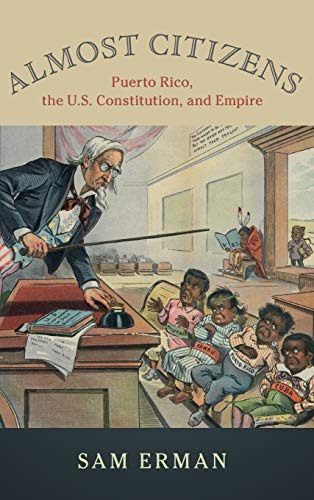

Almost citizens : Puerto Rico, the U.S. Constitution, and empire / Sam Erman, University of Southern California.
Series Studies in legal historyEditor: Cambridge, United Kingdom ; New York, NY, USA : Cambridge University Press, ©2019Descripción: xv, 275 pages : illustrations ; 24 cmTipo de contenido:- text
- unmediated
- volume
- 9781108415491
- KF4720.P83 E76 2018
| Imagen de cubierta | Tipo de ítem | Biblioteca actual | Biblioteca de origen | Colección | Ubicación en estantería | Signatura topográfica | Materiales especificados | Info Vol | URL | Copia número | Estado | Notas | Fecha de vencimiento | Código de barras | Reserva de ítems | Prioridad de la cola de reserva de ejemplar | Reservas para cursos | |
|---|---|---|---|---|---|---|---|---|---|---|---|---|---|---|---|---|---|---|
| Libro | Biblioteca Encarnación Valdés Colección de Puerto Rico | 342.7308 E711a (Navegar estantería(Abre debajo)) | Disponible | 80000002627050 |
Descripciones mejoradas de Syndetics:
Almost Citizens lays out the tragic story of how the United States denied Puerto Ricans full citizenship following annexation of the island in 1898. As America became an overseas empire, a handful of remarkable Puerto Ricans debated with US legislators, presidents, judges, and others over who was a citizen and what citizenship meant. This struggle caused a fundamental shift in constitution law: away from the post-Civil War regime of citizenship, rights, and statehood, and toward doctrines that accommodated racist imperial governance. Erman's gripping account shows how, in the wake of the Spanish-American War, administrators, lawmakers, and presidents together with judges deployed creativity and ambiguity to transform constitutional meaning for a quarter of a century. The result is a history in which the United States and Latin America, Reconstruction and empire, and law and bureaucracy intertwine.
Based on author's thesis (doctoral - University of Michigan, 2010), issued under title: Puerto Rico and the Promise of United States Citizenship : Struggles around Status in a New Empire, 1898-1917.
Includes bibliographical references and index.
Machine generated contents note: Introduction; 1. 1898: 'The constitutional lion in the path'; 2. The Constitution and the new US expansion: debating the status of the Islands; 3. 'We are naturally Americans': Federico Degetau and Santiago Iglesias pursue citizenship; 4. 'American aliens': Isabel Gonzalez, Domingo Collazo, Federico Degetau, and the Supreme Court, 1902-1905; 5. Reconstructing Puerto Rico, 1904-1909; 6. The Jones Act and the long path to collective naturalization; Conclusion.
"Almost Citizens lays out the tragic story of how the United States denied Puerto Ricans full citizenship following annexation of the island in 1898. As America became an overseas empire, a handful of remarkable Puerto Ricans debated with US legislators, presidents, judges, and others over who was a citizen and what citizenship meant. This struggle caused a fundamental shift in constitution law: away from the post-Civil War regime of citizenship, rights, and statehood and toward doctrines that accommodated racist imperial governance. Erman's gripping account shows how, in the wake of the Spanish-American War, administrators, lawmakers, and presidents together with judges deployed creativity and ambiguity to transform constitutional meaning for a quarter of a century. The result is a history in which the United States and Latin America, Reconstruction and empire, and law and bureaucracy intertwine"--
"This book tells the story of "almost citizens"-the people of Puerto Rico who were deemed neither citizens nor aliens, and who lived in a land deemed neither foreign nor domestic. For them, citizenship functioned like terrain during war. It was a prize to be won and a field of battle, whose strategic value shifted as the fight developed. This book follows the debates about the U.S. Constitution that swirled about them. It tends to the voices of federal judges and elected officials, but also follows Puerto Rican politicians, labor organizers, litigants, lawyers, administrators of government agencies, and journalists in Puerto Rico and on the mainland. People in all of these groups had a view of what citizenship should look like, and the idea of citizenship took shape and changed only as they advanced their sometimes competing concepts in media, law, and bureaucratic maneuvers. The story begins at the very end of the nineteenth century as annexation of the islands that comprise Puerto Rico, Hawaii, Guam, American Samoa, and the Philippines was bringing millions of people of African, Asian, and indigenous Pacific Island descent under U.S. control. Would these people become U.S. citizens and, if so, what would that citizenship mean? Citizenship at this time did not always or automatically guarantee full rights to participate in public life. Though women were undoubtedly citizens, only four states accorded them suffrage on an equal basis with men. Southern states were driving African American citizens from the ballot box and the public sphere. Among many other examples, Mexican American and Chinese American children were often required to attend segregated schools. Most of those whose rights were thus constrained were nonetheless deemed "Americans"--