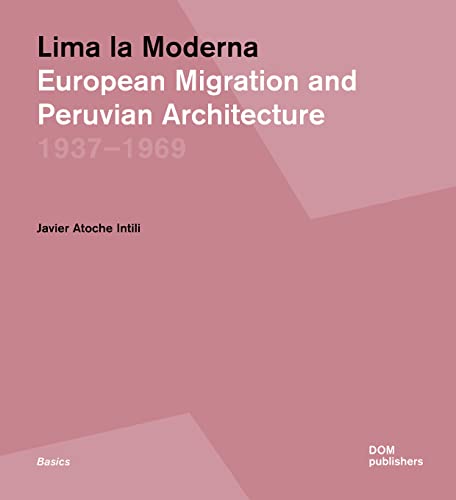

Lima la Moderna : European migration and Peruvian architecture, 1937-1969./ Javier Atoche Intili ; translated by Scott Daniel. txt
Series Basics. 176 Lima la ModernaEditor: Berlin : DOM Publishers, 2023Descripción: 239 p. : ill. ; col. ; facsimiles ; map ; plans ; portraits ; 23 cmTipo de contenido:- still image
- text
- unmediated
- volume
- 3869225955
- 9783869225951
- European migration and Peruvian architecture, 1937-1969
- 23 720.985252
- NA915 A86 2023
| Imagen de cubierta | Tipo de ítem | Biblioteca actual | Biblioteca de origen | Colección | Ubicación en estantería | Signatura topográfica | Materiales especificados | Info Vol | URL | Copia número | Estado | Notas | Fecha de vencimiento | Código de barras | Reserva de ítems | Prioridad de la cola de reserva de ejemplar | Reservas para cursos | |
|---|---|---|---|---|---|---|---|---|---|---|---|---|---|---|---|---|---|---|
| Libro Col. General CARIBET | CARIBET Biblioteca Arquitectura Colección General CARIBET | General NA915 A86 2023 (Navegar estantería(Abre debajo)) | 1 | Disponible | 91000000071852 |
Descripciones mejoradas de Syndetics:
The participation of foreign intellectuals in the urban development of Peruvian cities, and particularly of Europeans in the introduction of new types of buildings in Lima, remains one of the most important influences on local architects and engineers.
Based on the award-winning doctoral thesis of Javier Atoche Intili, a specialist in architectural heritage with roots in both South America and Europe, this monograph focuses on the study of the most active European designers in 1940s Peru, including the Austrian Richard Neutra, the German-born Paul Lester Wiener and the Spaniard Josep Lluis Sert.
It also considers the economic, political and cultural circumstances that underpinned the design and use of multi-storey buildings in the historic centre of Lima: from the introduction of urban planning regulations to the presence of European-born architects who designed a significant number of these buildings, including Paul Linder from Germany, Mario Bianco from Italy and Theodor Cron from Switzerland. Finally, it reflects on the protection, conservation and valorisation of this vast architectural heritage.
Includes bibliographical references.
6 The 'La CaIcina — John Rusk Giancarlo Carnevale --
8 Preface Marina Montuori --
12 Introduction --
22 Part I --
On the historical relationship between --
28 I. European migration urban development in Lima --
1.1. European participation in Lima planning --
1.2. Fernando Belaúande Terry the Europeans who migrated to the United States of America --
1.3. Agrupación Espacio and the European architects who migrated to Peru --
64 Part II --
On European designers working in Peru in the twentieth century --
70 II. Paul Linder (1897-1968), a Bauhausler at the Escuela Nacional de Ingenieros --
11.1. Training in Germany, trips to Spain (1916-1924) --
11.2. Professional practice and German works (1924-1938) --
11.3. Trips to the American continent and the arrival in Peru (1938-1939) --
11.4. Peruvian works: from enigmatic monumentality to functional legibility --
11.5. Edificio Arnodi: reference to local traditions and exclusion from the exhibition Latin American Architecture Since 1945 (1950-1955) --
11.6. Paul Linder's university activities and his efforts to spread modern culture in Peru (1942-1966) --
111. Mario Bianco (1903-1990): from the Piano Regionale Piemontese to the Plan Piloto de Lima --
111.1 Teaching at the Regia Scuola di lngegneria di Torino and professional practice in Italy (1942, 1944) --
111.2. The contributions to post-war reconstruction, the Piano Regionale Piemontese and the departure for Peru (1944-1947) --
111.3. Bianco's activity in Agrupación Espacio (1947-1951) --
111.4. Escuela Nacional de Ingenieros, the Department of Architecture and the exhibition Latin American Architecture Since 1945 (1948-1955) --
111.5. Junta de Obras Públicas del Callao and the construction of the Unidad Vecinal de Santa Marina (1949-1952) --
111.6. Oficina Nacional de Planeamiento y Urbanismo, the planning of the Plan Piloto de Lima and the construction of the Hotel Savoy (1948-1957) --
132 Iv. Theodor Cron (1921-1964), Neues Bauen and Peruvian regionalism --
IV.1. Architects trained at the Eidgenossische Technische Hochschule in Zurich and active in Peru in the mid-twentieth century (1937-1953) --
IV.2. Theodor Cron's training and departure for Peru (1921-1948) --
IV.3. The apartments on Calle Roma (1948-1949) --
IV.4. Participation of European builders in early projects (1950-1953) --
IV.5. European commissioning and construction of the Compañía de Seguros Peruano - Suiza (1952-1956) --
IV.6. Other commercial projects and return to Switzerland (1956-1963) --
164 V. Multi - storey buildings in Lima: genealogy of a modern type (1939-1970) --
V.1. Foreign references and the import of a type (1928-1943) --
V.2. Evolution of the Peruvian multi - storey building (1939-1970) --
V.3. Multi - storey buildings: Lima's modern vocation --
200 Part Ill --
On the recognition of the values of twentieth century Peruvian architecture --
206 VI. Multi - storey buildings in Lima: a heritage 'under construction' (1964-2020) --
VI.1. Protection of Peruvian architecture, from the origins of the problem to the institutionalisation of the twentieth-century's heritage concept --
VI.2The multi-storey building in inventories and research on twentieth century Peruvian architecture --
VI.3. Considerations for the role of research in the protection of Peruvian architectural heritage in the twentieth century --
234 Bibliography --
238 Acknowledgements --
A monograph focusing on the study of the most active European designers in 1940s Peru, including the Austrian Richard Neutra, the German-born Paul Lester Wiener and the Spaniard Josep Lluis Sert.