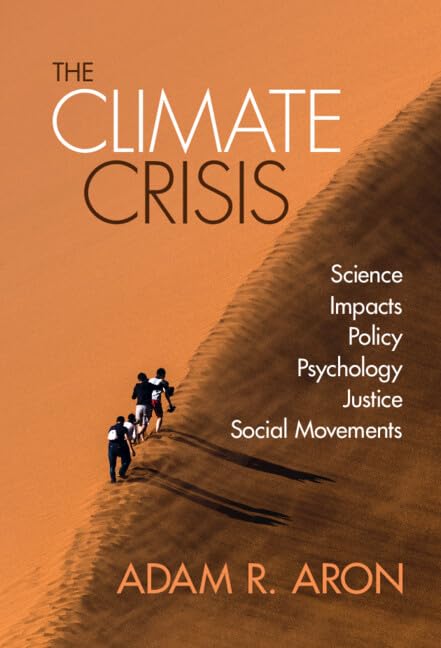
Imagen de portada de Amazon
Imagen de Amazon.com
Imagen de cubierta Syndetics
Portada de Syndetics
Imagen de OpenLibrary

The climate crisis : science, impacts, policy, psychology, sociology, and justice / Adam Aron, University of California, San Diego.

Por: Editor: New York, NY : Cambridge University Press, 2023Descripción: xvii, 358 pages : illustrations ; 23 cmTipo de contenido:
  • text
Tipo de medio:
  • unmediated
Tipo de soporte:
  • volume
ISBN:
  • 9781108833806
  • 9781108987158
Tema(s): Clasificación CDD:
  • 333.72 23/eng/20211119
Clasificación LoC:
  • QC903 .A768 2023
Contenidos:
The History of Human-Caused Global Heating -- Climate Science -- Climate Impacts -- Capitalism and the Climate Crisis -- Skepticism, Misinformation, and Motivated Cognition -- Science Communication: Countering Skepticism and Delivering -- Information Clearly -- Elevating Risk Perceptions About Global Heating -- Principles for Just and Effective Action -- A Technical and Social Framework to Guide Climate Action -- Building and Taking Collective Action.
Resumen: "Why, despite all we know about the causes and harms of global heating, has so little effective action been taken to cut greenhouse gas emissions, and what we can do to change that? This book explains the mechanisms and impacts of the climate crisis, traces the history and reasons behind the lack of serious effort to combat it, describes some people's ongoing scepticism and how to shift it, and motivates an urgent program of action. It argues that the pathway to stopping dangerous global heating will require a much larger mobilization of advocacy and activism to impel decision makers to abandon fossil fuels, and transition to renewable energy and electrification embedded in a political and social framework guided by justice principles. It is an excellent resource for students and researchers on the climate crisis, the need for a renewable energy transition, and the current blocks to progress"-- Provided by publisher.
Valoración
    Valoración media: 0.0 (0 votos)
Existencias
Imagen de cubierta Tipo de ítem Biblioteca actual Biblioteca de origen Colección Ubicación en estantería Signatura topográfica Materiales especificados Info Vol URL Copia número Estado Notas Fecha de vencimiento Código de barras Reserva de ítems Prioridad de la cola de reserva de ejemplar Reservas para cursos
Libro Biblioteca de Mayagüez Colección General mb QC903 .A768 2023 (Navegar estantería(Abre debajo)) c. 1 Disponible 50000003292264
Total de reservas: 0

Descripciones mejoradas de Syndetics:

Why, despite all we know about the causes and harms of global heating, has so little effective action been taken to cut greenhouse gas emissions, and what we can do to change that? This book explains the mechanisms and impacts of the climate crisis, traces the history and reasons behind the lack of serious effort to combat it, describes some people's ongoing scepticism and how to shift it, and motivates an urgent program of action. It argues that the pathway to stopping dangerous global heating will require a much larger mobilization of advocacy and activism to impel decision makers to abandon fossil fuels, and transition to renewable energy and electrification embedded in a political and social framework guided by justice principles. It is an excellent resource for students and researchers on the climate crisis, the need for a renewable energy transition, and the current blocks to progress.

Includes bibliographical references and index.

The History of Human-Caused Global Heating -- Climate Science -- Climate Impacts -- Capitalism and the Climate Crisis -- Skepticism, Misinformation, and Motivated Cognition -- Science Communication: Countering Skepticism and Delivering -- Information Clearly -- Elevating Risk Perceptions About Global Heating -- Principles for Just and Effective Action -- A Technical and Social Framework to Guide Climate Action -- Building and Taking Collective Action.

"Why, despite all we know about the causes and harms of global heating, has so little effective action been taken to cut greenhouse gas emissions, and what we can do to change that? This book explains the mechanisms and impacts of the climate crisis, traces the history and reasons behind the lack of serious effort to combat it, describes some people's ongoing scepticism and how to shift it, and motivates an urgent program of action. It argues that the pathway to stopping dangerous global heating will require a much larger mobilization of advocacy and activism to impel decision makers to abandon fossil fuels, and transition to renewable energy and electrification embedded in a political and social framework guided by justice principles. It is an excellent resource for students and researchers on the climate crisis, the need for a renewable energy transition, and the current blocks to progress"-- Provided by publisher.

Reseñas proporcionadas por Syndetics

CHOICE Review

The tripartite structure of The Climate Crisis clearly indicates the envisioned readership: part 1 addresses the history of climate science and climate change, with a special focus on capitalism; part 2, "From Skepticism to Belief," offers a primer on how to successfully confront skepticism about climate change impacts; part 3 tackles the question of what is required to inspire positive action. The first part provides a good introduction to the greenhouse effect and historical climate change--although unfortunately, the primary role of 19th-century agriculture in generating greenhouse gases, viz., John L. Brooke's research for Climate Change and the Course of Global History (CH, Nov'14, 52-1443)--is unmentioned. Both the modern instrumentalist attitude toward nature, and attributing it as the result of capitalism, are reductionist. Yet both are forgivable, and since the author is a cognitive neuroscientist, it is in the latter two parts that his academic expertise and activist experience really shine. The psychological and sociological reasons why some people resist climate change facts are clearly explained. Each important term (e.g., epistemic skepticism) is boldfaced and appears in a useful glossary. Tables, explanatory boxes, and figures abound, though their readability is marred by the use of light gray display text, somewhat remedied on the accompanying website, which offers downloadable (and clearer) versions. Summing Up: Recommended. All readers. --Robert T. Ingoglia, St. Thomas Aquinas College
Compartir
logopucpr-y-vive

Contáctanos

¡Queremos saber de ti!

Tel. 787.841.2000 Ext. 1801

bibliotecavaldes@pucpr.edu

⁣Búscanos en las redes

© 2026 Desarrollado por Ignite Online • All Rights Reserved • Powered by Koha.