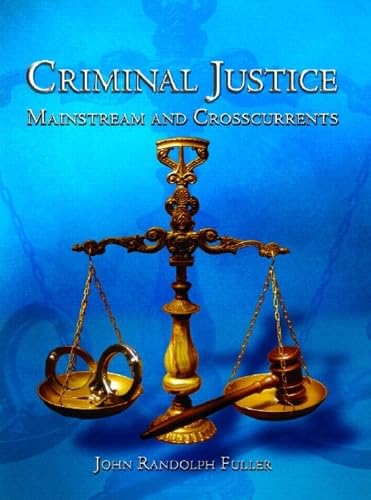

Criminal justice mainstream and crosscurrents John Randolph Fuller.
Detalles de publicación: Upper Saddle River, N.J. Pearson/Prentice Hall c2006.Descripción: xxiv, 593 p. ill. (some col.) 29 cmISBN:- 013112255X
- 364.973 F9654c 22
- HV9950 .F85 2006
| Imagen de cubierta | Tipo de ítem | Biblioteca actual | Biblioteca de origen | Colección | Ubicación en estantería | Signatura topográfica | Materiales especificados | Info Vol | URL | Copia número | Estado | Notas | Fecha de vencimiento | Código de barras | Reserva de ítems | Prioridad de la cola de reserva de ejemplar | Reservas para cursos | |
|---|---|---|---|---|---|---|---|---|---|---|---|---|---|---|---|---|---|---|
| Libro | Biblioteca Encarnación Valdés Colección General bev | 364.973 F9654c (Navegar estantería(Abre debajo)) | Disponible | 80000002180415 |
Descripciones mejoradas de Syndetics:
Prentice Hall is proud to introduce Criminal Justice: Mainstream & Crosscurrents by John Fuller, a brand new contemporary and comprehensive textbook option for your Introduction to Criminal Justice course. Building upon John Fuller's experience as a criminal justice practitioner, scholar and teacher, Criminal Justice: Mainstream & Crosscurrents asks students to think critically about the goals and processes of the criminal justice system and introduces them to important ethical dilemmas faced by criminal justice professionals.
The book examines the goals and structure of the CJ system (theories) and contrasts the system's successes and efforts at reform (realities)."I would argue that this is the best introductory to criminal justice text available. It is highly readable, interesting, up to date, supported with empirical work and critical...plus it just reads so well."
Kim Davies, Augusta State College
"I applaud the author for writing something other than a replica of existing intro texts. I believe it's time we provide instructors with viable options."
-Ronald Burns, Texas Christian University
"The text not only caught my attention, but was difficult to put down, so in essence I am saying it is not only educational but entertaining as well."
-David Streeter, Catawba Valley Community College
"I like the narrative style that explains legal concepts in a clear and comprehensible manner without losing the reader in legal jargon."
-Robert P. Griffiths, Esq., Suffolk County Community College
Includes bibliographical references and indexes.
Tabla de contenidos provista por Syndetics
- I Crime: Problems, Measurement, Theories, and Law
- 1 The Problem of Social Control
- Introduction
- What is Crime?
- Social Control
- Crime in the United States
- Sensational Crime
- Street Crime
- Corporate Crime, White Collar Crime, and Organized Crime
- The Criminal Justice System
- Levels of Government
- Local-Level Criminal Justice
- State-Level Criminal Justice
- Federal-Level Criminal Justice
- The Criminal Justice Process
- The Problem with the System Metaphor
- It All Begins with the Family
- Religion
- Schools
- The Media
- The System of Last Resort
- Summary
- 2 The Nature and Measurement of Crime
- Introduction
- Categories of Crime and Criminals
- Crimes Against the Person
- Crimes Against Property
- Crimes Against the Public Order
- Measurement of Crime
- The Uniform Crime Reports
- National Incident-Based Reporting System (NIBRS)
- Victimization Surveys
- Self-Report Studies
- Fear of Crime
- Summary
- 3 Theories of Crime
- Introduction
- Demonology
- The Classical School of Criminology
- Cesare Beccaria
- Jeremy Bentham
- The Positivist School of Criminology
- Biological Theories of Crime
- Psychological Theories Of Crime
- Sociological Theories of Crime
- Critical Sociological Theories of Crime
- Summary
- 4 Criminal Law
- Introduction
- The Development of Criminal Law
- The Code of Hammurabi
- Magna Carta
- Common Law
- Sources of Law
- Constitutions
- Statutes
- Administrative Rules
- Types of Law
- Criminal Law
- Criminal vs. Civil Law
- Substantive Law
- Procedural Law
- Case Law
- Types of Crime
- Felonies
- Misdemeanors
- Inchoate Offenses
- Features of Crime
- Actus Reus
- Mens Rea
- Concurrence
- Strict Liability
- Criminal Responsibility and Criminal Defense
- Summary
- II Enforcing The Law
- 5 The History and Organization of Law Enforcement
- Introduction
- A Brief History of the Police
- Police in Ancient Times
- Policing in Early England
- The Gin Effect
- Policing in the United States
- The 19th Century
- The New York City Influence
- London vs. New York
- The Chicago Influence
- Vigilante Policing
- The Introduction Of Police Professionalism
- The Wickersham Commission and August Vollmer
- Other Reformers
- Modern Police Organization
- The Problem of Jurisdiction
- The Levels of Law Enforcement
- The Federal Level
- Careers
- Federal Bureau of Investigation
- The Secret Service
- The State Level
- Highway Patrol
- The Local Level
- Sheriffs' Offices
- Innovations in Policing
- The Kansas City Preventive Patrol Experiment
- The Rand Study of Detectives
- The DARE Program
- Summary
- 6 Controlling the Police
- Introduction
- Police Discretion
- The Expectations of Law Enforcement
- The Quasi-Military Nature of Police Organizations
- The Variety of Policing Styles
- The Watchman Style
- The Legalistic Style
- The Service Style
- The Police Subculture and Police Corruption
- Police Corruption
- The Knapp Commission
- Procedural Laws and Policing
- The Fourth Amendment
- Search
- Special-Needs Searches
- Seizures