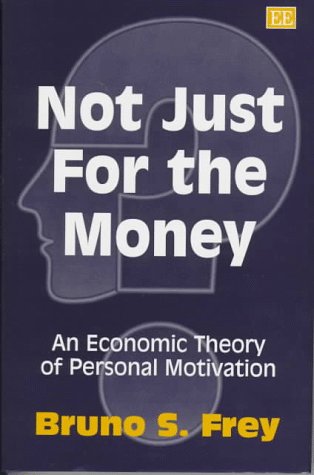

Not just for the money an economic theory of personal motivation Bruno S. Frey.
Detalles de publicación: Cheltenham, UK Brookfield, Vt. Edward Elgar Pub. c1997.Descripción: xii, 156 p. ill. 22 cmISBN:- 1858985099
- 1858988454 (pbk.)
- 331.21 21
- HF5549.5.M63 F74 1997
| Imagen de cubierta | Tipo de ítem | Biblioteca actual | Biblioteca de origen | Colección | Ubicación en estantería | Signatura topográfica | Materiales especificados | Info Vol | URL | Copia número | Estado | Notas | Fecha de vencimiento | Código de barras | Reserva de ítems | Prioridad de la cola de reserva de ejemplar | Reservas para cursos | |
|---|---|---|---|---|---|---|---|---|---|---|---|---|---|---|---|---|---|---|
| Libro | Biblioteca Encarnación Valdés Colección General bev | 331.21 F8931n (Navegar estantería(Abre debajo)) | Disponible | 80000002112236 |
Descripciones mejoradas de Syndetics:
In Not Just for the Money Professor Frey challenges traditional economic theory and argues that people do not act in expectation of monetary gain alone, nor do they work solely because they are paid. Furthermore, the author claims that higher monetary compensation as well as regulations crowd-out motivation in important circumstances. Offering higher pay may make people less committed to their work and may reduce their performance. They thus behave in exactly the opposite way the fundamental price-effect of economics predicts.
The first part of the book considers the Crowding-Out Effect and the Motivational Spill-Over Effect. The second part explores a large number of applications to constitutional questions, various policy issues and the organization of firms. The final part discusses the substantial consequences for policy making and economic theory.
This path breaking book is bound to create controversy and debate. It will appeal not only to economists but to a wide range of social scientists who want to go beyond the traditional assumption of economic man.
Includes bibliographical references and indexes.
Tabla de contenidos provista por Syndetics
- Contents
- 1 Introduction
- Part I The Crowding-Out Effect
- 2 Everyday Experiences
- 3 The Psychological Background
- 4 Integration into Economics
- 5 Motivational Spill-Over Effect
- Part II Applications
- 6 A Strict or Lenient Constitution?
- 7 Environmental Policy
- 8 Siting Policy, or: the NIMBY-problem (with Felix Oberholzer-Gee)
- 9 Social and Organizational Policy
- 10 Work Motivation and Compensation Policy
- Part III Conclusions
- 11 Consequences for Economic Policy
- 12 Consequences for Economic Theory
- References
- Index