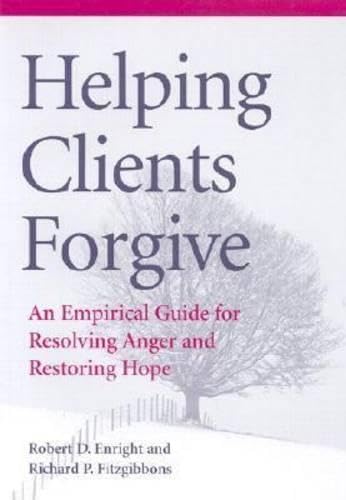

Helping clients forgive an empirical guide for resolving anger and restoring hope Robert D. Enright, Richard P. Fitzgibbons.
Detalles de publicación: Washington, DC American Psychological Association 2000.Descripción: xiii, 376 p. 26 cmISBN:- 1557986894
- 21 616.8914 E595h
- RC489 .F67 .E57 2000
| Imagen de cubierta | Tipo de ítem | Biblioteca actual | Biblioteca de origen | Colección | Ubicación en estantería | Signatura topográfica | Materiales especificados | Info Vol | URL | Copia número | Estado | Notas | Fecha de vencimiento | Código de barras | Reserva de ítems | Prioridad de la cola de reserva de ejemplar | Reservas para cursos | |
|---|---|---|---|---|---|---|---|---|---|---|---|---|---|---|---|---|---|---|
| Libro | Biblioteca Encarnación Valdés Colección General bev | 616.8914 E595h (Navegar estantería(Abre debajo)) | Disponible | 80000002103060 |
Descripciones mejoradas de Syndetics:
Forgiveness has been found to be a pivotal process in helping clients resolve anger over past betrayals, relieve depression and anxiety, and restore peace of mind. Synthesizing over 20 years of research in forgiveness, pioneers Robert Enright and Richard Fitzgibbons explain the process of forgiveness in psychotherapy in a way that can be applied by clinicians regardless of their theoretical orientation. How to recognize when forgiveness is an appropriate client goal, how to introduce and explain to clients what forgiveness is and isn't, step-wise ways of working forgiveness into therapy with individuals, couples and families are among the many topics covered in this comprehensive volume. The roles that anger and forgiveness play in specific emotional disorders and clinical examples of work with individuals suffering from these disorders make this a highly practical resource as well as a well-documented sourcebook for all mental health practitioners.
Includes bibliographical references and index.
Tabla de contenidos provista por Syndetics
- List of Tables, Exhibits, and Figures(p. ix)
- Preface(p. xi)
- Introduction: Why Learn About Forgiveness and Forgiveness Therapy?(p. 3)
- Part I Forgiveness As a Key to Healing in Psychotherapy
- Chapter 1 Forgiveness in Psychotherapy: An Overview(p. 13)
- Chapter 2 Deepening the Understanding of Forgiveness(p. 29)
- Chapter 3 What Forgiveness is Not(p. 37)
- Chapter 4 The Social--Cognitive Development of Forgiveness(p. 53)
- Chapter 5 The Process Model of Forgiveness Therapy(p. 65)
- Chapter 6 Empirical Validation of the Process Model of Forgiveness(p. 89)
- Part II Applying Forgiveness Within Specific Disorders and Populations
- Chapter 7 Forgiveness in Depressive Disorders(p. 113)
- Chapter 8 Forgiveness in Anxiety Disorders(p. 135)
- Chapter 9 Forgiveness in Substance Abuse Disorders(p. 155)
- Chapter 10 Forgiveness in Children and Adolescents(p. 169)
- Chapter 11 Forgiveness in Marital and Family Relationships(p. 193)
- Chapter 12 Forgiveness in Eating Disorders(p. 215)
- Chapter 13 Forgiveness in Bipolar and Other Mental Disorders(p. 225)
- Chapter 14 Forgiveness in Personality Disorders(p. 239)
- Part III Philosophical Foundations and Empirical Investigations
- Chapter 15 Moral, Philosophical, and Religious Roots of Forgiveness(p. 253)
- Chapter 16 Skeptical Views of Forgiveness(p. 267)
- Chapter 17 Empirical Support for the Social--Cognitive Model of Forgiveness(p. 277)
- Chapter 18 Other Forgiveness Interventions(p. 287)
- Chapter 19 Measures of Interpersonal Forgiveness(p. 305)
- Epilogue: The Future of Forgiveness(p. 323)
- References(p. 331)
- Author Index(p. 359)
- Subject Index(p. 367)
- About the Authors(p. 377)
Notas de autor provistas por Syndetics
Robert D. Enright, PhD is a licensed psychologist and professor of educational psychology at the University of Wisconsin, Madison, a position he has held since 1978Richard P. Fitzgibbons, MD, is the director of a private practice outside Philadelphia