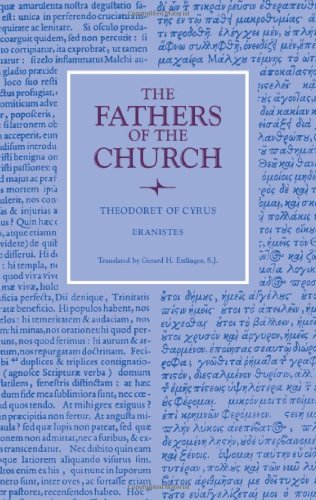

Eranistes Theodoret of Cyrus ; translated by Gerard H. Ettlinger.
Idioma: Inglés Lenguaje original: griego antiguo (hasta 1453) Series The Fathers of the church ; v. 106Detalles de publicación: Washington, D.C. Catholic University of America Press c2003.Descripción: x, 281 p. 22 cmISBN:- 0813201063 (alk. paper)
- 270 s 21
- BR60.F3 T48 2003 BR65.T753
| Imagen de cubierta | Tipo de ítem | Biblioteca actual | Biblioteca de origen | Colección | Ubicación en estantería | Signatura topográfica | Materiales especificados | Info Vol | URL | Copia número | Estado | Notas | Fecha de vencimiento | Código de barras | Reserva de ítems | Prioridad de la cola de reserva de ejemplar | Reservas para cursos | |
|---|---|---|---|---|---|---|---|---|---|---|---|---|---|---|---|---|---|---|
| Libro | Biblioteca Encarnación Valdés Colección General bev | 281.1 F252 I (Navegar estantería(Abre debajo)) | v.106 | Disponible | 80000002120882 |
Descripciones mejoradas de Syndetics:
This translation of a major document in patristic Christology, the first translation since the 19th century, is based on the modern critical edition of Theodoret's Greek text. Theodoret was a leading theologian of his time in the Antiochene tradition, and in the ""Eranistes"" (written in 447) he offers a lengthy exposition of his Christology, coupled with a refutation of the so-called Monophysite Christology that, despite its condemnation at the General Council held at Chalcedon in 451, survives to this day, having been embraced by several large churches of the East. The ""Monophysite"" controversy caused a tremendous rift between East and West, and the ""Eranistes"" portrays the hostility and the stubborn resistance to the thought of others that afflicted both sides in the conflict. The ""Eranistes"" is written in the form of three dialogues between two characters: Orthodox , who represents Theodoret's thought, and Eranistes, who is presented as a heretic. In two dialogues Theodoret argues that the Word of God was immutable and impassible in his divine nature, and that Christ experienced change and passion only in his human nature. A third dialogue argues that, in the union of the divinity and humanity in the one person of the Word incarnate, the natures remained unmixed. To bolster his arguments Theodoret incorporates extensive citations, not only from orthodox ecclesiastical writers, but also from the heretic Apollinarius and the suspected Arian, Eusebius of Emesa. The texts of many of these citations are known only from the ""Eranistes"" and are therefore witnesses to the development of patristic Christology. Critical issues in Antiochene and Alexandrian Christology are broached by Theodoret in the text and are further discussed by the translator in the introduction and notes.
Includes bibliographical references and indexes.