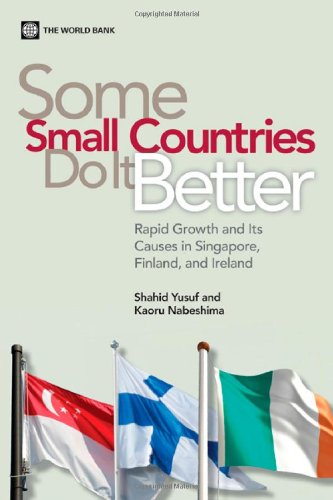

Some small countries do it better rapid growth and its causes in Singapore, Ireland, and Finland Shahid Yusuf, Kaoru Nabeshima.
Detalles de publicación: Washington, D.C. World Bank 2011.Descripción: xiii, 169 p. ill. 23 cmISBN:- 9780821388464
- 9780821389256 (electronic)
- 338.9 Y958s 23
- HC59.3 .Y97 20122
| Imagen de cubierta | Tipo de ítem | Biblioteca actual | Biblioteca de origen | Colección | Ubicación en estantería | Signatura topográfica | Materiales especificados | Info Vol | URL | Copia número | Estado | Notas | Fecha de vencimiento | Código de barras | Reserva de ítems | Prioridad de la cola de reserva de ejemplar | Reservas para cursos | |
|---|---|---|---|---|---|---|---|---|---|---|---|---|---|---|---|---|---|---|
| Libro | Biblioteca Encarnación Valdés Colección General bev | 338.9 Y958s (Navegar estantería(Abre debajo)) | Disponible | 80000002461633 |
Descripciones mejoradas de Syndetics:
Countries worldwide are struggling to imitate the industrial prowess of the East Asian pacesetters, but growth accelerations have proven remarkably transient. Building a portfolio of tradable goods and services and steadily raising the level of investment in these activities, has generally defied the best policy efforts - in particular, bringing investment ratios on par with East Asian averages has presented the greatest challenge. Hence the search is on for growth recipes not so tightly bound to investment, to manufacturing activities, and to the export of manufactured products. In casting around for such recipes validated by demonstrated results, the experience of economies which have relied more on other drivers of growth - human capital and knowledge - is highly attractive. Finland and Ireland are among the tiny band of small nations that grew rapidly for well over a decade by achieving the maximum mileage from an adequate investment in physical assets and by harnessing the potential of human capital and technologies. Singapore combined high investment with a comprehensive and complementary strategy of building high quality human and knowledge assets. This approach enabled the three countries to diversify much faster into higher tech manufactures and tradable services and profit from globalization. The approach adopted by these three countries may be of greater relevance in the highly competitive global environment of the early 21st century because it does not necessarily assume heroic levels of investment. Moreover, it may be better tailored to the opportunities for middle and lower middle income economies threatened by the middle income trap and seeking growth rates in the 6 percent range, and for the smaller, late starting, low income countries with youthful, rapidly increasing populations that need to grow at high single digit rates in order to create enough jobs and to double per capita incomes in 10 years.
Includes bibliographical references and index.
Tabla de contenidos provista por Syndetics
- Preface and Acknowledgments(p. ix)
- About the Authors(p. xi)
- Abbreviations(p. xiii)
- Chapter 1 Looking for Growth(p. 1)
- Growth: The Stylized Facts(p. 7)
- Hunting for Quarks(p. 14)
- Looking at the "Sifire" Family of Models(p. 21)
- References(p. 24)
- Chapter 2 How Sifire Compressed Development(p. 31)
- Globalization: The Vital Backdrop(p. 32)
- Old Light(p. 37)
- Crises and Consequences(p. 39)
- Investing in Growth(p. 41)
- Learning and Innovation(p. 43)
- Creative Cities(p. 47)
- What Sifire Got Right(p. 48)
- References(p. 49)
- Chapter 3 Elements of a Learning Economy(p. 55)
- Changes in Economic Structure(p. 55)
- The Rise of High-Tech Exports(p. 59)
- Education Sector: An Overview(p. 64)
- Innovation Capabilities(p. 78)
- Innovation Facilitator(p. 87)
- Concluding Observations(p. 96)
- References(p. 97)
- Chapter 4 Governance and Growth(p. 101)
- Coordinators(p. 104)
- Institutions for Growth(p. 109)
- Power of Urban Networks(p. 111)
- References(p. 115)
- Chapter 5 Delivering Quality Education(p. 117)
- The Power of Quality Education(p. 119)
- Vocational Training(p. 123)
- Sustaining Consistent Performance(p. 125)
- Starting Almost from Scratch: What It Takes(p. 126)
- References(p. 128)
- Chapter 6 The Message from Sifire(p. 131)
- Pragmatic Governance(p. 133)
- Leveraging Global Markets and General-Purpose Technologies(p. 133)
- Updating the Sifire Experience(p. 135)
- Quality of Human Capital(p. 138)
- Implications for African Countries(p. 140)
- References(p. 145)
- Appendix A (p. 149)
- Appendix B (p. 155)
- Index(p. 159)
- Figures
- 1.1 Sources of Economic Growth by Region, 1989-95 and 1995-2003(p. 8)
- 1.2 Percentage Point Contribution of Real Net Exports to GDP Growth in Asia, 1995-2000 and 2000-06(p. 12)
- 3.1 Finland's Industrial Composition, 1970-2007(p. 56)
- 3.2 Ireland's Industrial Composition, 1970-2007(p. 58)
- 3.3 Singapore's Industrial Composition, 1970-2007(p. 59)
- 3.4 Finland's Composition of Exports by Technology Class, 1970 and2000(p. 63)
- 3.5 Ireland's Composition of Exports by Technology Class, 1970 and 2000(p. 63)
- 3.6 Singapore's Composition of Exports by Technology Class, 1970 and 2000(p. 64)
- 3.7 Average Years of Schooling for People 15-Years-Old and Above, 1960-2000(p. 66)
- 3.8 Public Expenditure per Student(p. 67)
- 3.9 Composition of Graduates in Finland, Tertiary Education, 1981-99(p. 75)
- 3.10 Openness to Trade, 2001-08(p. 89)
- 3.11 Imports of Goods and Services, 2001-08(p. 90)
- 3.12 Net Foreign Direct Investment Flows, 1980-2008(p. 91)
- 3.13 Royalty Payments, 1975-2007(p. 93)
- 3.14 Royalty Payments as Share of GDP, 1975-2007(p. 93)
- 4.1 Finnish Innovation System: Organizations and Coordination(p. 106)
- 4.2 Irish Science and Technology Structure(p. 108)
- 4.3 TheEDB Network(p. 109)