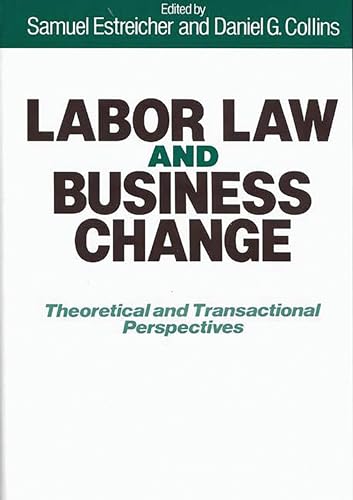

Labor law and business change theoretical and transactional perspectives edited by Samuel Estreicher and Daniel G. Collins.
Detalles de publicación: New York Quorum Books 1988.Descripción: viii, 353 p. 24 cmISBN:- 0899301991 (lib. bdg. : alk. paper)
- 344.73/0189 347.304189 19
- KF3369 .L28 1988
| Imagen de cubierta | Tipo de ítem | Biblioteca actual | Biblioteca de origen | Colección | Ubicación en estantería | Signatura topográfica | Materiales especificados | Info Vol | URL | Copia número | Estado | Notas | Fecha de vencimiento | Código de barras | Reserva de ítems | Prioridad de la cola de reserva de ejemplar | Reservas para cursos | |
|---|---|---|---|---|---|---|---|---|---|---|---|---|---|---|---|---|---|---|
| Libro | Biblioteca Encarnación Valdés Colección General bev | 344.730189 L123 (Navegar estantería(Abre debajo)) | Disponible | 80000000492085 |
Descripciones mejoradas de Syndetics:
This study is a useful survey of a range of crucial problems in the current industrial relations system. Whether the US's present collective bargaining system can accommodate the massive dislocations of global competitive capitalism is a debatable, and vital, question. This collection offers important insights into the matter. Choice
A collection of specially written essays by distinguished legal scholars and practicing lawyers, this book explores the ways in which collective bargaining practices have been forced to adapt and change in response to a radical restructuring in the labor and personnel relations of American businesses. As the contributors demonstrate, current trends--such as a shift from manufacturing to service employment, deregulation, a hostile political environment, and a host of mergers and acquisitions--have made an understanding of traditional labor law doctrine increasingly less central to actual practice. Practitioners today need a thorough grasp of complex new workplace regulations and a mastery of the interplay between legal rules and practical constraints on transactions like plant closings, assets or stock sales, bankruptcy reorganization, and union representation on corporate boards of directors. Labor Law and Business Change places these changes within a comprehensive legal and practical framework and provides expert advice to those who must deal with these developments in the course of structuring particular business transactions.
"Book evolved from the 1984 'Workshop on Labor Law and Business Change' at New York University"--Pref.
Includes index.
Bibliography: p. [325]-336.
Tabla de contenidos provista por Syndetics
- Theoretical Perspectives
- The Potential of Collective Bargaining in an Era of Economic Restructuring
- The Scope of the Duty to Bargain Concerning Business Transformations Information-Sharing Obligations
- Successorship Obligations
- The Role of Labor Arbitration ERISA
- Considerations in Business Change Transactions
- Union Directors and Fiduciary Duties under State
- Corporate Law Comparative Perspectives
- Transactional Perspectives
- Sales of Assets, Mergers and Acquisitions: A Management View
- Sale of Assets, Mergers and Acquisitions: A Union View Plant
- Closings, Relocations and Transfers of Unit Work: A Management View
- Plant Closings, Relocations and Transfers of Unit Work: A Union View
- Automation, Technological Change, and the Merits of Collective Bargaining: A Management View
- Automation and Technological Change: A Union View
- Employee Ownership: A Union View
- Bankruptcy Reorganization and Rejection of Collective Bargaining Agreements
- An Alternative to Oppressive Labor Contracts?
- Protecting Union Interests in Employer Bankruptcy
- Bibliography
- Index
Reseñas proporcionadas por Syndetics
CHOICE Review
The subject of business change and the law is particularly timely. In our turbulent environment, the rights of employers and unions to implement or forestall change may be crucial. This book consists of 17 essays dealing with the law and organizational restructuring from both theoretical and practical perspectives. In the first section of the study, the authors examine a number of collective bargaining issues arising from managerial reorganization of a company, including the scope of the duty to bargain, obligations to divulge information, the duties of a successor employer, the role of labor arbitration, and continuing pension liabilities. The second part of the study is devoted to an analysis of specific activities, such as the sale of assets, plant closings and relocations, technological change, and bankruptcy reorganizations. Both management and union views are presented. This study is a useful survey of a range of crucial problems in the current industrial relations system. Whether the US's present collective bargaining system can accommodate the massive dislocations of global competitive capitalism is a debatable, and vital, question. This collection offers important insights into the matter. Upper-division and graduate collections. -R. L. Hogler, Colorado State UniversityNotas de autor provistas por Syndetics
SAMUEL ESTREICHER is Professor of Law at New York University School of Law.
DANIEL G. COLLINS is also Professor of Law at New York University School of Law.