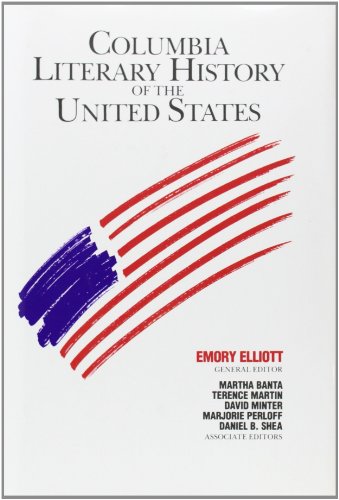

Columbia literary history of the United States Emory Elliott, general editor ; associate editors, Martha Banta ... [et al.] ; advisory editors, Houston A. Baker ... [et al.].
Detalles de publicación: New York Columbia University Press 1988.Descripción: xxviii, 1263 p. 24 cmISBN:- 0231058128 (alk. paper)
- 810/.9 19
- PS92 .C64 1988
| Imagen de cubierta | Tipo de ítem | Biblioteca actual | Biblioteca de origen | Colección | Ubicación en estantería | Signatura topográfica | Materiales especificados | Info Vol | URL | Copia número | Estado | Notas | Fecha de vencimiento | Código de barras | Reserva de ítems | Prioridad de la cola de reserva de ejemplar | Reservas para cursos | |
|---|---|---|---|---|---|---|---|---|---|---|---|---|---|---|---|---|---|---|
| Libro | Biblioteca de Mayagüez Colección General mb | PS92 .C64 1988 (Navegar estantería(Abre debajo)) | Disponible | 50000002026341 |
Descripciones mejoradas de Syndetics:
For the first time in four decades, there exists an authoritative and up-to-date survey of the literature of the United States, from prehistoric cave narratives to the radical movements of the sixties and the experimentation of the eighties.
This comprehensive volume--one of the century's most important books in American studies--extensively treats Hawthorne, Melville, Dickinson, Hemingway, and other long-cherished writers, while also giving considerable attention to recently discovered writers such as Kate Chopin and to literary movements and forms of writing not studied amply in the past. Informed by the most current critical and theoretical ideas, it sets forth a generation's interpretation of the rise of American civilization and culture.
The Columbia Literary History of the United States contains essays by today's foremost scholars and critics, overseen by a board of distinguished editors headed by Emory Elliott of Princeton University. These contributors reexamine in contemporary terms traditional subjects such as the importance of Puritanism, Romanticism, and frontier humor in American life and writing, but they also fully explore themes and materials that have only begun to receive deserved attention in the last two decades. Among these are the role of women as writers, readers, and literary subjects and the impact of writers from minority groups, both inside and outside the literary establishment.
Includes index.
Tabla de contenidos provista por Syndetics
- Preface
- General Introduction
- Note on the Text
- Acknowledgments
- Part 1 Beginnings to 1810
- Associate Editor
- I A Key into the Languages of America
- The Native Voice
- The Literature of Discovery and Exploration
- English Literature at the American Moment
- The Puritan Vision of the New World
- II The Prose and Poetry of Colonial America
- History and Chronicle
- Sermons and Theological Writings
- Biography and Autobiography
- The Poetry of Colonial America
- III America in Transition
- From Cotton Mather to Benjamin Franklin
- Jonathan Edwards, Charles Chauncy, and the Great Awakening
- Thomas Jefferson and the Writing of the South
- IV The Literature of the New Republic
- The American Revolution as a Literary Event
- Poetry in the Early Republic
- Charles Brockden Brown and Early American Fiction
- Toward a National Literature
- Part 2 1810-1865
- Associate Editor
- I The Age in Perspective
- Idealism and Independence
- II Cultural Diversity and Literary Forms
- Washington Irving and the Knickerbocker Group
- James Fenimore Cooper and the Writers of the Frontier
- Edgar Allan Poe and the Writers of the Old South
- William Cullen Bryant and the Fireside Poets
- The Rise of the Woman Author
- Forms of Regional Humor
- A New Nation's Drama
- III Intellectual Movements and Social Change
- Social Discourse and Nonfictional Prose
- The Transcendentalists
- IV The American Renaissance
- Ralph Waldo Emerson
- Henry David Thoreau
- Nathaniel Hawthorne
- Herman Melville
- Walt Whitman
- Part 3 1865-1910
- Associate Editor
- I Signs of the Times
- Literature and Culture
- Culture and Consciousness
- II Genre Deliberations
- Realism and Regionalism
- Naturalism and the Languages of Determinism
- III Literary Diversities
- Literature for the Populace
- Immigrants and Other Americans
- Women Writers and the New Woman
- IV Major Voices
- Emily Dickinson
- Mark Twain
- Henry Adams
- Henry James
- Part 4 1910-1945
- Associate Editor
- I Contexts and Backgrounds
- The Emergence of Modernism
- Intellectual Life and Public Discourse
- Literary Scenes and Literary Movements
- II Regionalism, Ethnicity, and Gender: Comparative Literary Cultures
- Regionalism: A Diminished Thing
- Afro-American Literature
- Mexican American Literature
- Asian American Literature
- Women Writers Between the Wars
- III Fiction
- The Diversity of American Fiction
- Ernest Hemingway, F. Scott Fitzgerald, and Gertrude Stein
- William Faulkner
- IV Poetry and Criticism
- The Diversity of American Poetry
- Robert Frost
- Ezra Pound and T. S. Eliot
- William Carlos Williams and Wallace Stevens
- Literary Criticism
- Part 5 1945 to the Present
- Associate Editor
- I The Postwar Era
- Culture, Power, and Society
- The New Philosophy
- Literature as Radical Statement
- II Forms and Genres
- Poetry Twentieth-Century Drama
- Neorealist Fiction
- Self-Reflexive Fiction
- III The Present
- The Fictions of the Present
- The Avante-Garde and Experimental Writing
- Notes on Contributors
- Index