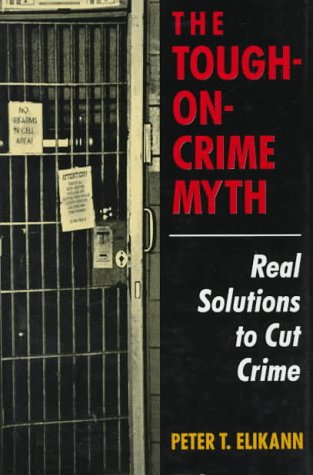
Imagen de portada de Amazon
Imagen de Amazon.com
Imagen de cubierta Syndetics
Portada de Syndetics
Imagen de OpenLibrary

The tough-on-crime myth real solutions to cut crime Peter T. Elikann.

Por: Detalles de publicación: New York Insight Books c1996.Descripción: xvi, 323 p. 22 cmISBN:
  • 0306454033
Tema(s): Clasificación CDD:
  • 364.4/0973 20
Clasificación LoC:
  • HV7431 .E38 1996
Valoración
    Valoración media: 0.0 (0 votos)
Existencias
Imagen de cubierta Tipo de ítem Biblioteca actual Biblioteca de origen Colección Ubicación en estantería Signatura topográfica Materiales especificados Info Vol URL Copia número Estado Notas Fecha de vencimiento Código de barras Reserva de ítems Prioridad de la cola de reserva de ejemplar Reservas para cursos
Libro Biblioteca Encarnación Valdés Colección General bev 364.40973 E42t (Navegar estantería(Abre debajo)) Disponible 80000002006420
Total de reservas: 0

Descripciones mejoradas de Syndetics:

Elikann, a criminal defense attorney and policy analyst, argues that an increasing reliance on prisons in fighting crime actually increases crime. He shows how long sentences for first-time nonviolent offenders, especially drug offenders, is depleting local and national crime-fighting resources, and advocates community service, job training, drug rehabilitation, and civic restitution as ways to deal with nonviolent offenders. Of interest to general readers, lawyers, politicians, and criminologists. Annotation c. by Book News, Inc., Portland, Or.

Includes bibliographical references (p. 273-305) and index.

Tabla de contenidos provista por Syndetics

  • Preface(p. vii)
  • Chapter 1 Introduction and Overview(p. 1)
  • Chapter 2 What Police, Prosecutors, and Wardens Think Is the Main Obstacle to Fighting Crime(p. 17)
  • Chapter 3 The Lock-'Em-Up Strategy(p. 31)
  • Chapter 4 Why the Incarceration Explosion?(p. 79)
  • Chapter 5 The Ineffectiveness of Prisons(p. 123)
  • Chapter 6 The War on Drugs(p. 161)
  • Chapter 7 Alternatives to Incarceration(p. 197)
  • Chapter 8 What the American People Want(p. 229)
  • Chapter 9 The Death of Conscience(p. 239)
  • Chapter 10 Conclusion(p. 265)
  • Notes(p. 273)
  • Index(p. 307)

Reseñas proporcionadas por Syndetics

Publishers Weekly Review

A former reporter in both the print and electronic media and now a prominent defense attorney, Elikann brings the best of both worlds to this exhaustive study of America's losing wars against crime in general and drugs in particular. Elikann places much of the blame for the fact that there has been a 500% increase in violent crime since 1960 on legislators who boast that they are tough on crime. He contends that three-strikes-you're-out sentencing guidelines are foolish, that the effect of mandated minimum terms has been to fill prisons with those convicted of minor drug offenses so there is no room for truly violent criminals and that it is irresponsible to spend vast sums on building prisons while earmarking too little to rehabilitate the inmates. Elikann is outraged that there are now more than 200 million guns in the U.S., and he argues that the War on Drugs has been and is still a joke that has failed utterly, despite the billions spent to win it. Filled with compelling statistics and revealing glimpses into the lives and minds of convicts and ex-convicts, Elikann's well-argued, passionate book contends that those who favor certain anticrime nostrums are actually, if unwittingly, encouraging crime's continuation and probably its growth. (Oct.) (c) Copyright PWxyz, LLC. All rights reserved

CHOICE Review

Elikann is a criminal defense attorney, journalist, and lecturer. In this book he provides a lively assessment of the current status of the crime problem. His generally effective blend of journalistic reporting, citation of criminological scholars, official data, and brief narrative accounts or anecdotes exposes some common public misconceptions about the nature of the crime problem and the viability of current responses to it. Elikann's basic thesis is that although the "tough on crime" rhetoric and policy making often plays well to a frightened American public, it is far less obvious that it gets to the heart of the crime problem. This thesis has been explored in many other books (e.g., Victor E. Kappeler, Mark Blumberg, and Gary W. Potter's The Mythology of Crime and Criminal Justice, 1993) but Elikann's book is especially directed toward concerned citizens. He favors investment in children, community based programs, and alternative sanctions, and provides some evidence that more citizens support such initiatives when they are made fully aware of them. General readers. D. O. Friedrichs University of Scranton
Compartir
logopucpr-y-vive

Contáctanos

¡Queremos saber de ti!

Tel. 787.841.2000 Ext. 1801

bibliotecavaldes@pucpr.edu

⁣Búscanos en las redes

© 2026 Desarrollado por Ignite Online • All Rights Reserved • Powered by Koha.