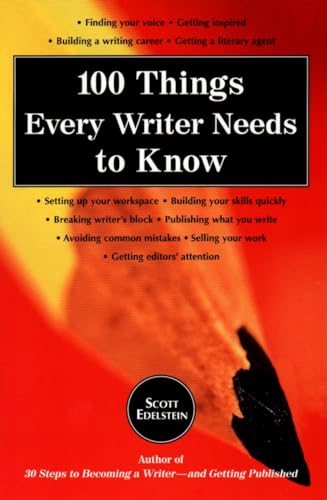

100 things every writer needs to know \ Scott Edelstein.
Detalles de publicación: New York, N.Y. Perigee Books 1999.Edición: 1st edDescripción: ix, 245 p. 21 cmISBN:- 0399525084
- One hundred things every writer needs to know
- 808.02 E219o 21
- PN147 .E24 1999
| Imagen de cubierta | Tipo de ítem | Biblioteca actual | Biblioteca de origen | Colección | Ubicación en estantería | Signatura topográfica | Materiales especificados | Info Vol | URL | Copia número | Estado | Notas | Fecha de vencimiento | Código de barras | Reserva de ítems | Prioridad de la cola de reserva de ejemplar | Reservas para cursos | |
|---|---|---|---|---|---|---|---|---|---|---|---|---|---|---|---|---|---|---|
| Libro | Biblioteca Encarnación Valdés Colección General bev | 808.02 E219o (Navegar estantería(Abre debajo)) | Disponible | 80000002251067 |
Descripciones mejoradas de Syndetics:
Writer, editor, and literary agent Scott Edelstein has done it all--and now this industry insider brings his valuable secrets to both beginning and established writers. Covering everything from building writing skills to dealing with editors to starting a writing business, this all-important guide will get you started and point you in the right direction. With matter-of-fact advice and encouragement from an expert, you'll get the information, inspiration, and guidance you need to write your best and begin a successful writing career.
Includes bibliographical references (p. 235-242).
What this book can do for you -- Basic wisdom -- The writing process -- Building your writing skills -- Making money from your writing -- The writer's life -- Useful resources for writers.
Tabla de contenidos provista por Syndetics
- Introduction What This Book Can Do for You(p. 1)
- Basic Wisdom
- 1 Anyone who writes is a writer(p. 5)
- 2 Every writer starts out as a beginner(p. 6)
- 3 Some writers are born, but most of us are trained(p. 7)
- 4 Writing isn't inherently noble, painful, or glamorous(p. 9)
- 5 Writing is an act and a process, not a definition of who you are(p. 11)
- 6 The only way to discover whether you have writing talent is to write(p. 12)
- 7 There is no single "right" way to write(p. 13)
- 8 Nothing will teach you more about writing than the act of writing itself(p. 14)
- 9 Each writer builds their skills at their own rate of speed(p. 15)
- 10 You can safely ignore most of the "have to's" you've been taught about writing(p. 16)
- 11 Outfit yourself with a few basic reference volumes(p. 19)
- 12 To get the most out of writing, write what you would enjoy reading(p. 21)
- 13 Getting published isn't hard, but getting published in prominent places is(p. 23)
- 14 Being published doesn't make you a better writer or person(p. 25)
- 15 Beware of anyone who wants money from you to read, represent, or publish your work(p. 26)
- 16 Unless you're rich or have substantial savings, don't quit your job to become a freelance writer(p. 28)
- 17 Ask yourself honestly what you want to get out of writing. Then make that your goal(p. 30)
- 18 If you don't like what you're writing--or the act of writing in general--you can always stop(p. 33)
- The Writing Process
- 19 Each person's writing process is unique(p. 37)
- 20 Discover the times, places, and circumstances that help you write at your best(p. 39)
- 21 Some writers find it very helpful to keep a journal or notebook(p. 42)
- 22 You can start work on a piece of writing almost anywhere--with an event, a person, a quotation, an image, an idea, a setting, or just about anything else(p. 43)
- 23 You don't have to know where your piece is going when you begin writing it(p. 44)
- 24 You don't have to write your piece in the same order in which people will ultimately read it(p. 45)
- 25 To help structure your piece or organize your ideas, try outlining or netlining(p. 46)
- 26 When you're not sure what word, phrase, or image to use, skip over it(p. 52)
- 27 Write more words than you need--then cut the excess later(p. 53)
- 28 Be willing to take risks and make mistakes(p. 54)
- 29 Ignore the perfectionist, the worrier, and the nitpicker inside your head(p. 56)
- 30 Virtually all writers need to revise and edit their work--often many times(p. 57)
- 31 Read your work aloud after each draft--and as you edit(p. 59)
- 32 Put your piece aside overnight before each round of revising or editing(p. 60)
- 33 The final decisions on writing, revising, editing, and publishing anything you've created are yours and yours alone(p. 61)
- 34 It's fine to work on more than one piece at a time(p. 62)
- 35 Some writers develop their own distinct style; others change their style from piece to piece(p. 63)
- 36 "Writer's block" has many different causes--and at least as many solutions(p. 65)
- 37 Never throw away anything you write(p. 71)
- Building Your Writing Skills
- 38 Become familiar with some basic writing terms(p. 75)
- 39 Get in touch with what inspires you(p. 94)
- 40 Take time to meditate and ponder(p. 97)
- 41 Fantasize. Ask "What If?"(p. 100)
- 42 Show rather than tell(p. 102)
- 43 Involve your reader's senses(p. 104)
- 44 Write multiple variations, versions, or scenarios(p. 106)
- 45 Combine unexpected elements(p. 108)
- 46 Writing teachers, classes, and workshops range from wonderful to outright harmful(p. 110)
- 47 Get feedback on your writing from people you trust(p. 113)
- 48 Consider carefully what others have to say about your writing--but never let their comments overrule your own judgment(p. 116)
- 49 Follow your heart and gut(p. 118)
- 50 Let your writing find its own way(p. 119)
- Making Money from your Writing
- 51 Understand the difference between a salaried writer, a contract writer, and a freelancer(p. 123)
- 52 It's possible to get rich by writing--but it doesn't happen often(p. 125)
- 53 There is far more money in writing for businesses and nonprofits than there is in writing for publication(p. 128)
- 54 Plan to start out small, then work your way up slowly(p. 130)
- 55 Most communication fields (publishing, film, TV, etc.) are moderately to highly dysfunctional(p. 133)
- 56 Nonfiction accounts for 95 percent of all published material, and 95 percent of all the money writers make(p. 136)
- 57 There are three ways to publish material in periodicals
- 1 Complete whatever pieces you desire, then submit them for publication
- 2 Pitch ideas for pieces to editors, then contract in advance to write them; and
- 3 Write whatever editors ask you to write, on assignment(p. 137)
- 58 Unless you're dealing with the film or TV industries, you don't have to worry about people stealing your work or ideas. If you are dealing with Hollywood, there is a way to protect yourself and your work(p. 148)
- 59 You don't need to register your work with the Copyright Office, or mail a copy to yourself, or print a copyright notice on it(p. 150)
- 60 Unless you become famous, expect to be rejected much or most of the time(p. 152)
- 61 It's quite simple to establish a pen name for yourself(p. 154)
- 62 If you're serious about marketing your writing, you must do your own thorough market research(p. 155)
- 63 Use Writer's Market as one place to begin your market research, but only as a beginning(p. 161)
- 64 Some of the best-paying publications--and some of the easiest ones to get published in--can't be found at any bookstore or newsstand(p. 164)
- 65 It's essential to send your work not only to the right publishers, but to the right editors as well(p. 166)
- 66 You may send the same manuscript to many different editors at once(p. 172)
- 67 Avoid sending query letters to editors, publishers, and producers(p. 174)
- 68 Most editors and producers will not give you much feedback on your work(p. 176)
- 69 When editors and producers do give you feedback, don't take it too seriously most of the time(p. 177)
- 70 Treat editors, producers, agents, and other media professionals like normal human beings(p. 178)
- 71 When an unexpected opportunity arises, don't be afraid to grab it(p. 179)
- 72 Virtually everything in a publishing contract is potentially negotiable(p. 181)
- 73 Don't be afraid to ask for what you want or need(p. 184)
- 74 Don't promise anything you can't deliver(p. 185)
- 75 Most published nonfiction books start out as book proposals(p. 187)
- 76 You don't need a literary agent unless you wish to sell a book, a full-length play, or material for major TV or film production(p. 190)
- 77 To get an agent, write a brief letter to twenty to twenty-five people selected from the resources listed in this chapter(p. 191)
- 78 Legitimate literary agents earn their money by selling writers' work and receiving a commission (usually 10-15 percent)--not through any other means(p. 196)
- 79 Many of the people who call themselves literary agents operate scams and schemes that can cost you money and do you harm(p. 198)
- 80 Don't waste your time entering lots of literary contests, particularly those with entry fees(p. 201)
- 81 Paying a "vanity press" to publish your book actually discourages bookstores from buying it(p. 203)
- 82 Self-publishing is a viable option only if you know your market, are good at promotion and publicity, and are willing to devote at least twenty hours a week to promoting and marketing your book(p. 205)
- 83 Be very wary of "copublishing" arrangements(p. 207)
- 84 Avoid sending your work to poetry anthologies that advertise for submissions(p. 210)
- 85 Plenty of jobs are available for writers and editors--but they're not easy to get(p. 212)
- 86 One of the best ways to land a writing or editing job is through an internship or assistant's position(p. 214)
- The Writer's Life
- 87 Building a successful writing career requires skill, time, patience, perseverance, and flexibility. Being good at marketing helps, too(p. 219)
- 88 Your successes and failures as a writer will be half the result of your own effort, half the result of luck(p. 220)
- 89 Writing is by nature a solitary activity(p. 221)
- 90 Most freelance writers have at least one other job(p. 222)
- 91 Integrate your writing with the rest of your life. Don't neglect your family--or yourself--in favor of your writing(p. 223)
- 92 When you read something by a widely published writer and find yourself saying, "I can write better than that," you're probably right(p. 224)
- 93 It is up to you to decide how much to network, schmooze, and socialize with other writers(p. 226)
- 94 The opinions of any two writers, editors, or writing teachers will often differ(p. 228)
- 95 Expect some negative reviews, reactions, and opinions(p. 229)
- 96 When the going gets tough, reward yourself(p. 230)
- 97 There are real but limited benefits to joining writers' groups, centers, clubs, and organizations(p. 231)
- 98 There's something unique to you and your writing that's every bit as important as the ninety-nine other tips and guidelines in this book(p. 232)
- 99 Keep reminding yourself why you write and what you get out of writing(p. 233)
- 100 Enjoy yourself. The very best reason to write is for the pleasure of it(p. 234)
- Appendix Useful Resources for Writers(p. 235)