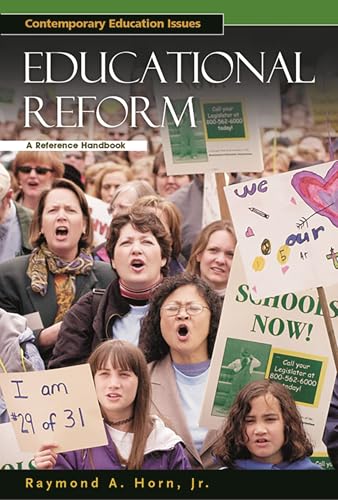

Understanding educational reform a reference handbook Raymond A. Horn.
Series Contemporary education issuesDetalles de publicación: Santa Barabara, CA ABC-CLIO 2002.Descripción: xiv, 338 p. 23 cmISBN:- 1576078086
| Imagen de cubierta | Tipo de ítem | Biblioteca actual | Biblioteca de origen | Colección | Ubicación en estantería | Signatura topográfica | Materiales especificados | Info Vol | URL | Copia número | Estado | Notas | Fecha de vencimiento | Código de barras | Reserva de ítems | Prioridad de la cola de reserva de ejemplar | Reservas para cursos | |
|---|---|---|---|---|---|---|---|---|---|---|---|---|---|---|---|---|---|---|
| Libro | Biblioteca de Mayagüez Colección General mb | LA 209.2 .H58 2002 (Navegar estantería(Abre debajo)) | Disponible | 50000002121175 |
Descripciones mejoradas de Syndetics:
The only handbook of its kind to bring together materials from a wide range of authoritative works, providing the reader with a comprehensive overview of reform in American education.
Crafted in ten skillfully written chapters, Educational Reform covers the history, politics, and processes of educational reform and addresses reforms in curriculum, instruction, and assessment. Starting with a definition of educational reform and where its far-reaching results can lead, the work goes on to assess the role of the public in educational reform, the educational reform industry, and resistance to reform.
Of interest to school boards and administrators and useful in graduate and undergraduate courses in education, it is written in a conversational tone that brings the subject out of the realm of dry analysis. Readers will benefit not only from the numerous case studies that intersperse the themes discussed, but also from the extensive bibliography of print and nonprint resources (including websites) listed for further study. There is little doubt that the classroom must change to meet the needs of the 21st century--read Educational Reform to learn just how.
Inlcudes bibliographical references and index.
Tabla de contenidos provista por Syndetics
- Series Editor's Preface(p. xi)
- Preface(p. xiii)
- Chapter 1 The Essential Questions about Educational Reform(p. 1)
- Defining Educational Reform(p. 1)
- Educational Reform, Change, and Progress(p. 1)
- The Political Context of Defining Reform(p. 4)
- Using a Post-Formal Method to Understand Educational Reform(p. 6)
- The Need for Educational Reform(p. 6)
- Arguments Supporting the Need for Reform--and Some Caveats(p. 6)
- Going Beyond Reform--School Choice and Deschooling(p. 10)
- Reform and the Purpose of Education(p. 12)
- Functional Purposes(p. 12)
- Philosophical Purposes(p. 13)
- The Importance of a Critical Approach(p. 15)
- The Sustainability of Educational Reform(p. 19)
- The Persistent Failure of Educational Reform(p. 19)
- Messy Problems and Educational Dilemmas(p. 20)
- The Need for Time to Fully Implement Reforms(p. 21)
- Reasons That Some Reforms Should Not Be Sustained(p. 22)
- When Do You Give Up on a Reform?(p. 24)
- Historical Responses to These Questions(p. 25)
- Chapter 2 The History of Reform in American Education(p. 31)
- The Mid-1800s to 1900(p. 31)
- The Late 1800s(p. 32)
- The Committee of Ten and the Humanist View of Curriculum(p. 33)
- The Child Study and Child Development Movement(p. 34)
- 1900 to 1950(p. 34)
- The Cardinal Principles of Secondary Education(p. 34)
- Vocational Education(p. 35)
- The Social Efficiency Movement(p. 36)
- Progressives, Social Reformers, Social Meliorists(p. 37)
- Essentialist Education Movement(p. 39)
- The Eight-Year Study and the Tyler Rationale(p. 39)
- Life Adjustment Education(p. 40)
- The 1950s(p. 40)
- Sputnik and a Return to Humanism(p. 41)
- James Conant and the Reform of the American High School(p. 41)
- The National Defense Education Act and the National Science Foundation(p. 42)
- Reform Outcomes and Patterns of the 1950s(p. 43)
- The Beginning of the Quest for Equity(p. 44)
- The 1960s and 1970s(p. 44)
- Striving for Equity in American Education(p. 45)
- The Elementary and Secondary Education Act and Compensatory Reform(p. 45)
- Continuing Federal Reform into the 1970s(p. 46)
- New Reforms, the Fate of Previous Reform, and the Critics of Education(p. 47)
- The 1980s and 1990s(p. 50)
- The Influence of Business in Educational Policy(p. 50)
- Compensatory Education(p. 51)
- Commission Reports and Reform Initiatives(p. 51)
- Restructuring, Educational Standards, and Accountability(p. 57)
- Outcomes of the Reforms of 1980 to the Present(p. 59)
- Chapter 3 Chronology(p. 65)
- Chapter 4 The Politics of Educational Reform(p. 81)
- Conservative, Liberal, and Radical perspectives on Education and Reform(p. 81)
- The Conservative View(p. 81)
- The Liberal View(p. 84)
- The Radical View(p. 87)
- The Culture Wars(p. 90)
- Market-Based Reform(p. 94)
- Total Quality Management(p. 95)
- The Influence of Business Consultants on Education(p. 96)
- The Privatization of Public Schools(p. 96)
- The Deeper Issues of the Privatization of Public Schools(p. 99)
- Channel One: Students as Consumers and Schools as New Markets(p. 100)
- School Choice and the Politics of Educational Reform(p. 101)
- Teacher Unions and the Politics of Educational Reform(p. 103)
- Chapter 5 The Process of Educational Reform(p. 109)
- Initiating Educational Reform(p. 109)
- Implementing Educational Reform(p. 114)
- Implementation of Educational Reform by State Governments(p. 114)
- Implementation of Educational Reform by Universities(p. 117)
- Implementation of Educational Reform by Professional Organizations(p. 119)
- Implementation of Educational Reform through Professional Development in Schools(p. 121)
- Implementation of Educational Reform by Textbook Publishers(p. 126)
- The Influence of Mass Media on the Implementation of Educational Reform(p. 131)
- Two Basic Elements of the Reform Process--Conversation and Stakeholder Participation(p. 136)
- Conversation(p. 136)
- Participation(p. 140)
- The Dilemma of How to Deal with Change(p. 144)
- The Complexity of Educational Change(p. 144)
- Approaches to Educational Change(p. 149)
- Conclusion(p. 153)
- Chapter 6 The Dilemma of Educational Research(p. 157)
- The Dueling Philosophies of Research Methodology(p. 160)
- The Purpose of Educational Research(p. 160)
- The Origins of Knowledge and Educational Decision Making(p. 162)
- The Current Condition of Educational Research(p. 165)
- The Current Condition As It Is Assessed(p. 166)
- Creating and Implementing Quality Research Standards(p. 168)
- Political Pressure on Educational Research(p. 170)
- The Inadequate Funding of Educational Research(p. 171)
- The Quandary of Quantitative and Qualitative Research(p. 172)
- Quantitative Research(p. 172)
- Qualitative Research(p. 176)
- The Contentious Relationship of Theory and Practice(p. 186)
- Defining the Relationship between Theory and Practice: Dewey and Thorndike(p. 186)
- Attempts to Recombine Theory and Practice(p. 190)
- Chapter 7 Reform in Curriculum, Instruction, and Assessment(p. 197)
- Defining Curriculum(p. 198)
- The Differing Manifestations of Curriculum, Instruction, and Assessment(p. 202)
- Curriculum(p. 203)
- Instruction(p. 214)
- Assessment(p. 219)
- The Standards and Accountability Movement(p. 224)
- Chapter 8 The Role of the Public in Education Reform(p. 229)
- Defining Community(p. 230)
- Public Understanding of and Participation in Educational Reform(p. 234)
- The Relationship between the School and the Public(p. 236)
- Public Involvement through Site-Based Reforms(p. 241)
- Public Involvement through School Choice(p. 243)
- Conclusion(p. 244)
- Chapter 9 Resistance to Reform(p. 247)
- The Cultural Context of Resistance to Reform(p. 249)
- The Personal Context of Resistance to Reform(p. 256)
- Resistance and Accountability(p. 263)
- Chapter 10 Selected Print and Nonprint Resources(p. 267)
- Print Resources(p. 267)
- Curriculum, Educational Change, and School Reform(p. 267)
- History of Education(p. 283)
- Reform in School Administration(p. 285)
- Nonprint Resources(p. 286)
- Glossary(p. 297)
- Index(p. 315)
- About the Author(p. 339)