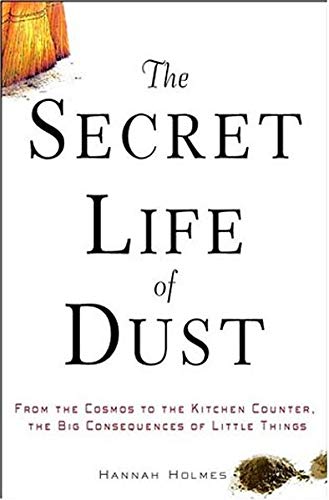
Imagen de portada de Amazon
Imagen de Amazon.com
Imagen de cubierta Syndetics
Portada de Syndetics
Imagen de OpenLibrary

The secret life of dust from the cosmos to the kitchen counter, the big consequences of little things Hannah Holmes.

Por: Detalles de publicación: New York Wiley c2001.Descripción: ix, 240 p. 25 cmISBN:
  • 0471211672 (electronic bk.)
  • 0471377430 (acid-free paper)
Tema(s): Clasificación CDD:
  • 551.51/13 21
Clasificación LoC:
  • Q173 .H733 2001
Premios: Haga clic para abrir en una nueva ventana
Valoración
    Valoración media: 0.0 (0 votos)
Existencias
Imagen de cubierta Tipo de ítem Biblioteca actual Biblioteca de origen Colección Ubicación en estantería Signatura topográfica Materiales especificados Info Vol URL Copia número Estado Notas Fecha de vencimiento Código de barras Reserva de ítems Prioridad de la cola de reserva de ejemplar Reservas para cursos
Libro Biblioteca de Mayagüez Colección General mb Q173 .H733 2001 (Navegar estantería(Abre debajo)) Disponible 50000003169744
Total de reservas: 0

Descripciones mejoradas de Syndetics:

Hannah Holmes A mesmerizing expedition around our dusty world
Some see dust as dull and useless stuff. But in the hands of author Hannah Holmes, it becomes a dazzling and mysterious force; Dust, we discover, built the planet we walk upon. And it tinkers with the weather and spices the air we breathe. Billions of tons of it rise annually into the air--the dust of deserts and forgotten kings mixing with volcanic ash, sea salt, leaf fragments, scales from butterfly wings, shreds of T-shirts, and fireplace soot. Eventually, though, all this dust must settle.
The story of restless dust begins among exploding stars, then treks through the dinosaur beds of the Gobi Desert, drills into Antarctic glaciers, filters living dusts from the wind, and probes the dark underbelly of the living-room couch. Along the way, Holmes introduces a delightful cast of characters--the scientists who study dust. Some investigate its dark side: how it killed off dinosaurs and how its industrial descendents are killing us today. Others sample the shower of Saharan dust that nourishes Caribbean jungles, or venture into the microscopic jungle of the bedroom carpet. Like The Secret Life of Dust, however, all of them unveil the mayhem and magic wrought by little things.
Hannah Holmes (Portland, ME) is a science and natural history writer for the Discovery Channel Online. Her freelance work has been widely published, appearing in the Los Angeles Times Magazine, the New York Times Magazine, Outside, Sierra, National Geographic Traveler, and Escape. Her broadcast work has been featured on Living on Earth and the Discovery Channel Online's Science Live.

Includes bibliographical references (p. 211-228) and index.

gccfeb2009

Tabla de contenidos provista por Syndetics

  • Acknowledgments(p. IX)
  • Introduction(p. 1)
  • 1 The World in a Grain of Dust(p. 5)
  • 2 Life and Death among the Stars(p. 14)
  • 3 A Light and Intriguing Rain of Space Dust(p. 27)
  • 4 The (Deadly) Dust of Deserts(p. 43)
  • 5 A Steady Upward Rain of Dust(p. 59)
  • 6 Dust on the Wind Heeds No Borders(p. 80)
  • 7 Did Dust Do In the Ice Age?(p. 98)
  • 8 A Steady Downward Rain of Dust(p. 118)
  • 9 A Few Unsavory Characters from the Neighborhood(p. 140)
  • 10 Microscopic Monsters and Other Indoor Devils(p. 164)
  • 11 Dust to Dust(p. 193)
  • Web Sites(p. 205)
  • Bibliography(p. 211)
  • Index(p. 229)

Extracto provisto por Syndetics

Chapter One THE WORLD IN A GRAIN OF DUST Picture a juice glass sitting on a porch railing in the sunshine. It may look empty, but churning inside that glass are twenty-five thousand microscopic pieces of dust--at least . And these dusts are a little bit of everything on Earth. One minute they're tiny crumbs chipped off Saharan sand and invisible shreds of camel hair. Then the wind shifts, and you are surrounded by spores of forest fungi and fragments of desiccated violets. A bus stops nearby to take on passengers, and flakes of human skin mixed with minuscule specks of black soot momentarily dominate.     Every time you inhale, thousands upon thousands of motes swirl into your body. Some lodge in the maze of your nose. Some stick to your throat. Others find sanctuary deep in your lungs. By the time you have read this far, you may have inhaled 150,000 of these worldly specks--if you live in one of the cleanest corners of the planet. If you live in a grubbier region, you've probably just inhaled more than a million.     Although these dusts have been waved aside for most of human history, in this book we'll see that dust is terrifically consequential. Some dusts menace the planet and its living residents. Some are beneficial to people, plants, and animals. Many are merely fascinating. All are going under the microscope. And the secret lives of dust are being revealed. One of the most impressive revelations is how much dust surrounds us--the sheer tonnage of stuff rising off the face of the Earth. Because these specks are so small and shifty, the estimates are still rough. Nonetheless, irrefutably huge amounts of small things take to the wind each year.     Between 1 and 3 billion tons of desert dust fly up into the sky annually. One billion tons would fill 14 million boxcars, in a train that would wrap six times around the Earth's equator.     Three and a half billion tons of salt flecks rise off the oceans.     Trees and other plants exhale a billion tons of organic chemicals into the wind, perhaps one-third of which condenses into tiny, sailing beads.     Plankton, volcanoes, and swamps leak 20 to 30 million tons of sulfur compounds, about half of which forms little airborne specks.     Burning trees and grasses throw up 6 million tons of black soot.     The world's glaciers slowly grind their host mountains into dust that takes to the wind--but in what quantities? No one knows.     Likewise, how many glassy bits of volcanic ash are blasted into the ether?     And the dusts of life-flying fungi, viruses, diatoms, bacteria, pollen, fibers of rotting leaves, eyes of flies and legs of spiders, scales from the wings of butterflies, hair fragments from polar bears, skin flakes from elephants--how many tons of these roam the atmosphere?     About 4 million years ago our ancestors began to augment the dusty exhalations of nature. At first we supplemented the soot, as we mastered the mesmerizing tool of fire. Then, when we learned about the miracle of metals, our smokes grew richer with microscopic beads of hot bronze, iron, copper, gold, and silver. The advent of spinning and weaving produced invisible fragments of animal and plant fibers, which the wind lifted out of our encampments. Finally, with the industrial revolution, our dust output shifted into high gear.     Ninety to 100 million tons of sulfur now rise annually from the world's fossil-fuel burners--mainly coal-fired power plants, but also oil-fired plants and diesel engines. Every natural sulfur bead in the sky is now accompanied by between three and five human-made beads. And the Earth hosts more fuel burners every day.     More than 100 million tons of nitrogen oxides, which like sulfur gas are prone to form dusty particles in the sky, flow upward from our farms, and automobiles and other fuel-burning inventions.     Eight million tons of black soot in the sky are attributable not to burning trees and grasses but to the conflagration of fossil fuels--especially coal. Even of the 6 million tons of soot that rain upward from tree-and-grass fires, most can be traced to the human hand.     Whether the skies carry 1 billion or 3 billion tons of desert dust, fully half may be our responsibility. Our agriculture and other assaults on the landscape may have doubled the amount of desert dust naturally present in the air.     And the miscellaneous dusts of the twentieth century-nerve-racking mercury and stupefying lead; carcinogens from dioxin to polychlorinated biphenyls (PCBs); the radioactive dusts of nuclear disasters, pesticides, asbestos, and poisonous smokes--how many tons of these roam the skies each year? That is unknown. * * * If the quantities of dust are hard to gauge, dust scholars have an easier time pinning a size on various dusts. Generally, the dusts that whirl around us are so small that gravity has to fight to get control of them. Forces on the surface of a piece of dust--static electricity, even the interaction of one atom with another--can overpower the call of gravity. Dust can perch on the ceiling as easily as on the tabletop.     Scientists measure dust in microns, or twenty-five-thousandths of an inch. Consider the hair on your arm. A single hair might be 100 microns wide. Now imagine taking up scissors and snipping off a section 100 microns long . That tiny snippet, visible only if you know where to look for it, is too big to be dust. From a scientist's perspective, that snippet falls in the family of sand.     The very biggest grains of dust are, technically, only two-thirds as wide as a hair. These fat dusts are usually the work of nature. The diameter of pollen grains, for instance, ranges from a full hair's width to a tenth of a hair's width. If you sift a handful of sand from the beach or the desert, the faint powder that sticks to your palm will be a range of sizes, with lots of grains in the fatter category. The flakes of dead skin that float out through the weave of your shirt to form an invisible halo around you are rectangles one-tenth of a hair wide and two-tenths of a hair long. Many of the salt flecks that blow off the oceans are upward of 5 microns wide. And those are still some of the larger dusts.     Health scientists fret more about small dusts than large ones. That's because the human body has evolved to bar the entrance of nature's big creations. Nearly all pollens, for example, are so big that they get hung up inside the nose--as people with allergies are well aware. But small dusts can slide right past the traps inside your head and sail deep into your delicate lungs.     Until recently, scientists drew the line between safe and dangerous dusts at ten microns--one-tenth of a hair's width. But as dust investigators peered more closely at their little subjects, they decided to move the line. Medical research now shows that dusts less than one-quarter that big--a twenty-fifth of a hair--cause the most disease and death. Even as scientists rewrite dust limits to protect our lungs, they're still struggling to understand how tiny dusts kill.     So which dusts fall on the small side of the line? A few natural dusts make the cut: bacteria and fungal spores are usually well under 10 microns But industrial dusts are the dominant force in the "teensy" category. Pesticide dusts are often between half a micron and 10 microns wide. The very biggest particles in a puff of tobacco smoke are less than half a micron wide--that', one two-hundredth of a hair. The smallest particles in automobile exhaust are a hundredth of a micron-one ten-thousandth of a hair. This is also the realm of tiny particles that form when pollution gases condense into beads in the air. Viruses and big molecules are about the same size. You can begin to imagine how 25,000 of these tiny motes could roam a juice glass unnoticed. For all the murder and mischief we'll see it commit in this book, dust is nonetheless indispensable. The Sun we circle was created inside a giant womb of protective space dust. Some of that same dust--tiny specks the size of cigarette smoke--came together to make our planet. In cosmically large quantities, dust blackens the Milky Way, blocking our view of most of the stars. And each star that dies rains more dust out into the galaxy, like a black firecracker. It is this dust of expired stars that will form the next generation of Suns, Earths, and other heavenly bodies.     And here on Earth we wouldn't want to do without dust. For starters, a clean world would be an oppressively muggy world. In the planet's water cycle, water evaporates off the oceans and lakes, condenses in the air, and falls back to the ground. But that condensation step assumes a sky full of dust, upon whose little surfaces water vapor can gather. Without dust, water vapor wouldn't begin to condense until the relative humidity was about 300 percent . This would make the sultriest summer day seem dry and crisp by comparison. For lack of a more suitable nucleus, the water vapor would condense on your body.     Since a cloud is just a collection of water droplets condensed around various dusts, a shortage of dust also implies a shortage of clouds in the sky. And clouds reflect much of the sunlight that hits them, casting shade on the planet. At any given time, they cover about half the Earth. Without them, it would get mighty warm down here.     Many of the dusts that roam the Earth are little bits of life, whose ability to travel on the wind keeps the planet healthy and green. Fungi, for instance, make a living breaking down a variety of substances, including the dead flesh of plants and animals, and even rocks. Their efforts free trapped nutrients and enrich the soil. And the overwhelming majority of fungus species have adapted to fling their spores into the wind. These tough spores travel the world, falling back to Earth at the whim of wind and rain.     Many pollens also evolved to exploit the wind. The bigger grains hitchhike aboard bees and other nectar hunters. But the smaller ones sail through the air on their own, perchance to touch down on a suitable flower, thus ensuring the perpetuation of green and growing things.     Microscopic diatoms, which are glass-shelled algae, may distribute themselves this way, too. Even minuscule worms called nematodes are small enough to climb onto the wind and spread their race. Antarctica, for instance, was probably scrubbed clean of life in the last ice age. But now a variety of microorganisms, including the relatively large nematodes, have colonized the cold patches of dirt in the continent's McMurdo Dry Valleys. The most likely explanation for their presence is that their ancestors flew in from South America, Africa, or Australia.     Among the many marvelous subtopics of dust research, one that refuses to dry up and blow away is the notion that some tiny life forms not only ride the wind, but also reproduce in that dusty domain. Various researchers have proposed that some bacteria help water vapor to condense in the sky and then divide and multiply inside the drops they create.     Even the billions of tons of lifeless rock dust that clot the air downwind of deserts are valuable to the Earth. Certain islands in the Caribbean would be naked, gray rock if it weren't for the dusts of deserts and volcanoes that settle heavily upon them. Instead they are humps of lush and happy vegetation. Likewise the tapestry of the Amazon rain forest is indebted to dust. In such a rainy climate, water quickly flushes nutrients out of the soil. But each winter, when the trade winds head southwest from the Sahara, rich dust rains down on the South American forests and refreshes the soil.     Falling rock dust feeds tiny mouths in some of the world's most desolate places. On the Earth's glaciers, settling dust arrives like a catering service, spreading assorted dishes out for the enjoyment of some of the hardiest life forms we know of. Even inside a glacier we'll see that well-traveled dust can sustain a tiny web of life. Dust that falls in the ocean can also fuel a bloom of plants. These plants are microscopic phytoplankton. But despite their unobtrusive size, plankton are the bread and butter of the oceanic food chain. And in a twist on the "dust to dust" cycle, they sometimes take nutrients from falling desert dust and then send aloft a sulfur-rich dust that plays a key role in forming clouds.     To some degree, scientists have learned how an assortment of living and dead dusts tinker with the weather. And it's now becoming clear that dust alters the world's long-term climate , too. Traditionally, climatologists have focused their fears on gases that trap heat near the Earth, but as the globe gets warmer, little airborne specks have become a very big topic. Scientists now know that some of our dusts reflect sunlight and cool the planet. And others, especially our black soots, may be soaking up huge amounts of heat as they roam the sky. Some marvelous theories even implicate a global blizzard of dust in the sudden retreat of the glaciers at the end of the last ice age. But for now, the brightest minds on Earth can't say exactly what dust is doing to the thermostat, whether for better or worse. The relationship between dust and humanity has also been complex--for thousands of years.     Eight thousand years ago, Chinese farmers discovered the charms of massive deposits of desert dust that had settled out of the air in central China. This blanket, about three hundred feet thick, was effortlessly tilled and nutritious for plants. Today similar dust deposits all over the world, including the central United States, are under intense cultivation. Unfortunately, as we'll see, loosening this ancient dust can sometimes be disastrous.     Perhaps four thousand years after Chinese farmers dug into their dust, people in ancient Mesopotamia were melting down their own local powder to manufacture rocks. At a site called Mashkan-shapir, archaeologists recently discovered large, flat rectangles of black rock, whose composition resembled no natural basalt. But the chemistry of the rocks did match the dust deposited on the banks of the local river. The archaeologists speculated that a natural shortage of wood and stone inspired the people of Mashkan-shapir to heat their dust to twenty-two hundred degrees, then mold the molten dust into rocks.     At that same early date, the people of Finland were exploring the merits of a special dust of their own. This dust, which was pounded from strange, fibrous rocks, strengthened the clay that they used for both pottery and house chinking. Farther south in Europe, people eventually learned to weave the fibers of this same rock--asbestos--into fireproof cloth. And early naturalists did notice that asbestos weavers were a particularly unhealthy lot.     On the other side of the world the Maya people at Tikal, Guatemala, seem to have carefully added a substantial percentage of volcanic dust, or ash, to their pottery to toughen it. That tradition demands a large supply of ash--which has produced a mystery: The nearest ash deposits aren't terribly close by. Was volcanic dust so valuable that it was worth lugging through a hundred miles of jungle? An alternative explanation is equally intriguing: Central American volcanoes were a lot more active a lot more recently than we realize, throwing their ash all the way to Tikal.     Today humanity still employs dust for planting crops, for building, and for Pottery--and for thousands of other purposes. Cement walls are a mixture of rock dust and pebbles. Sheetrock is a mineral powder, compressed into a convenient form. Colored dust gives paint its hue. Rock dusts give scouring powder its grit, toothpaste its polish, and talcum powder its silkiness. Eye shadow can be a mixture of dazzling dusts, from talc to powdered fish scales and pigments. Aspirins and vitamins are compacted dusts. Magazine paper is made shiny with the thinnest coating of dried clay dust. Pencils hold a core of pressed graphite powder. Bread is made of powdered wheat kernels, and so is pasta. Yellow mustard is the dust of mustard seeds, and soft cocoa is the dust of hard cocoa beans. Modern life relies heavily on dust.     One reason we powder so many things is that dust offers huge amounts of surface area to work with. Since chemical reactions generally take place on the surface of an object, the more surface you can provide, the more intense the reaction will be. Imagine, if you will, steeping fifty whole coffee beans in a mug of hot water. Yuck. Then imagine grinding fifty coffee beans to dust and repeating the experiment. Or imagine dropping a bar of solid soap into the washing machine with a load of clothes. Then imagine shredding that soap into powder and repeating the exercise. More surface area permits more interaction.     This characteristic can produce results both wonderous--and woeful. Some of the dusts that swirl around us are fearsome and invisible rogues. Leave aside for a moment poison particles launched by human industry. Plain old desert dust has a dark side of its own.     Seventy-five million years ago, for instance, simple desert dust seems to have set a subtle trap for a fieldful of dinosaurs. One minute these formidable creatures were going about their domestic duties. And the next minute the dust in the surrounding sand dunes conspired to entomb them. (The detective work required to reconstruct such an old murder scene, and to implicate something as easily overlooked as dust, is considerable, we'll see.)     Perhaps those dinosaurs were the lucky ones. Ten million years later the dinosaur story would come to a much slower and more final close, as a worldwide cloud of dust from a giant meteorite impact darkened the sky and blotted out the Sun. That dust murdered birds, sea life, and small, pioneering mammal species as well.     Desert dust still delivers trouble to this day. A dust-related disease stands charged with the slaying of purple sea-fan corals. Dust from the Sahara has long beaten a path across the Atlantic Ocean to rain down on the Caribbean. But in the 1970s a terrible drought in the African Sahel region south of the great desert began to send extra dust rolling down this skyway. And as the falling dust grew thick in the Caribbean in the early 1980s, scientists saw a plague sweep through the coral reefs. Coincident with the dust invasion, two species of coral were nearly wiped out, a species of sea urchin was decimated, and the purple sea fans developed dark, lumpy lesions. It took some sleuthing, but a scientist has pinned the sea-fan plague on a fungus in the Saharan dust.     Scientists are now examining this dust more closely and finding everything from radioactive elements to mercury and an impressive array of fungi. In the summer in southern Florida, says one longtime dust scholar, this far-flung desert dust is the most common sort of particle in the air. There may be implications for human health.     Health experts already know that some dusts can be deadly to people. When they rank U.S. cities by the quantity of pollution dust in the air, then rank the same cities by deadliness, they find a match. The dustier the city, the higher the death rate. One federal agency estimates that pollution dusts alone kill sixty thousand people each year in the United States. The crucial question in this case of mass murder is ... which dusts do the killing?     Some dusts are obviously fatal. Coal dust, for instance, kills 1,500 miners every year in the United States. The dust of powdered quartz kills 250 more miners, sandblasters, and other laborers in this country. The needle-shaped dusts of asbestos cause deadly cancers of the lung and gut. But none of those dusts hangs terribly thickly in city air. Something else is at work. The clues are piling up against the tiny chemical dusts of our own making.     The dusts we find indoors can be as kind and as cruel as those found outside.     The dust bunnies that skulk beneath the couch and behind the refrigerator contain everything from space diamonds to Saharan dust to the bones of dinosaurs and bits of modern tire rubber. But they also hold poisonous lead and long-banned pesticides, dangerous molds and bacteria, cancer-causing smoke particles, and a sample of all the convenient chemicals that we innocently distribute through our houses in the name of cleanliness. The dust bunny is riddled with allergy-inducing dust-mite parts, with the mites themselves, and with the predatory mites and pseudoscorpions that stalk and kill them.     In addition, house dust bears some blame for lead poisoning among children. As children crawl across carpeting--especially aged, dust-packed carpeting--their sticky little paws gather dust. And then those paws go into their mouths. One of the best indicators of how much lead a child's blood will contain is how much lead a sample of carpet dust contains.     Oddly, if it weren't for the chemicals and metals that foul house dust, we might learn to love our dust bunnies. For decades, allergists have shot up some of their patients with a distillation of dust taken straight from the vacuum-cleaner bag. Although the secret to the success of this bizarre protocol isn't known, allergists swear it does tame dust allergies. And some of the most riveting research in all of dust science is now drawing a connection between dusty homes and healthy children. An epidemic of asthma is exploding among the children of developed nations. But a flurry of studies is showing that babies who do their crawling and finger sucking in dusty, germy houses are less likely to get the wheezing disease. Something in house dust, doctors insist, must toughen a baby's immune system. Indoors or outdoors, dust is unavoidable. And a marvelous fraction of that dust holds the secret to our past.     Some of the dust that swirls around us was knocked off distant, colliding asteroids eons ago. Some of it boiled off comets that may have passed our way a few years ago or a few centuries ago. This stuff, still holding its ancient grains of primordial stardust, settles on Earth at a rate of one magical speck per square meter per day.     Because these extraordinary dusts carry the secret of our cosmic past, we'll see that scientists go to extreme measures to capture them. And catching these microscopic time capsules is only half the battle: To analyze such smoke-small specks is sometimes simply impossible. But whenever a dust scholar is able tease out the chemical fingerprint of a grain of space dust, she comes a little bit closer to understanding the origins of our world.     That is the secret of our past. (Continues...) Excerpted from THE SECRET LIFE OF DUST by Hannah Holmes. Copyright © 2001 by Hannah Holmes. Excerpted by permission. All rights reserved. No part of this excerpt may be reproduced or reprinted without permission in writing from the publisher.

Reseñas proporcionadas por Syndetics

Library Journal Review

Can the ordinary subject of dust lead to discussions on planetary evolution, allergies, lung disease, dinosaurs, and pollution? Holmes, a writer for the Discovery Channel Online and contributor to Outside, Sierra, and other magazines, enthusiastically shows that it can, covering these areas and others in her enjoyable new book. Inspired by a trip to the Gobi Desert, during which she was inundated with dust, Holmes explores how dust has been crucial in the birth of planets, how it affects the earth's environment and weather, and how humans create it as well. Out to communicate straight facts and science, she considers technical points in language that is clear and comprehensible even for those lacking a science background. In addition to the bibliography, Holmes provides a listing of web sites for each chapter so that readers may easily obtain current information and graphics. Who would have known so much can come from so little? Strongly recommended for all popular science collections. Michael D. Cramer, Raleigh, NC (c) Copyright 2010. Library Journals LLC, a wholly owned subsidiary of Media Source, Inc. No redistribution permitted.

Publishers Weekly Review

Despite its ubiquity, dust is not a popular subject among scientists, and lay people tend to brush it off. But Holmes, a science and natural history writer for the Discovery Channel Online, teases many tantalizing facts from this particulate microscopic substance. "[P]olar researchers are drinking water that fell as snow during the crusades," for instance. "Hundreds of years' worth of dust has piled up on the well floor," most of it "space dust," as "only a small amount of windblown Earth dusts" reach Antarctica. Some readers may be turned off or sent on a wild cleaning frenzy by much of the information: "you breathe about 700,000 of your own skin flakes each day," for instance, or "a cup of flour... isn't legally filthy until it contains about 150 insect fragments and a couple of rodent hairs." And some of her more harrowing facts might inspire minor lifestyle changes: household dust is comprised of all manner of toxic materials, like "widely produced" chromium and mercury metals, pesticides, and herbicides, and "the average child eats 15 or 20 milligrams of dust a day, and superslurpers eat 30 to 50 milligrams." While factoid set-pieces run the show here, Holmes's tours through the science behind them are lucid. Allergy sufferers and other interested parties will relish this book; others may prefer to remain blissfully ignorant of their particulate surroundings. (Aug.) (c) Copyright PWxyz, LLC. All rights reserved

CHOICE Review

Science writer Holmes will have readers looking at dust in a new light as they vacuum their rugs. Born in a supernova, a huge cloud of space dust was the origin of the solar system and of us. More than 100 tons of space dust rains down on Earth daily, but it is planet-formed dust that is the theme of this well-written book. Holmes writes of the great desert dust storms (the Sahara yearly puts 600 million tons into the atmosphere) that disperse around the globe. Humans breathe in more than a billion and a half dust particles daily from "clean air." Holmes describes the health effects of all this dust, but that of household dust is the most striking. Poorly vacuumed rugs may contain up to three and a half cups of dust per square meter, containing, among other things, 18,000 dust mites per teaspoon of dust and creating an asthma epidemic in the US where the number of sufferers have increased 150 percent since 1970. Holmes cites the "hygiene hypothesis" as a partial explanation--the obsession to keep houses and children spotless may have lowered resistance to allergens found in household dust. An entertaining and informative book; chapter list of Web sites; extensive bibliography. All levels. C. G. Wood formerly, Eastern Maine Technical College

Booklist Review

To document the surprising powers of dust, Holmes has burrowed deep into a dozen disciplines, so turning a substance that we normally just sneeze at into a mysterious and fascinating force. Thanks to Holmes' tireless research, we learn, for instance, how comet dust may have cradled the first life on Earth and how man-made dust now threatens to snuff out much of what the primal dust once made possible. Holmes allows us to ride the wild currents of the planet's great dust rivers from the Sahara to Boise, from New Mexico to Bermuda, and she invites us to peer into the microworld of dust-borne mites, bacteria, and viruses. But the same investigation that unravels dust's ancient riddles also delivers a big modern warning: human activity is making dust more lethal than ever before. The controversy over how to deal with this growing health threat will keep this book passing from hand to hand, ensuring that for all it has to teach about dust, this volume will collect none of it on the library shelf. --Bryce Christensen

Notas de autor provistas por Syndetics

Hannah Holmes is a science and natural history writer, and a regular contributor to the Discovery Channel Online. Her freelance work has been widely published, appearing in the Los Angeles Times Magazine, the New York Times Magazine, Outside, Sierra, National Geographic Traveler, and Escape. Her broadcast work has been featured on NPR's Living on Earth and the Discovery Channel Online's Science Live
Compartir
logopucpr-y-vive

Contáctanos

¡Queremos saber de ti!

Tel. 787.841.2000 Ext. 1801

bibliotecavaldes@pucpr.edu

⁣Búscanos en las redes

© 2026 Desarrollado por Ignite Online • All Rights Reserved • Powered by Koha.