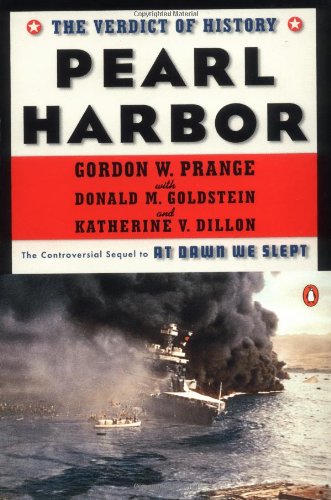
Imagen de portada de Amazon
Imagen de Amazon.com
Imagen de cubierta Syndetics
Portada de Syndetics
Imagen de OpenLibrary

Pearl Harbor the verdict of history Gordon W. Prange, with Donald M. Goldstein and Katherine V. Dillon.

Por: Colaborador(es): Detalles de publicación: New York Penguin Books 1991.Descripción: xxxiii, 699 p. ill., map 24 cmISBN:
  • 0140159096
Tema(s): Clasificación CDD:
  • 940.54/26 21
Clasificación LoC:
  • D767.92 .P722 1991
Valoración
    Valoración media: 0.0 (0 votos)
Existencias
Imagen de cubierta Tipo de ítem Biblioteca actual Biblioteca de origen Colección Ubicación en estantería Signatura topográfica Materiales especificados Info Vol URL Copia número Estado Notas Fecha de vencimiento Código de barras Reserva de ítems Prioridad de la cola de reserva de ejemplar Reservas para cursos
Libro Biblioteca de Mayagüez Colección General mb D767.92 .P722 1991 (Navegar estantería(Abre debajo)) Disponible 50000003187928
Total de reservas: 0

Descripciones mejoradas de Syndetics:

THE CONTROVERSIAL SEQUEL TO AT DAWN WE SLEPT -- A PROBING ANALYSIS OF THE ROOT CAUSES OF PEARL HARBOR, AMERICA'S MOST CATASTROPHIC MILITARY DEFEAT

The monumental bestseller At Dawn We Slept was a landmark re-creation of the apocalyptic events of December 7, 1941. This provocative sequel delves even further to examine the underlying causes of Pearl Harbor and the revisionist theories that Roosevelt and other high officials knew about the attack.

With the same imposing scholarship and narrative drive that distinguished its predecessor, Pearl Harbor uncovers the secret roles played by the president, his cabinet secretaries, admirals, and generals in the weeks before the attack. Based on more than forty years of research, extensive interviews, and an insider's knowledge of the military, this book poses an explosive and highly convincing new theory of America's entry into the Pacific War. Like the very best works of history, it not only expands but dramatically deepens our understanding of the events that were once the province of myth and rumor.

Includes bibliographical references (p. 663-675) and index.

gccago2008

Tabla de contenidos provista por Syndetics

  • Introduction(p. vii)
  • Preface(p. xiii)
  • List of Major Personnel(p. xix)
  • Abbreviations(p. xxiii)
  • Prologue(p. xxxi)
  • Part I The Base and the Summit
  • 1. "We Were All Out There"(p. 3)
  • 2. "Slow in Waking Up"(p. 15)
  • 3. "Too Deeply to Bury Their Hate"(p. 34)
  • 4. "Bait for a Japanese Attack"(p. 45)
  • 5. "To Avoid War with Japan"(p. 66)
  • 6. "He Had Supreme Responsibility"(p. 91)
  • 7. "On Lines of National Policy"(p. 105)
  • 8. "Looking in the Wrong Direction"(p. 121)
  • Part II Advisers, Planners, and Chiefs
  • 9. "With Knives and Hatchets"(p. 141)
  • 10. "Unsurmountable Obstacles"(p. 158)
  • 11. "Crimination and Recrimination"(p. 177)
  • 12. "To Help and Serve"(p. 194)
  • 13. "Faults of Omission"(p. 212)
  • 14. "Outside of Effective Contact"(p. 233)
  • 15. "A Finger of Blame"(p. 248)
  • 16. "Primarily a Failure of Men"(p. 267)
  • 17. "The Pitfalls of Divided Responsibility"(p. 285)
  • 18. "A Lack of Imagination"(p. 298)
  • 19. "East Wind Rain"(p. 312)
  • Part III Field Commanders and Operators
  • 20. "A Sentinel on Duty"(p. 333)
  • 21. "Alerted to Prevent Sabotage"(p. 348)
  • 22. "The Failure to Comprehend"(p. 363)
  • 23. "An Important Man in an Important Post"(p. 384)
  • 24. "Peculiar, Complicated and Tense"(p. 398)
  • 25. "Always Striving for Perfection"(p. 416)
  • 26. "His Most Grievous Failure"(p. 430)
  • 27. "The Last Critical Stages"(p. 446)
  • 28. "It Is Inexplicable"(p. 464)
  • Part IV The View from the Crow's Nest
  • 29. "Blessed by the War God"(p. 479)
  • 30. "A Strategic Imbecility"(p. 498)
  • 31. "A Mental Attitude"(p. 516)
  • 32. "In the Wake of the Pearl Harbor Disaster"(p. 532)
  • 33. "Remember Pearl Harbor!"(p. 549)
  • Appendices
  • 1. The Pearl Harbor Investigations(p. 647)
  • 2. Japanese Proposals of November 20, 1941(p. 650)
  • 3. "War Warning" Messages of November 27, 1941(p. 651)
  • 4. Proposed Modus Vivendi(p. 653)
  • 5. Japan's "Bomb Plot" Message(p. 656)
  • 6. The Hull Note of November 26, 1941(p. 657)
  • 7. Popov Questionnaire(p. 660)
  • Selected Bibliography(p. 663)
  • Index(p. 677)

Reseñas proporcionadas por Syndetics

Library Journal Review

Although few serious historians believe that President Roosevelt enticed the Japanese to attack at Pearl Harbor, the hoary accusation still retains some pop ularity among laypersons. In this se quel to At Dawn We Slept ( LJ 11/1/81), Prange's successors address them selves to the question of blame for the attack and fire a heavy broadside against the historical revisionists and their high-level plots. Its relentless log ic and exhaustive detail will satisfy scholars and others intrigued by the controversy. Casual readers will find that this historiographical drama lacks the narrative structure and gripping prose style of Prange's earlier works. Literary Guild alternate; Military Book Club main selection. Raymond L. Puffer, U.S. Air Force History Prog., Los Angeles (c) Copyright 2010. Library Journals LLC, a wholly owned subsidiary of Media Source, Inc. No redistribution permitted.

Publishers Weekly Review

In this superb sequel to At Dawn We Slept, the authors examine meticulously the circumstances surrounding the December 7, 1941 disaster and turn up neither villain nor scapegoat. In their analysis of the roles of the president and key cabinet members, of the chiefs of staff, military commanders and war plans officers, they draw the conclusion that much was taken for granted, principally that the Japanese would not attack Pearl Harbor. On the basis of their solid scholarship, the authors refute the revisionist view that Roosevelt deliberately withheld information from the military commanders in Hawaii to ensure that the attack would come unopposed. Included is a discussion of concurrent events and attitudes in the U.S. Philippine command and explanations why General MacArthur, unlike Admiral Kimmel and General Short in Hawaii, kept his command after the disaster and never had to face an investigation. The book closes with a chapter expounding ``the lessons the United States learnedor should have learned at Pearl Harbor.'' Illustrated. Military Book Club main selection; Literary Guild alternate. December 9 (c) Copyright PWxyz, LLC. All rights reserved

CHOICE Review

The late Gordon Prange has produced what may be the most important and least biased account to date on the greatest debacle in American military history. Rather than just a retelling of this ``day of infamy,'' Prange attempts to assign responsibility for the disaster. The book will help demolish the arguments of revisionist historians who claim that Roosevelt failed to notify the fleet deliberately so as to arouse American public opinion for support of the war. (See, for example, Charles Tansill's Back Door to War, 1952, and John Toland's Infamy: Pearl Harbor and Its Aftermath, CH, Oct '82). Although Prange does an excellent job of exonerating Roosevelt and his advisors from conspiracy, his attempt to shift the blame from Washington to Hawaii and the local commanders is not quite so convincing. The author has done a meticulous job of research, including interviews, unpublished letters, diaries, and every important archival source. The selected bibliography will prove useful to scholars, the index will make this a valuable resource, and the excellent photographs of the leading Japanese and American protagonists will help the reader to understand better this fascinating but complex tale. Although of primary interest to upper-division history majors, graduate students, and faculty, this book belongs on the shelf of all college libraries, where it will serve as an excellent accompaniment to Prange's earlier work,At Dawn We Slept (1981).-M. O'Donnell, College of Staten Island, CUNY
Compartir
logopucpr-y-vive

Contáctanos

¡Queremos saber de ti!

Tel. 787.841.2000 Ext. 1801

bibliotecavaldes@pucpr.edu

⁣Búscanos en las redes

© 2026 Desarrollado por Ignite Online • All Rights Reserved • Powered by Koha.