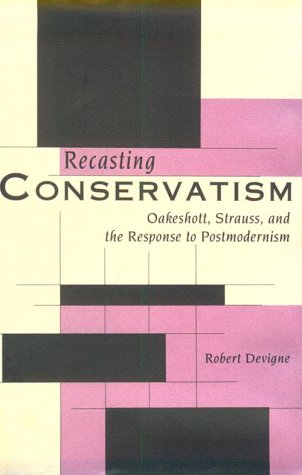
Imagen de portada de Amazon
Imagen de Amazon.com
Imagen de cubierta Syndetics
Portada de Syndetics
Imagen de OpenLibrary

Recasting conservatism Oakeshott, Strauss, and the response to postmodernism Robert Devigne.

Por: Detalles de publicación: New Haven Yale University Press c1994.Descripción: xiii, 268 p. 25 cmISBN:
  • 0300055943 (cloth : alk. paper)
Tema(s): Clasificación CDD:
  • 320.5/2/0973 20
Clasificación LoC:
  • JA84.U5 D42 1994
Valoración
    Valoración media: 0.0 (0 votos)
Existencias
Imagen de cubierta Tipo de ítem Biblioteca actual Biblioteca de origen Colección Ubicación en estantería Signatura topográfica Materiales especificados Info Vol URL Copia número Estado Notas Fecha de vencimiento Código de barras Reserva de ítems Prioridad de la cola de reserva de ejemplar Reservas para cursos
Libro Biblioteca Encarnación Valdés Colección General bev 320.52 D (Navegar estantería(Abre debajo)) Disponible 80000001809386
Total de reservas: 0

Descripciones mejoradas de Syndetics:

Explores how conservative thought in the work of Oakeshott and Strauss and their followers responds to the postmodern loss of tradition, morality, and authority in contemporary British and American society. The work also compares each theory to previous political outlooks in both countries.

Includes bibliographical references(p.205-255) and index.

Reseñas proporcionadas por Syndetics

CHOICE Review

In this excellent study of contemporary conservatism, British and American political theories are compared with each other and with their respective pasts. British theory finds its spokesperson in Michael Oakeshott, whose conservatism is rooted in Thomas Hobbes: to wit, authority rests not upon nature (philosophy) or revelation (religion) but upon rules useful for peaceful living, and the source of these rules is the central state, whose sovereignty is in no way shared with or checked by local communities. The spokesperson for American conservatism is Leo Strauss, described as a sophist, Machiavellian, and historicist (a controversial interpretation at the least, though not acknowledged as such by the author): society must rest upon transcendental thought (not upon commands and rules), but philosophy cannot confirm these truths and, given America's diverse population, a national consensus cannot be formed to support them; thus the truths of society must be generated by local majorities (meaning that the federal government should retreat from the field of social policy). Although conservative theories in America and Britain are quite different in their prescriptions, their starting point is much the same, namely, the crisis caused by the Enlightenment, by the exposure of society to philosophy. Upper-division undergraduate, graduate. P. Coby; Smith College
Compartir
logopucpr-y-vive

Contáctanos

¡Queremos saber de ti!

Tel. 787.841.2000 Ext. 1801

bibliotecavaldes@pucpr.edu

⁣Búscanos en las redes

© 2026 Desarrollado por Ignite Online • All Rights Reserved • Powered by Koha.