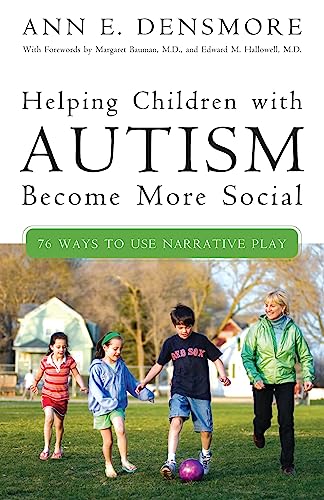

Helping children with autism become more social 76 ways to use narrative play Ann E. Densmore ; foreword by Edward M. Hallowell ; foreword by Margaret Bauman ; drawings by Edgar Stewart and Zachary Newman.
Detalles de publicación: Westport, Conn. Praeger 2007.Descripción: xliii, 226 p. ill. 25 cmISBN:- 9780275997021 (alk. paper)
- 0275997022 (alk. paper)
- 618.928588206 D413h 22
- RJ506.A9 D454 2007
- WM 203.5
| Imagen de cubierta | Tipo de ítem | Biblioteca actual | Biblioteca de origen | Colección | Ubicación en estantería | Signatura topográfica | Materiales especificados | Info Vol | URL | Copia número | Estado | Notas | Fecha de vencimiento | Código de barras | Reserva de ítems | Prioridad de la cola de reserva de ejemplar | Reservas para cursos | |
|---|---|---|---|---|---|---|---|---|---|---|---|---|---|---|---|---|---|---|
| Libro | Biblioteca Encarnación Valdés Colección General bev | 618.928588206 D413h (Navegar estantería(Abre debajo)) | Disponible | 80000002375940 |
Descripciones mejoradas de Syndetics:
Autism has been identified as the fastest growing, serious developmental disability in the United States, where nearly 2 million people are affected. One of the most frustrating aspects of autism and similar disorders is that affected children affected do not interact with others and often seem unaware of the people and the environment around them. Therapist Densmore takes us with her as she works in a remarkable program she has developed to lead such children into the social world. Allowing readers to look over her shoulder during sessions, Densmore explains Narrative Play, her approach to inspiring social contact. The work includes interviews with parents of children with autism and will be of wide interest to professionals, teachers, parents, and family members who can use the approach to help a child move into the social world. The book, and the theory it promulgates, will also interest students of psychology, special education, pediatrics, neurology, and speech.
Autism has now reached epidemic proportions. It has been identified as the fastest growing, serious developmental disability in the United States, where nearly 2 million people are affected. For parents, therapists, and teachers, one of the most frustrating aspects of autism and similar disorders is that children affected are not social. They do not interact with others--even parents and siblings--and often seem unaware of the people and environment around them. In this work, therapist Ann E. Densmore takes us with her as she works with children with autism in a remarkable program she has developed to lead such children into the social world. They travel to farms, ponds, playgrounds, and other natural settings where they interact with peers and siblings, and with the novel therapist whose play therapy has brought remarkable results for many children.
Using a conversational style that allows readers to look over her shoulder during sessions, Densmore explains her approach to inspiring social contact, Narrative Play. A child moves through four stages in this approach, finally combining language, play and narrative skills to interact with others. The work includes interviews with parents of children with autism, and will be of wide interest to professionals, teachers, parents, and family members who can use this approach to help a child move into the social world. This work, and the theory it promulgates will also interest students of psychology, special education, pediatrics, neurology, and speech.
Includes bibliographical references (p. [207]-215) and index.