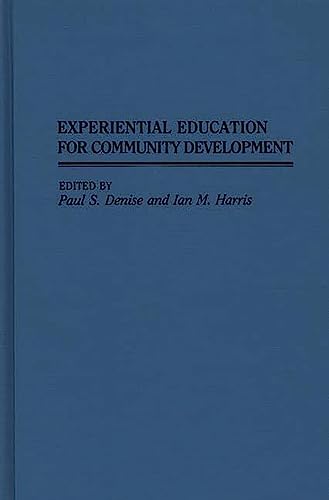

Experiential education for community development edited by Paul S. Denise and Ian M. Harris.
Series Contributions to the study of education ; no. 31Detalles de publicación: New York Greenwood Press 1989.Descripción: xiii, 299 pISBN:- 0313264058
- 307.1/4/07 19
- HN49.C6 E97 1989
| Imagen de cubierta | Tipo de ítem | Biblioteca actual | Biblioteca de origen | Colección | Ubicación en estantería | Signatura topográfica | Materiales especificados | Info Vol | URL | Copia número | Estado | Notas | Fecha de vencimiento | Código de barras | Reserva de ítems | Prioridad de la cola de reserva de ejemplar | Reservas para cursos | |
|---|---|---|---|---|---|---|---|---|---|---|---|---|---|---|---|---|---|---|
| Libro | Biblioteca de Mayagüez Colección General mb | HN 49 .C6 E97 1989 (Navegar estantería(Abre debajo)) | Disponible | 50000001800043 |
Descripciones mejoradas de Syndetics:
These 20 essays illustrate teaching strategies that can be incorporated into community-based practicums and internships. The book explores the innovative uses of experiential education in community work. Useful techniques for community problem-solving and ways in which groups can learn to work together more effectively are provided. There are new applications of democratic practice. Mutual self-respect and collective self-reliance are encouraged. Practitioners will find they can have power in an increasingly interdependent society and world. Experiential Education for Community Development suggests a degree of pre-planning accompanied by analysis.
The essays are organized by topic. Two beginning essays provide an overview and general theoretical orientation to the material. The next four sections offer a variety of case studies on community work education experience in the United States and other countries drawn primarily from programs of community and organizational development and community education. An afterword presents a synthesis of the editors' findings and an assessment of the future of experiential education in community work. This volume is the third in a series on the concepts, issues, and strategies of community development education and training. Experiential Education for Community Development is a valuable resource for practitioners and teachers of community work.
Includes index.
Bibliography : p. 283-288
Tabla de contenidos provista por Syndetics
- Preface
- Theories, Definitions and Origins of Experiential
- Education Experiential Education for Community Development
- Learning about Japan: Some Theoretical Bases
- Citizens and Citizen Groups in Communities A Ray of Hope for the Farmers of San Filipe
- Community Development Skills Training: A Collaborative Approach
- The Service Civil Service International in West Africa
- VISTA as Experiential Education
- Leaders in Community Organizations Sunnyslope
- Managing Change for Public Institutions and Community Change Agents
- A Case Study from Zaire
- The Kitwe Story: Change Agent Training for Zambian Urban Settlements
- A Model Curriculum for Mental Health Paraprofessionals
- College and University Programs
- The University's Role in Promotion Community Services
- The Antioch Experience
- Evaluation The Key to a Successful International Program
- Granting College Credit for Prior Community Work
- University Year for Action: A Community Service- Learning Program
- Innovative College and University Courses The Navajo Cultural Immersion Project
- Learning in the Community: An Undergraduate Training Program
- The Rural Community Development Learning Center
- Action-Oriented Experiential Education: The Case of Land-Use Plans
- Afterword
- Bibliography
- Index
Notas de autor provistas por Syndetics
PAUL S. DENISE is an Assistant Professor of Community Development at Southern Illinois University-Carbondale.
IAN M. HARRIS is Professor of Educational Policy and Community Studies at the University of Wisconsin-Milwaukee.