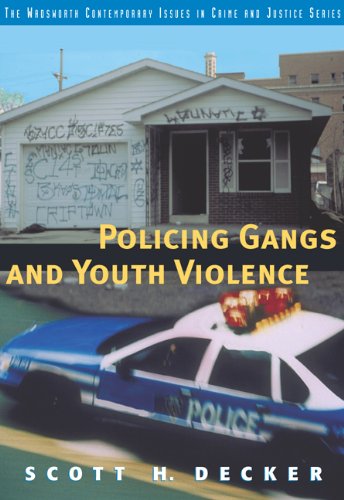

Policing gangs and youth violence edited by Scott H. Decker.
Series Contemporary issues in crime and justice seriesDetalles de publicación: Belmont, CA Wadsworth/Thomson Learning c2003.Descripción: xiii, 298 p. ill. 24 cmISBN:- 0534598412
- 363.23 P7666
- HV7936.C83 P657 2003
| Imagen de cubierta | Tipo de ítem | Biblioteca actual | Biblioteca de origen | Colección | Ubicación en estantería | Signatura topográfica | Materiales especificados | Info Vol | URL | Copia número | Estado | Notas | Fecha de vencimiento | Código de barras | Reserva de ítems | Prioridad de la cola de reserva de ejemplar | Reservas para cursos | |
|---|---|---|---|---|---|---|---|---|---|---|---|---|---|---|---|---|---|---|
| Libro | Biblioteca Mons. Iñaki Mallona (Arecibo) Colección General ab | 363.23 P7666 (Navegar estantería(Abre debajo)) | Disponible | 60000002997259 |
Descripciones mejoradas de Syndetics:
This title is part of The Wadsworth Professionalism in Policing Series, edited by Samuel Walker. This reader is a descriptive presentation of current practices within policing and juvenile justice (focusing on gangs) that utilize the community-policing model. By looking at specific strategies and their efficacy, the authors attempt to combat a major perceived problem with community policing; that the methodology of community policing can be subjective and nebulous, using ill-defined and misinterpreted practices. This book shows what is working for agencies across the country and how these "best practices" can be employed.
Includes bibliographical references and index.
Gangs, community policing, and problem solving Jack R. Greene -- Policing gangs in an era of community policing Vincent J. Webb, Charles M. Katz -- Boston's Youth Violence Prevention Program : a comprehensive community-wide approach Jack McDevitt, Anthony Braga, Dana Nurge, Michael Buerger -- Problem solving to reduce gang and drug-related violence in Indianapolis Edmund F. McGarrell, Steven Chermak -- From Boston to Boyle Heights : the process and prospects of a "pulling levers" strategy in a Los Angeles barrio George Tita, K. Jack Riley, Peter Greenwood -- Evaluating nuisance abatement at gang and drug houses in Chicago James R. "Chip" Coldren, Jr., Daniel F. Higgins -- Beyond curfews and crackdowns : an overview of the Mountlake Terrace Neutral Zone-AmeriCorps Program Quint C. Thurman, David G. Mueller -- Suppression without prevention, prevention without suppression : gang intervention in St. Louis Scott H. Decker, G. David Curry -- The Anti-Gang Initiative in Detroit : an aggressive enforcement approach to gangs Timothy S. Bynum, Sean P. Varano -- For the sake of the neighborhood? : civil gang injunctions as a gang intervention tool in Southern California Cheryl L. Maxson, Karen Hennigan, David C. Sloane -- Gang suppression through saturation patrol and aggressive curfew and truancy enforcement : a quasi-experimental test of the Dallas Anti-Gang Initiative Eric J. Fritsch, Tory J. Caeti, Robert W. Taylor -- Policing gangs and youth violence : where do we stand, where do we go from here? Scott H. Decker.
Presented in this book are current practices within policing and juvenile justice (focusing on gangs), which utilize the community-policing model. By looking at specific strategies and their efficacy, the authors attempt to combat a major perceived problem with community policing; that the methodology of community policing can be subjective and nebulous, using ill-defined and misinterpreted practices. This book shows what is working for agencies across the country and how these "best practices" can be employed. Includes a focus on Boston as a model for gang policing strategies, other chapters are set in different regions of the United States.
Tabla de contenidos provista por Syndetics
- Foreword(p. x)
- Preface(p. xiii)
- I Introduction(p. 1)
- 1 Gangs, Community Policing, and Problem Solving(p. 3)
- Community Policing and Problem Solving: From Individuals to Organizations(p. 4)
- Suppression or Prevention: What's the Mix?(p. 5)
- The Shifting Nature of Youth/Crime Problems--Root and Proximate Cause(p. 6)
- Clearly Specifying and Measuring Police and Community "Treatments"(p. 9)
- Mobilizing External Others for Effective Interventions(p. 11)
- Organizational Issues Confronting Problem Solving for Gangs(p. 13)
- Concluding Remarks(p. 15)
- 2 Policing Gangs in an Era of Community Policing(p. 17)
- Introduction(p. 17)
- Theoretical and Policy Rationales for the Establishment of Specialized Police Gang Units(p. 19)
- Police Gang Unit Functions and Specialization(p. 25)
- Gang Units as Loosely Coupled Organizations(p. 30)
- Police Gang Units in a Time of Community-Oriented Policing(p. 35)
- Two Models of Police Gang Units(p. 42)
- Toward Improving the Effectiveness of Police Gang Units(p. 43)
- II Problem-Solving Approaches to Gangs and Youth Violence(p. 51)
- 3 Boston's Youth Violence Prevention Program: A Comprehensive Community-Wide Approach(p. 53)
- Description of Study Site(p. 54)
- A Short History of Gangs in Boston(p. 54)
- Contemporary Boston Gang Problems(p. 56)
- Boston Policy Initiatives and Programs to Reduce Youth Violence(p. 58)
- The Impact of Operation Ceasefire on Youth Violence in Boston(p. 67)
- The Changing Face of Gangs in Boston(p. 69)
- Conclusion(p. 73)
- 4 Problem Solving to Reduce Gang and Drug-Related Violence in Indianapolis(p. 77)
- Background--Indianapolis(p. 77)
- Intervention: Multiagency Problem Solving(p. 80)
- Multiagency Problem-Solving Approach(p. 82)
- Initial Assessment of Impact(p. 89)
- Feedback to the Working Group(p. 97)
- Conclusion(p. 98)
- 5 From Boston to Boyle Heights: The Process and Prospects of a "Pulling Levers" Strategy in a Los Angeles Barrio(p. 102)
- Introduction(p. 102)
- Describing the Los Angeles Experience(p. 104)
- The Boston Gun Project(p. 104)
- The Los Angeles Replication(p. 105)
- Response: Developing the "Stick"(p. 115)
- Initiating the Intervention: Defining a Trigger Event(p. 120)
- Response: Developing the "Carrot"(p. 122)
- Potential Community Responses(p. 123)
- Formulating Responses(p. 124)
- Concluding Observations(p. 124)
- 6 Evaluating Nuisance Abatement at Gang and Drug Houses in Chicago(p. 131)
- Introduction: Enhancing Chicago's Community-Policing Strategy(p. 131)
- Backdrop of Gang and Drug Problems in Chicago(p. 132)
- The Municipal Drug and Gang Enforcement Strategy(p. 134)
- Evaluation Design(p. 137)
- Planned Inspection and Enforcement Process(p. 138)
- Actions Taken by MDGE(p. 141)
- Process Evaluation(p. 142)
- Changes in MDGE Goals and Objectives(p. 143)
- Impact Evaluation(p. 148)
- Impact Analysis Results(p. 154)
- Summary and Recommendations(p. 160)
- 7 Beyond Curfews and Crackdowns: An Overview of the Mountlake Terrace Neutral Zone-Americorps Program(p. 167)
- Introduction(p. 167)
- Literature Review(p. 168)
- Descriptions of the Study Site and Intervention(p. 171)
- Methods(p. 173)
- Conclusions(p. 184)
- III Suppression-Based Approaches to Gangs and Youth Violence(p. 189)
- 8 Suppression Without Prevention, Prevention Without Suppression: Gang Intervention in St. Louis(p. 191)
- Introduction(p. 191)
- Responding to Gang-Related Crime and Delinquency(p. 192)
- The St. Louis Context(p. 193)
- Study Methodology(p. 196)
- The St. Louis Anti-Gang Initiative Intensive Case Study(p. 196)
- AGI Activities(p. 196)
- Outcome Measures(p. 198)
- The Anti-Gang Initiative in Review(p. 206)
- The Application of the SafeFutures Model in St. Louis(p. 207)
- Concluding Thoughts on Gang Intervention(p. 211)
- 9 The Anti-Gang Initiative in Detroit: An Aggressive Enforcement Approach to Gangs(p. 214)
- Site Description(p. 214)
- Crime Patterns(p. 215)
- Brief History of Detroit(p. 215)
- Gangs in Detroit(p. 217)
- Initiation of Detroit's Anti-Gang Initiative(p. 222)
- Methodology(p. 229)
- Findings(p. 230)
- Conclusions(p. 234)
- 10 For the Sake of the Neighborhood?: Civil Gang Injunctions as a Gang Intervention Tool in Southern California(p. 239)
- Introduction(p. 239)
- Conceptual Underpinnings of Gang Injunctions(p. 242)
- The Injunction Mechanism Described(p. 245)
- What Is the Evidence of Success?(p. 254)
- Legal Issues Raised by CGIs(p. 257)
- Conclusion(p. 260)
- 11 Gang Suppression Through Saturation Patrol and Aggressive Curfew and Truancy Enforcement: A Quasi-Experimental Test of the Dallas Anti-Gang Initiative(p. 267)
- Introduction(p. 267)
- Literature Review(p. 268)
- The Police Role in Dealing with Gangs(p. 271)
- Methodology(p. 274)
- Findings(p. 276)
- Discussion and Conclusions(p. 279)
- IV Conclusion(p. 285)
- 12 Policing Gangs and Youth Violence: Where Do We Stand, Where Do We Go from Here?(p. 287)
- Responding to Gangs and Youth Violence(p. 288)
- Contemporary Responses to Gangs and Youth Violence(p. 289)
- Index(p. 294)