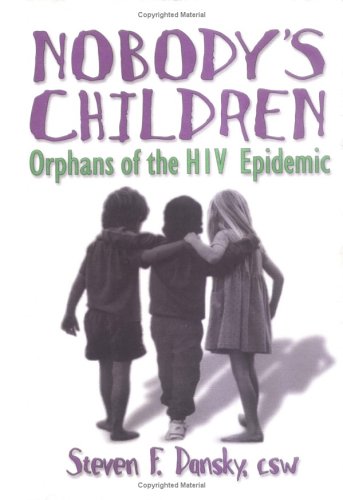

Nobody's children orphans of the HIV epidemic Steven F. Dansky.
Series Haworth social work practiceDetalles de publicación: New York Harrington Park Press c1997.Descripción: xv, 178 p. ill. 22 cmISBN:- 1560238550 (hc : alk. paper)
- 1560239239 (pbk. : alk. paper)
- 305.9/06945 21
- HV983 .D36 1997
| Imagen de cubierta | Tipo de ítem | Biblioteca actual | Biblioteca de origen | Colección | Ubicación en estantería | Signatura topográfica | Materiales especificados | Info Vol | URL | Copia número | Estado | Notas | Fecha de vencimiento | Código de barras | Reserva de ítems | Prioridad de la cola de reserva de ejemplar | Reservas para cursos | |
|---|---|---|---|---|---|---|---|---|---|---|---|---|---|---|---|---|---|---|
| Libro | Biblioteca Encarnación Valdés Colección General bev | 305.906945 D191n (Navegar estantería(Abre debajo)) | Disponible | 80000002070731 |
Descripciones mejoradas de Syndetics:
By the year 2000, an estimated 82,000 to 125,000 children will become orphans of the human immunodeficiency virus (HIV). Nobody's Children: Orphans of the HIV Epidemic shows how caregivers and the community can meet the ever-increasing social and economic needs of these children and their new families. Care providers learn ways to expand their imaginations to create new solutions and to approach the difficult issue of permanency planning. For the children and parents who are victims of the HIV epidemic and for the adoptive parents of these special children, Nobody's Children is a book about courage, hope, and inspiration.
Author Steven Dansky details how the HIV epidemic has further disintegrated an already challenged family structure and how the nexus of poverty and substance use is central, in certain populations, to the effect of HIV disease. The orphans of HIV are children left behind from families functioning, for the most part, marginally. However, Nobody's Children provides the living proof that one can survive the most dire circumstances. The book takes the struggle to survive into reconstituted families: a single mother choosing to adopt, gay men refusing to succumb to societal prohibitions against parenting, and parents infected by HIV discussing their condition with their children. Other vital topics this book clarifies for you include: current epidemiology--gives an analysis of the current trends in HIV disease, globally and in the U.S. testimony from adopted children--tells the stories of those children who have survived the loss of their parents to HIV disease family stories--offers intimate, insightful views of reconstituted families future custody plans--tells why plans frequently are not made because of denial, fear of disclosure, lack of a potential guardian, lack of formal counseling or legal advice, and inflexible laws stand-by guardianship laws--such laws allow parents to name a guardian for their children on a temporary basis (already enacted in New York and Illinois) new foster care programs--describes innovative plans designed to meet the complex needs of HIV-affected children children's reaction to death--explains the normal grieving process and gives warning signs that indicate when professional help may be needed
The moving stories in Nobody's Children take the American family to the frontier of single parenthood and lesbian and gay families. By presenting the issues and problems of children orphaned by HIV and by arming readers with the information and hope necessary for positive action, Nobody's Children offers inspiration for overcoming the effects of the HIV epidemic.
Includes bibliographical references (p. 155-170) and index.