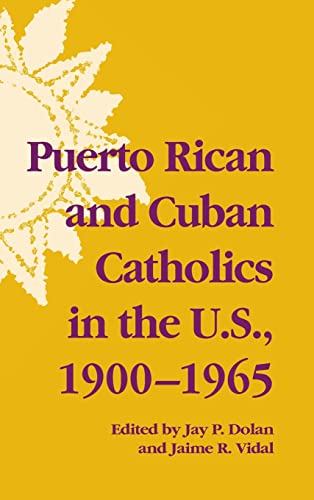

Puerto Rican and Cuban Catholics in the U.S., 1900-1965 edited by Jay P. Dolan and Jaime R. Vidal.
Series The Notre Dame history of Hispanic Catholics in the U.S ; v. 2Detalles de publicación: Notre Dame University of Notre Dame Press c1994.Descripción: vii, 259 p. 23 cmISBN:- 0268038058
- 282/.73/089687291 20
- BX1407.P83 P84 1994
| Imagen de cubierta | Tipo de ítem | Biblioteca actual | Biblioteca de origen | Colección | Ubicación en estantería | Signatura topográfica | Materiales especificados | Info Vol | URL | Copia número | Estado | Notas | Fecha de vencimiento | Código de barras | Reserva de ítems | Prioridad de la cola de reserva de ejemplar | Reservas para cursos | |
|---|---|---|---|---|---|---|---|---|---|---|---|---|---|---|---|---|---|---|
| Libro | Biblioteca Encarnación Valdés Colección de Puerto Rico | 282.73 P977 (Navegar estantería(Abre debajo)) | Disponible | 80000001809816 |
Descripciones mejoradas de Syndetics:
When Puerto Ricans and Cubans arrived in the United States both groups presented to American Catholics the paradox of cultures pervaded by Catholic symbols, attitudes, and traditions, but out of touch with the values and priorities of the institutional Church. Furthermore, both Cubans and Puerto Ricans tend to perceive themselves as being in the U.S. provisionally and therefore insist on holding on to their language and culture, while striving to build communities of their own where these values will be preserved. In this seminal volume Jaime R. Vidal and Lisandro Pérez present for the first time an in-depth historical analysis of the Puerto Rican and Cuban-American Catholic experience, beginning with their roots in the history of their homelands up to the closing of Vatican II.
In the first section of Puerto Ricans, Vidal discusses the American Church's attempt to assimilate them into its structure and style, which was at cross purposes with the Puerto Rican "revolving door" migration trends that have constantly reinforced their identity. Focusing on the Puerto Rican community in New York City, Vidal demonstrates that the policies of the institutional Church have made it difficult for them to find their place within the U.S. Catholic structure. This has led to a certain amount of marginalization of the Church within the Puerto Rican Community.
Lisandro Pérez then discusses the Cuban-American Catholic experience, especially the first waves of Cuban migration during the 1960s. Since the first political exiles were from the upper and middle classes of Cuban society, this led to expectations that the Cubans would quickly blend into the white, middle-class American community at both the religious and the social levels. Pérez analyzes the response of the Miami diocese to support the exiles and concludes that the Cubans have not been fully assimilated into the American Catholic Church because they view themselves as an exiled society that hopes eventually to return to Cuba.
Includes bibliographical references (p. 209-247) and index.
Reseñas proporcionadas por Syndetics
CHOICE Review
Through the pioneering work of Julian Samora, University of Notre Dame Press has become one of the major publishers of works on Latinos in the US. The series of which these three books are part represents recognition of the growing importance of the Spanish-speaking population to the Catholic Church as an institution. At first glance, the research cutoff date of date of 1965 seems to be a limitation, especially considering the dramatic increase in population of Latinos generally and Chicanos in particular that has occurred since then. However, the contents of volume 3--subtitled Issues and Concerns--in part address this gap. The series editors also recognize that like Asian Americans, Latinos are too diverse a group to lump together. The first volume, on Mexican Americans, takes cognizance of the fact that Mexican Americans alone constitute some 16 million of the 24 million Latinos in the US. Although highly instructive, the essays that make up this volume are uncritical. The introduction states that the loyality of many Mexican Americans is torn by competition from other churches, forces within US society, and the poverty of Mexicans: "In these circumstances the age-old faith communities are being tested more severely than ever before and the institutional Church faces a daunting challenge." This statement appears to set the tone for this and the next volume, in which contributors eschew a critical examination of the Church's role in the Spanish colonization--and later Irish colonization--of Mexican and African American culture. Indeed, alienation goes beyond cultural expression to include class differences between those who control the church and those who attend mass. Volume 1 is divided into three sections: a long historical overview of Mexicans and the church that focuses on Mexican Americans in Texas, in California, and in the Midwest. Despite the uncritical nature of the work, which sometimes borders on being apologetic, it is important because it lays out the major actors in this history. Volume 2 makes clear that although Cubans and Puerto Ricans share some history as a result of the Spanish-American War, as well as a common language and island heritage, they are often diverse racially and economically. In a perceptive introductory article, Jaime R. Vidal makes the point that Puerto Ricans differ from Mexicans and other Latin Americans in that the Spanish colonists brought Catholicism with them, whereas in the case of Mexicans, the Indian populations were evangelized. These island cultures were dominated by criollos, Spaniards born in the New World, who later incorporated cultural elements from African slaves. Much of Vidal's discussion concerns New York. The weakest section of the first two volumes by far is that on Cubans in the US. The treatment could have been much fuller; although there are only a million Cuban Americans, they enjoy an influence well beyond their numbers. The narrative never gives the reader a feeling for a Cuban center equal to that of, for example, New York for Puerto Ricans or Los Angeles and San Antonio for Mexicans. Essays in volume 3, on cultural issues, are solid, with a leadoff article by Joan Moore, an eminent lay scholar. Generally, the articles in this volume are superior to those in the first two. Edmundo Rodriguez's treatment of historical movements such as the Cursillo de Cristiandad, the charismatic renewal, and societies of priests and nuns such as PADRES and HERMANAS is invaluable. The entire series is recommended, although this reviewer suggests that volume 3 be read first. Each volume has an index and solid endnotes. All levels. R. Acu~na; California State University, NorthridgeNotas de autor provistas por Syndetics
Jay P. Dolan is professor emeritus of history at the University of Notre Dame. He is the author of The American Catholic Experience: A History from Colonial Times to the Present and The Immigrant Church: New York's Irish and German Catholics, 1815-1865 , both published by the University of Notre Dame Press.
Jaime R. Vidal was assistant director of the Cushwa Center for the Study of American Catholicism, and assistant professor of theology at the University of Notre Dame. He subsequently was director of Hispanic Studies at the Pontifical College Josephinum, held the James Supple Chair of Catholic Studies at Iowa State University, and was director of the Franciscan Press at Quincy University. He is now retired and lives in Illinois.