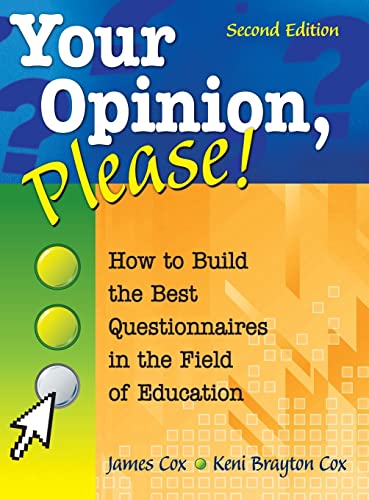

Your opinion, please! how to build the best questionnaires in the field of education James Cox, Keni B. Cox.
Detalles de publicación: Thousand Oaks, CA Corwin Press c2008.Edición: 2nd edDescripción: xiv, 119 p. ill. 29 cmISBN:- 9781412955386 (cloth : alk. paper)
- 1412955386 (cloth : alk. paper)
- 9781412955393 (pbk. : alk. paper)
- 1412955394 (pbk. : alk. paper)
- 370.72 C8771y2 22
- LB1028 .C67 2008
| Imagen de cubierta | Tipo de ítem | Biblioteca actual | Biblioteca de origen | Colección | Ubicación en estantería | Signatura topográfica | Materiales especificados | Info Vol | URL | Copia número | Estado | Notas | Fecha de vencimiento | Código de barras | Reserva de ítems | Prioridad de la cola de reserva de ejemplar | Reservas para cursos | |
|---|---|---|---|---|---|---|---|---|---|---|---|---|---|---|---|---|---|---|
| Libro | Biblioteca Encarnación Valdés Colección General bev | 370.72 C8771y2 (Navegar estantería(Abre debajo)) | Disponible | 80000002343286 |
Descripciones mejoradas de Syndetics:
"The authors′ thoughtful treatment and discussion of the subject deftly walks the reader through each stage of the survey questionnaire process. The book uses terrific examples, gives clear direction, and is an essential reference for survey research in education." --Lawrence Machi, Professor of Organizational LeadershipUniversity of La Verne
"More and more, district leaders are needing to collect perceptual data through surveys. This book provides guidance in a concise format for busy educators who may not have had training related to survey development." --Ronald L. Russell, Associate DirectorLoess Hills Area Education Agency 13, IA
A user-friendly guide to developing questionnaires that work!
Since the first edition of Your Opinion, Please! was published, the demand for accurate information and efficient ways of collecting data has increased in all arenas, and the field of education is no exception.
Written by experts, this accessible resource presents the vital elements for creating any type of survey or questionnaire. The second edition has been updated with a significant discussion on the value of using the Internet--and pitfalls to avoid--when gathering information and developing and distributing questionnaires. The updates also include a new chapter on designing questionnaires, in response to the increasing body of research focused on the design elements of questionnaire development.
The authors show novice and experienced researchers how to construct a basic questionnaire, collect and analyze the data, and report the results. The material takes readers through the essential stages of questionnaire development and covers:
Establishing and clarifying the guiding questions Designing the questionnaire Formatting responses Categorizing responses by group typeThis user-friendly guidebook also provides examples throughout to illustrate the questionnaire development process, a sample completed survey for reference, and a section on frequently asked questions.
Includes bibliographical references (p. 115) and index.
Establishing the guiding questions -- Operationalizing the guiding questions: creating specificity -- Writing items and formatting responses -- Designing the questionnaire -- Writing directions -- Who said what? categorizing respondents -- Conducting the alignment check -- Instrument validity and reliability -- Marketing the questionnaire : ensuring response -- The process of data analysis -- Communicating your results effectively -- To web or not to web -- Since you asked-- -- Resource A: evaluating the questionnaire: a self-assessment -- Resource B: sample introductions -- Resource C: sample directions and formats -- Resource D: critiquing questionnaires: finding flaws -- Resource E: modeling the product: stages 1 through 6.
Tabla de contenidos provista por Syndetics
- Acknowledgments
- About the Authors
- Introduction
- Part I Stages of Questionnaire Development
- Stage 1 Establishing the Guiding Questions
- Stage 2 Operationalizing the Guiding Questions: Creating Specificity
- Stage 3 Writing Items and Formatting Responses
- Stage 4 Designing the Questionnaire
- Stage 5 Writing Directions
- Stage 6 Who Said What? Categorizing Respondents
- Stage 7 Conducting the Alignment Check
- Stage 8 Instrument Validity and Reliability
- Stage 9 Marketing the Questionnaire: Ensuring Response
- Part II Getting From Here to There
- Stage 10 The Process of Data Analysis
- Stage 11 Communicating Your Results Effectively
- Stage 12 To Web or Not to Web
- Stage 13 Since You Asked ...
- Resource A Evaluating the Questionnaire: A Self-Assessment
- Resource B Sample Introductions
- Resource C Sample Directions and Formats
- Resource D Critiquing a Questionnaire: Finding Flaws
- Resource E Modeling the Product: Stages 1 Through 6
- References
- Index