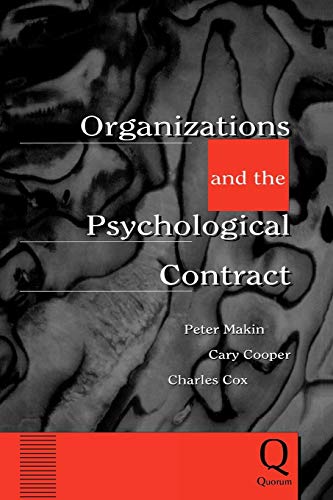

Organizations and the psychological contract managing people at work Peter J. Makin, Cary L. Cooper, Charles J. Cox.
Detalles de publicación: Westport, Conn. Quorum Books 1996.Descripción: x, 406 p. ill. 24 cmISBN:- 1-56720-091-5
- 21 158.7 M2354o
| Imagen de cubierta | Tipo de ítem | Biblioteca actual | Biblioteca de origen | Colección | Ubicación en estantería | Signatura topográfica | Materiales especificados | Info Vol | URL | Copia número | Estado | Notas | Fecha de vencimiento | Código de barras | Reserva de ítems | Prioridad de la cola de reserva de ejemplar | Reservas para cursos | |
|---|---|---|---|---|---|---|---|---|---|---|---|---|---|---|---|---|---|---|
| Libro | Biblioteca Encarnación Valdés Colección General bev | 158.7 M2354o (Navegar estantería(Abre debajo)) | Disponible | 80000002104423 |
Descripciones mejoradas de Syndetics:
Contracts in employment are of two kinds: the formal, written contract and the equally important, informal and unwritten psychological contract--how people think they should be treated. Both involve rights, obligations and expectations on the part of the employer and the employee, and a breach in one can have important effects on the other. For example, how people feel they are being treated by the organization can affect their perception of their levels of pay. Organizations and the Psychological Contract has two main aims in exploring these issues: to act as a handbook for practicing managers, and as a basic text in management courses.
Organizations and the Psychological Contract has two main aims in exploring these issues in the organizational context: to act as a handbook for practicing managers, and as a basic text in management courses. Relevant theories are explained and developed using practical examples, self-assessment exercises, and case studies. This is a revised and much expanded version of Managing People at Work , with the addition of chapters on Selection and Career Development, Understanding and Coping with Change, Empowerment and Self-Management, and the Behavioural Approach to Motivation. As well as undertaking research into many aspects of organizational life, the authors have many years' experience as consultants, acting for industrial and commercial organizations in all sectors of the economy.
Includes bibliographical references (p. [385]-400) and index.
Tabla de contenidos provista por Syndetics
- 1 Selection, placement and careers
- 2 Personality and individual differences at work
- 3 Interpersonal perception and interaction
- 4 Motivation
- 5 Behavioural approaches to motivation
- 6 Leadership and management styles
- 7 Group dynamics
- 8 Identifying organisational problems
- 9 Organisational change
- 10 Managing your boss
- 11 Understanding and coping with change
- 12 Empowerment and self-management
Notas de autor provistas por Syndetics
PETER J. MAKIN is Course Director of Manchester School of Management's MSc in Organizational Psychology.
CARY L. COOPER teaches Organizational Psychology at the Manchester School of Management. He was founding president of the British Academy of Management, and frequently appears in the media on both sides of the Atlantic talking about organizational issues.
CHARLES J. FOX teaches Organizational Psychology at the Manchester School of Management. He is also Editor of the Leadership and Organizational Development Journal .