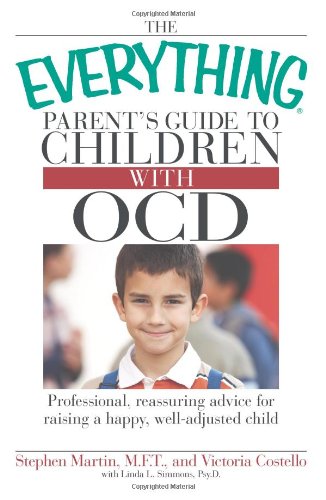

The everything parent's guide to children with OCD professional, reassuring advice for raising a happy, well-adjusted child Stephen Martin and Victoria Costello with Linda L. Simmons.
Detalles de publicación: Massachusetts Adams Media c2008.Descripción: xv, 288 p. 23 cmISBN:- 1598696858
- 9781598696851
- 618.92891425 M3791e 22
- RJ506.O25 F74 2009
| Imagen de cubierta | Tipo de ítem | Biblioteca actual | Biblioteca de origen | Colección | Ubicación en estantería | Signatura topográfica | Materiales especificados | Info Vol | URL | Copia número | Estado | Notas | Fecha de vencimiento | Código de barras | Reserva de ítems | Prioridad de la cola de reserva de ejemplar | Reservas para cursos | |
|---|---|---|---|---|---|---|---|---|---|---|---|---|---|---|---|---|---|---|
| Libro | Biblioteca Encarnación Valdés Colección General bev | 618.92891425 M3791e (Navegar estantería(Abre debajo)) | Disponible | 80000002401944 |
Descripciones mejoradas de Syndetics:
OCD can make a child's life difficult, turning simple tasks like homework and chores into almost impossible challenges. A child with OCD may feel stressed, worried, and even inadequate. Parents who suspect their child is suffering from OCD--or parents of a child with an OCD diagnosis--can rest easy with The Everything® Parent's Guide to Children with OCD. This helpful guide shows parents how to: * Recognize symptoms * Get an accurate diagnosis * Find the right doctor and therapist * Develop strategies for tackling schoolwork * Decide on the right treatment Parents will learn how to talk to a child about OCD and devise coping strategies for school, sports, friendships, and other everyday situations. Children with OCD can learn how to enjoy life--without all the worry! AUTHOR: Stephen Martin, M.F.T received his M.S. at the University of Southern California. He has twenty-five years of experience in private practice using a rational cognitive approach to treat mental disorders including depression, anxiety, and OCD. Victoria Costello (San Francisco, CA) is the former executive director of a community mental health clinic and the author of Why Grandpa Lay Down on the Railroad Tracks, a book that combines memoir and the latest genetic research to create a forensic portrait of four generations of mental illness in her own family. Linda L. Simmons, Psy.D. is a licensed psychologist. She specializes in treatment of psychiatric disorders such as depression, anxiety, OCD, and PTSD at the Manville School, an affiliate of the Harvard Medical School in Boston.
Includes bibliography and index.
Tabla de contenidos provista por Syndetics
- Introduction(p. xiii)
- Chapter 1 What Is Childhood Obsessive-Compulsive Disorder?(p. 1)
- Defining OCD(p. 1)
- OCD in Children: Three Mini-Portraits(p. 5)
- How Common Is Early-Onset OCD?(p. 7)
- When OCD Is a Family Affair(p. 9)
- Common Myths and Misconceptions(p. 13)
- Why Your Child Can't "Just Stop It"(p. 14)
- When Repetitions and Rituals Are Not OCD(p. 15)
- The OCD Symptom Spectrum: From Mild to Severe(p. 17)
- Symptoms Change as a Child Grows(p. 18)
- Chapter 2 How to Recognize Childhood OCD(p. 21)
- Understanding Obsessive Thoughts(p. 21)
- Contamination Fears(p. 24)
- The Need for Order(p. 26)
- Aggressive Thoughts(p. 28)
- Superstitious Thoughts(p. 29)
- Understanding Compulsive Behaviors(p. 30)
- Cleaning Compulsions(p. 31)
- Ordering Compulsions(p. 32)
- Hoarding Compulsions(p. 34)
- Avoidance Compulsions(p. 35)
- Ritualizing Compulsions(p. 37)
- Chapter 3 Causes of OCD(p. 39)
- What Today's Science Says about OCD(p. 39)
- A Tour of the Brain with OCD(p. 41)
- Creating a Family Mental Health Genetic Scorecard(p. 44)
- Researching Your Family Mental Health History(p. 45)
- Environmental Triggers(p. 47)
- Identifying Culprit Genes(p. 49)
- Chapter 4 The Experience of OCD for a Child(p. 51)
- Perceptions and Misconceptions(p. 51)
- OCD in Children and Preteens(p. 54)
- OCD in the Teenage Years(p. 57)
- Negative Coping Behaviors: Avoiding and Hiding(p. 61)
- What Children with OCD Need Most from Parents(p. 61)
- Chapter 5 The Parent's Role in Identifying OCD(p. 63)
- When Abnormal Becomes Normal(p. 63)
- The End of Denial(p. 66)
- If You Suspect OCD(p. 68)
- How to Help Your Child Take an OCD Self-Test(p. 70)
- Keep a Daily Log of Your Child's Behavior(p. 71)
- Chapter 6 Getting a Formal Diagnosis(p. 73)
- Where to Go for Help(p. 73)
- Who Will Diagnose Your Child?(p. 75)
- Tests for OCD(p. 78)
- The Moment of Truth: Hearing the Diagnosis(p. 82)
- Discussing Diagnosis and Treatment Options(p. 82)
- What if It's Wrong? Misdiagnosis Rates with OCD(p. 84)
- Talking about His Diagnosis(p. 85)
- Chapter 7 Differentiating OCD from Other Childhood Disorders(p. 89)
- What You Should Know Before Seeking Help(p. 89)
- The Link to Anxiety Disorders(p. 90)
- Social Anxiety Disorder (SAD)(p. 92)
- Eating Disorders(p. 93)
- Attention Deficit Hyperactivity Disorder (ADHD)(p. 95)
- Other Anxiety Disorders(p. 96)
- The Autism Spectrum(p. 98)
- Tourette's Syndrome (TS)(p. 100)
- How Depression Plays a Role(p. 101)
- Learning Disabilities(p. 102)
- Common Dual and Multiple Diagnoses(p. 103)
- Chapter 8 Deciding on Treatment: CBT(p. 105)
- How CBT Works(p. 105)
- Finding the Right Therapist(p. 107)
- Questions for Therapists(p. 109)
- Exposure Response Prevention (ERP)(p. 111)
- What to Expect When Therapy Begins(p. 114)
- One Therapist's View: Roxie's ERP Session(p. 115)
- Continuing Exposure Exercises at Home(p. 118)
- How Long Does Therapy Last?(p. 119)
- When You Live Far from Treatment Centers(p. 119)
- If Your Child Refuses Treatment(p. 120)
- A Report Card on Individual Therapy Outcomes(p. 121)
- Chapter 9 Deciding on Treatment: Medication(p. 123)
- When Medication Is Necessary(p. 123)
- Serotonin and SSRIs(p. 124)
- Medication Side Effects(p. 127)
- FDA SSRI Advisory: Weighing Medication Risks(p. 128)
- Questions about Medications(p. 129)
- A Report Card on Medication and Psychotherapy(p. 132)
- Summary of Expert Guidelines on Childhood OCD Treatment(p. 134)
- Chapter 10 Other Therapeutic Choices(p. 137)
- Group Psychotherapy Using ERP(p. 137)
- How Group CBT Therapy Works(p. 138)
- Other Types of OCD Peer Groups(p. 139)
- Inpatient Treatment for OCD(p. 140)
- Diet, Nutrition, and Supplements(p. 141)
- Neurofeedback Therapy(p. 142)
- Chapter 11 OCD at School(p. 145)
- Typical Learning Problems for OCD Students(p. 145)
- How Perfectionism and Procrastination Sabotage School Success(p. 147)
- When Safety Fears Enter the Classroom(p. 148)
- Forging a Partnership with School Staff(p. 149)
- How to Obtain School Services and Accommodations(p. 153)
- The Nuts and Bolts of IEP and 504 Education Plans(p. 155)
- Redefining Success Beyond Grades(p. 160)
- Become an Advocate for Your Child's Education(p. 161)
- The Home Schooling Option(p. 162)
- Chapter 12 Special Issues for Younger Children and Preteens(p. 165)
- Pediatric-Onset OCD(p. 165)
- First Signs of OCD(p. 167)
- Helping the Younger Child and Preteen Battle OCD(p. 170)
- Dealing with High-Stress Times(p. 172)
- Meltdowns and Tantrums(p. 173)
- The Beginning of Scrupulosity(p. 174)
- Dealing with Tics(p. 176)
- Social Difficulties(p. 179)
- Chapter 13 Special Issues for Teens(p. 181)
- Adolescents with OCD at School(p. 181)
- Dealing with Aggressive Thoughts(p. 183)
- Teen Sexuality and OCD(p. 184)
- Religiosity and Scrupulosity(p. 186)
- Eating Disorders(p. 189)
- Alcohol, Drugs, and Teens with OCD(p. 192)
- Help Your Teenager Find His Passion(p. 194)
- Chapter 14 Supporting Your Child(p. 197)
- Encouraging Self-Acceptance(p. 197)
- How Parents Sabotage a Child's Efforts(p. 199)
- How to Help Your Child Create Success(p. 200)
- Recognizing and Dealing with Triggers(p. 200)
- Defining Your Role(p. 203)
- Keeping a Daily Log(p. 205)
- Find Creative Outlets for Your Child(p. 205)
- Difficulties with Sleep(p. 207)
- Peer Support Groups(p. 209)
- Chapter 15 Family Dynamics(p. 211)
- Typical OCD-Related Family Stresses(p. 211)
- A Family Systems Approach to OCD(p. 212)
- Multicultural Issues and Parenting Styles(p. 213)
- How Family Therapy Works(p. 215)
- Family Therapy Basics(p. 216)
- Questions for a Family Therapist(p. 219)
- Marital Stress(p. 220)
- Other Therapy Options for Couples(p. 223)
- Chapter 16 A Parent's Home Tool Kit(p. 225)
- Keeping the Communication Lines Open(p. 225)
- Developing an OCD Battle Plan(p. 226)
- Naming and Managing the "Enemy"(p. 228)
- Disciplining a Child with OCD(p. 231)
- A Family Culture of Discipline(p. 232)
- Chapter 17 Support for Parents(p. 237)
- Signs of Caretaker Stress and Burnout(p. 237)
- If You Go Beyond Burnout(p. 238)
- Coping with Parental Guilt(p. 240)
- Accepting your Child's Strengths and Weaknesses(p. 242)
- You May Need Individual Therapy(p. 244)
- Setting Clear Boundaries and Time for Yourself(p. 245)
- Find a Local Parent Support Group(p. 245)
- Chapter 18 Paying for Your Child's OCD Care(p. 247)
- The Health Insurance Maze(p. 247)
- Understanding Your Mental Health Coverage(p. 248)
- Questions for Your Health Insurance Company(p. 250)
- Child Public Mental Health Resources(p. 251)
- Mental Health Insurance Parity(p. 253)
- Advocacy Efforts for Mental Health Parity(p. 255)
- Chapter 19 Lifelong Strategies(p. 257)
- Prospects for Independence(p. 257)
- Perfectionism and Its Limits(p. 260)
- Disability Rights in the Workplace(p. 262)
- Dealing with Relapses(p. 262)
- Enlisting Others by Selective Disclosure(p. 264)
- The Importance of Attitude(p. 265)
- Relationship Issues in Young Adulthood(p. 267)
- Severe OCD Symptoms in Young Adulthood(p. 268)
- Chapter 20 The Promise of New Research(p. 271)
- The Past: From Ignorance to Understanding(p. 271)
- The Present: Genomic Studies(p. 273)
- Important Ongoing OCD Studies(p. 274)
- The Pros and Cons of Participating in OCD Research Studies(p. 276)
- The Possible Future of OCD Treatment(p. 277)
- How to Become an OCD Advocate(p. 278)
- Appendix A Glossary(p. 279)
- Appendix B Resources(p. 283)
- Appendix C Bibliography(p. 286)
- Index(p. 287)
Notas de autor provistas por Syndetics
Stephen Martin, M.F.T., received his M.S. at University of Southern CaliforniaVictoria Costello is the former executive director of a community mental health clinic and the author of Why Grandpa Lay Down on the Railroad Tracks, a book that combines memoir and the latest genetic research to create a forensic portrait of four generations of mental illness in her own family
Linda L. Simmons, Psy.D., is a licensed psychologist. She specializes in the treatment of psychiatric disorders such as depression, anxiety, OCD, and PTSD