Imagen de Amazon.com

Portada de Syndetics
Imagen de OpenLibrary
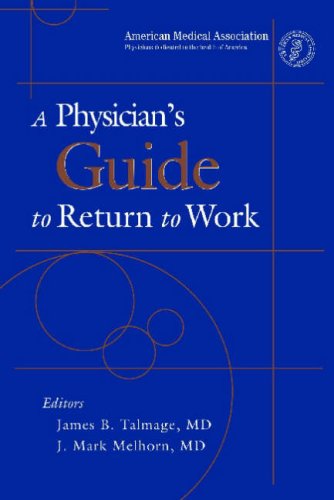
A physician's guide to return to work editors, James B. Talmage, J. Mark Melhorn.
Detalles de publicación: [Chicago, Ill.] AMA Press c2005.Descripción: xxii, 356 p. ill. 23 cmISBN:- 1579476287 (alk. paper)
- Work capacity evaluation -- United States
- Employment -- psychology
- Disability evaluation
- Convalescence -- psychology
- Rehabilitation . -- Psychology
- Convalescence -- Psychological aspects
- Work -- Psychological aspects
- Workers' compensation -- United States
- Vocational rehabilitation -- United States
- Disability evaluation -- United States
- 616.075 P5784 22
- RC963.4 .P48 2005
- 2005 F-538
- WB 320
Recursos en línea:
| Imagen de cubierta | Tipo de ítem | Biblioteca actual | Biblioteca de origen | Colección | Ubicación en estantería | Signatura topográfica | Materiales especificados | Info Vol | URL | Copia número | Estado | Notas | Fecha de vencimiento | Código de barras | Reserva de ítems | Prioridad de la cola de reserva de ejemplar | Reservas para cursos | |
|---|---|---|---|---|---|---|---|---|---|---|---|---|---|---|---|---|---|---|
| Referencia | Biblioteca Encarnación Valdés Sala de Referencia bev | 616.075 P5784 (Navegar estantería(Abre debajo)) | Disponible | 80000002284696 |
Total de reservas: 0
Descripciones mejoradas de Syndetics:
Helps primary care physicians and care providers navigate return-to-work issues. This book provides practical aspects of evidence-based medicine, causation analysis, functional capacity evaluations and the legal aspects of return-to-work decision making. It discusses the implications of medication, work aspects, and driving.
Includes bibliographical references and index.
Tabla de contenidos provista por Syndetics
- Dedication(p. iii)
- Preface(p. xi)
- Acknowledgments(p. xv)
- About the Editors(p. xvii)
- Contributors(p. xxi)
- Chapter 1 Why Staying at Work or Returning to Work Is in the Patient's Best Interest(p. 1)
- Consensus Statements(p. 2)
- A Review of the Literature(p. 3)
- Chapter 2 How to Think About Work Ability and Work Restrictions: Risk, Capacity, and Tolerance(p. 7)
- Risk(p. 7)
- Capacity(p. 9)
- Tolerance(p. 10)
- How to Evaluate Work Ability: A Seven-Step Process(p. 14)
- Summary(p. 15)
- Chapter 3 How to Negotiate Return to Work(p. 19)
- The Return-to-Work Decision Makers(p. 19)
- Defining Negotiation and Agreement(p. 21)
- The Five Steps From Injury to Resolution(p. 21)
- The Time Off Work and Return-to-Work Issue: Lost Work Days(p. 25)
- Return-to-Work Guides(p. 26)
- Negotiation Strategies for Return to Work(p. 29)
- Useful Responses to Three Common Attacks(p. 32)
- Summary(p. 33)
- Chapter 4 Return to Work: Forms, Records, and Disclaimers(p. 39)
- Communication: The Issues That Should Be Documented in Physician Records(p. 41)
- Four Screening Tests for Establishing Functional Capacity Guides(p. 44)
- Establishing Reasonable Functional Capacity Guides or Work Guides(p. 45)
- Sample Linkage Forms(p. 48)
- Additional Forms(p. 53)
- Writing Functional Capacity and Return-to-Work Guides(p. 53)
- Summary(p. 56)
- Chapter 5 Evidence-based Medicine(p. 59)
- Study Types(p. 60)
- Potential Flaws in Study Types(p. 64)
- Statistical Analysis(p. 65)
- Analyzing and Applying Study Results(p. 68)
- Summary(p. 69)
- Chapter 6 Causation Analysis(p. 73)
- Hill Criteria for Causation Analysis(p. 73)
- Addressing Causation(p. 76)
- Apportionment(p. 76)
- Causality Determination(p. 78)
- Summary(p. 80)
- Chapter 7 Functional Capacity Evaluation: Is It Helpful?(p. 83)
- The Purpose of the Functional Capacity Evaluation(p. 84)
- The Elements of a Functional Capacity Evaluation(p. 85)
- Validity and Reliability of the Functional Capacity Evaluation(p. 89)
- Using a Functional Capacity Evaluation to Make Return-to-Work Recommendations(p. 90)
- Summary(p. 91)
- Chapter 8 The Medical and Legal Aspects of Return-to-Work Decision Making(p. 95)
- Promoting the Return to Work: The Physician's Responsibility(p. 97)
- Knowing the Job Requirements and Knowing the Law(p. 98)
- Some Statutes That Apply to Return-to-Work Determinations(p. 99)
- Physician Liability in Making Return-to-Work Decisions(p. 107)
- Summary(p. 111)
- Chapter 9 Can This Patient Work? A Disability Perspective(p. 113)
- The Disability Decision Maker(p. 115)
- Defining Disability(p. 115)
- The Core Idea(p. 115)
- The Decision Maker in Context(p. 116)
- The Physician's Role(p. 118)
- Basic Concepts and Terminology(p. 118)
- Patient Interview: Defining Pertinent Functional Capacities(p. 121)
- Estimating Functional Capacity(p. 122)
- Supporting Symptoms in Excess of Findings(p. 123)
- Objective and Subjective: Different Issues, Different Tests(p. 124)
- Dimensions of Consistency(p. 124)
- Disability Applications and Supporting Medical Data(p. 125)
- Psychiatric Claims for Disability(p. 125)
- Examples of Attending Physician Statements(p. 126)
- Physical Demand Levels from the Dictionary of Occupational Titles(p. 129)
- Summary(p. 131)
- Chapter 10 Medications, Driving, and Work(p. 133)
- Magnitude of the Issue(p. 134)
- Potential Risks(p. 134)
- Decision Making(p. 137)
- Specific Medications(p. 139)
- Summary(p. 144)
- Chapter 11 How the Primary Care Physician Can Help Patients Negotiate the Return-to-Work/Disability Dilemma(p. 149)
- Understanding the Role of the Primary Care Physician(p. 149)
- Avoiding the Impact of Delay(p. 151)
- Improving Chances for Successful Return to Work: Sample Cases(p. 151)
- Summary(p. 160)
- Chapter 12 Working With Common Spine Problems(p. 163)
- Presumed Disability(p. 163)
- Lumbar Disk Herniation Resulting in Radiculopathy(p. 165)
- Mechanical Non-specific Low Back Pain(p. 170)
- Summary(p. 177)
- Chapter 13 Working With Common Upper Extremity Problems(p. 181)
- Presumed Disability(p. 182)
- Shoulder: Rotator Cuff Impingement Syndrome(p. 182)
- Shoulder: Rotator Cuff Tear(p. 187)
- Elbow: Lateral or Medial Epicondylitis(p. 192)
- Elbow: Ulnar Nerve Entrapment(p. 195)
- Wrist: Carpal Tunnel Syndrome(p. 197)
- Wrist: De Quervain's Tenosynovitis(p. 203)
- Finger or Thumb: Trigger(p. 205)
- Nontraumatic Soft-Tissue Disorder(p. 207)
- Summary(p. 210)
- Chapter 14 Working With Common Lower Extremity Problems(p. 215)
- Presumed Disability(p. 215)
- Sprains and Strains(p. 219)
- Fractures(p. 221)
- Dislocations(p. 223)
- Total Joint Arthroplasty(p. 225)
- Arthroscopic Knee Surgery(p. 228)
- Summary(p. 229)
- Chapter 15 Working With Common Cardiopulmonary Problems(p. 233)
- General Considerations in Cardiopulmonary Assessment(p. 233)
- Risk in Cardiopulmonary Disease(p. 240)
- Coronary Artery Disease(p. 240)
- Hypertension and Hypertensive Heart Disease(p. 254)
- Reactive Airway Disease/Chronic Obstructive Pulmonary Disease(p. 257)
- Summary(p. 260)
- Chapter 16 Working With Common Neurologic Problems(p. 267)
- Physician-Certified Absenteeism for Neurologic Illness(p. 267)
- Neurologic Illness: General(p. 269)
- Headache(p. 269)
- Epilepsy(p. 274)
- Brain Injury(p. 276)
- Multiple Sclerosis(p. 278)
- Polyneuropathy(p. 281)
- Summary(p. 283)
- Chapter 17 Working With Common Rheumatologic Disorders(p. 289)
- Nonobjective Factors in Assessing Work Disability(p. 290)
- Rheumatoid Arthritis(p. 292)
- Systemic Lupus Erythematosus(p. 295)
- Osteoarthritis(p. 297)
- Risk(p. 299)
- Capacity(p. 300)
- Tolerance(p. 300)
- Summary(p. 301)
- Chapter 18 Working With Common Psychiatric Problems(p. 305)
- The Problem of Mental Illness in the Workplace(p. 305)
- Evaluating Mental Impairment(p. 306)
- Social Security Administration's Criteria for Total Disability(p. 309)
- Major Depression(p. 311)
- Pain Syndrome With Medical and Psychological Factors(p. 312)
- Posttraumatic Stress Disorder(p. 314)
- Adjustment Disorder(p. 315)
- Excusing the Patient From Work(p. 317)
- Initiating Treatment Planning(p. 317)
- Returning the Patient to Work(p. 318)
- Summary(p. 319)
- Chapter 19 Working With Common Functional Syndromes: Fibromyalgia and Chronic Fatigue Syndrome(p. 321)
- Social Security Administration's Criteria for Total Disability(p. 322)
- Risk(p. 322)
- Capacity(p. 323)
- Tolerance(p. 323)
- Summary(p. 324)
- Chapter 20 The Social Security Administration Disability System(p. 327)
- Clarifying Misunderstanding of the Social Security Administration Disability System(p. 327)
- The Differences Between Impairment and Disability(p. 329)
- Overview of the Social Security Administration Disability System(p. 330)
- What the Physician Needs to Know(p. 331)
- Writing a Medical Source Opinion About Function(p. 334)
- Weighing of Source Opinions About Function by the Social Security Administration(p. 335)
- Summary(p. 336)
- Index(p. 337)